
Home
Why Things Matter: The Place of Values Science, Psychoanalysis and Religion
Barnes and Noble
Loading Inventory...
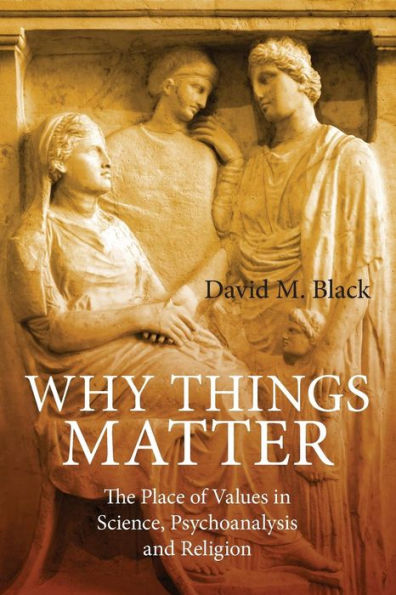
Why Things Matter: The Place of Values Science, Psychoanalysis and Religion in Chattanooga, TN
Current price: $160.00
Barnes and Noble
Why Things Matter: The Place of Values Science, Psychoanalysis and Religion in Chattanooga, TN
Current price: $160.00
Loading Inventory...
Size: Hardcover
In this book, David M. Black asks questions such as 'why do we care?' and 'what gives our values power?' using ideas from psychoanalysis and its adjacent sciences such as neuroscience and evolutionary biology in order to do so.
Why Things Matter
explores how the comparatively new scientific discipline of consciousness studies requires us to recognize that subjectivity is as irreducible a feature of the world as matter and energy. Necessarily inter-disciplinary, this book draws on science, philosophy and the history of religion to argue that there can be influential values which are not based exclusively on biological need or capricious life-style choices. It suggests that many recent scientific critics of religion, including Freud, have failed to see clearly the issues at stake.
This book will be key reading for psychoanalysts and psychotherapists as well as counsellors with an interest in the basis of religious feeling and in moral and aesthetic values. The book will also be of interest to scholars of psychoanalysis, philosophy and religion.
Why Things Matter
explores how the comparatively new scientific discipline of consciousness studies requires us to recognize that subjectivity is as irreducible a feature of the world as matter and energy. Necessarily inter-disciplinary, this book draws on science, philosophy and the history of religion to argue that there can be influential values which are not based exclusively on biological need or capricious life-style choices. It suggests that many recent scientific critics of religion, including Freud, have failed to see clearly the issues at stake.
This book will be key reading for psychoanalysts and psychotherapists as well as counsellors with an interest in the basis of religious feeling and in moral and aesthetic values. The book will also be of interest to scholars of psychoanalysis, philosophy and religion.
In this book, David M. Black asks questions such as 'why do we care?' and 'what gives our values power?' using ideas from psychoanalysis and its adjacent sciences such as neuroscience and evolutionary biology in order to do so.
Why Things Matter
explores how the comparatively new scientific discipline of consciousness studies requires us to recognize that subjectivity is as irreducible a feature of the world as matter and energy. Necessarily inter-disciplinary, this book draws on science, philosophy and the history of religion to argue that there can be influential values which are not based exclusively on biological need or capricious life-style choices. It suggests that many recent scientific critics of religion, including Freud, have failed to see clearly the issues at stake.
This book will be key reading for psychoanalysts and psychotherapists as well as counsellors with an interest in the basis of religious feeling and in moral and aesthetic values. The book will also be of interest to scholars of psychoanalysis, philosophy and religion.
Why Things Matter
explores how the comparatively new scientific discipline of consciousness studies requires us to recognize that subjectivity is as irreducible a feature of the world as matter and energy. Necessarily inter-disciplinary, this book draws on science, philosophy and the history of religion to argue that there can be influential values which are not based exclusively on biological need or capricious life-style choices. It suggests that many recent scientific critics of religion, including Freud, have failed to see clearly the issues at stake.
This book will be key reading for psychoanalysts and psychotherapists as well as counsellors with an interest in the basis of religious feeling and in moral and aesthetic values. The book will also be of interest to scholars of psychoanalysis, philosophy and religion.
You May Also Like

















More About Barnes and Noble at Hamilton Place
Barnes & Noble is the world’s largest retail bookseller and a leading retailer of content, digital media and educational products. Our Nook Digital business offers a lineup of NOOK® tablets and e-Readers and an expansive collection of digital reading content through the NOOK Store®. Barnes & Noble’s mission is to operate the best omni-channel specialty retail business in America, helping both our customers and booksellers reach their aspirations, while being a credit to the communities we serve.
2100 Hamilton Pl Blvd, Chattanooga, TN 37421, United States
Find Barnes and Noble at Hamilton Place in Chattanooga, TN
Visit Barnes and Noble at Hamilton Place in Chattanooga, TN
