
Home
When Good Jobs Go Bad: Globalization, De-unionization, and Declining Job Quality the North American Auto Industry
Barnes and Noble
Loading Inventory...
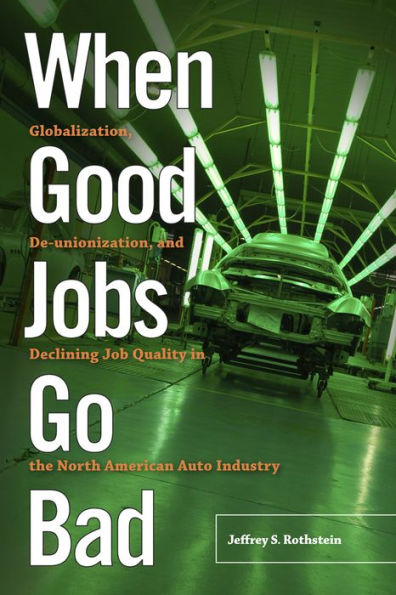
When Good Jobs Go Bad: Globalization, De-unionization, and Declining Job Quality the North American Auto Industry in Chattanooga, TN
Current price: $150.00
Barnes and Noble
When Good Jobs Go Bad: Globalization, De-unionization, and Declining Job Quality the North American Auto Industry in Chattanooga, TN
Current price: $150.00
Loading Inventory...
Size: Hardcover
From Chinese factories making cheap toys for export, to sweatshops in Bangladesh where namebrand garments are sewnstudies on the impact of globalization on workers have tended to focus on the worst jobs and the worst conditions. But in
When Good Jobs Go Bad
, Jeffrey Rothstein looks at the impact of globalization on a major industrythe North American auto industryto reveal that globalization has had a deleterious effect on even the most valued of bluecollar jobs.
Rothstein argues that the consolidation of the Mexican and U.S.Canadian auto industries, the expanding number of foreign automakers in North America, and the spread of lean production have all undermined organized labor and harmed workers. Focusing on three General Motors plants assembling SUVsan older plant in Janesville, Wisconsin; a newer and more viable plant in Arlington, Texas; and a “greenfield site” (a brandnew, stateoftheart facility) in Silao, Mexico
shows how global competition has made nonstop, monotonous, standardized routines crucial for the survival of a plant, and it explains why workers and their local unions struggle to resist. For instance, in the United States, General Motors forced workers to accept intensified labor by threatening to close plants, which led local unions to adopt “keep the plant open” as their main goal. At its new factory in Silao, GM had handpicked the unionone opposed to strikes and committed to labormanagement cooperationbefore it hired the first worker.
Rothstein’s engaging comparative analysis, which incorporates the viewpoints of workers, union officials, and management, sheds new light on labor’s loss of bargaining power in recent decades, and highlights the negative impact of globalization on all jobs, both good and bad, from the sweatshop to the assembly line.
When Good Jobs Go Bad
, Jeffrey Rothstein looks at the impact of globalization on a major industrythe North American auto industryto reveal that globalization has had a deleterious effect on even the most valued of bluecollar jobs.
Rothstein argues that the consolidation of the Mexican and U.S.Canadian auto industries, the expanding number of foreign automakers in North America, and the spread of lean production have all undermined organized labor and harmed workers. Focusing on three General Motors plants assembling SUVsan older plant in Janesville, Wisconsin; a newer and more viable plant in Arlington, Texas; and a “greenfield site” (a brandnew, stateoftheart facility) in Silao, Mexico
shows how global competition has made nonstop, monotonous, standardized routines crucial for the survival of a plant, and it explains why workers and their local unions struggle to resist. For instance, in the United States, General Motors forced workers to accept intensified labor by threatening to close plants, which led local unions to adopt “keep the plant open” as their main goal. At its new factory in Silao, GM had handpicked the unionone opposed to strikes and committed to labormanagement cooperationbefore it hired the first worker.
Rothstein’s engaging comparative analysis, which incorporates the viewpoints of workers, union officials, and management, sheds new light on labor’s loss of bargaining power in recent decades, and highlights the negative impact of globalization on all jobs, both good and bad, from the sweatshop to the assembly line.
From Chinese factories making cheap toys for export, to sweatshops in Bangladesh where namebrand garments are sewnstudies on the impact of globalization on workers have tended to focus on the worst jobs and the worst conditions. But in
When Good Jobs Go Bad
, Jeffrey Rothstein looks at the impact of globalization on a major industrythe North American auto industryto reveal that globalization has had a deleterious effect on even the most valued of bluecollar jobs.
Rothstein argues that the consolidation of the Mexican and U.S.Canadian auto industries, the expanding number of foreign automakers in North America, and the spread of lean production have all undermined organized labor and harmed workers. Focusing on three General Motors plants assembling SUVsan older plant in Janesville, Wisconsin; a newer and more viable plant in Arlington, Texas; and a “greenfield site” (a brandnew, stateoftheart facility) in Silao, Mexico
shows how global competition has made nonstop, monotonous, standardized routines crucial for the survival of a plant, and it explains why workers and their local unions struggle to resist. For instance, in the United States, General Motors forced workers to accept intensified labor by threatening to close plants, which led local unions to adopt “keep the plant open” as their main goal. At its new factory in Silao, GM had handpicked the unionone opposed to strikes and committed to labormanagement cooperationbefore it hired the first worker.
Rothstein’s engaging comparative analysis, which incorporates the viewpoints of workers, union officials, and management, sheds new light on labor’s loss of bargaining power in recent decades, and highlights the negative impact of globalization on all jobs, both good and bad, from the sweatshop to the assembly line.
When Good Jobs Go Bad
, Jeffrey Rothstein looks at the impact of globalization on a major industrythe North American auto industryto reveal that globalization has had a deleterious effect on even the most valued of bluecollar jobs.
Rothstein argues that the consolidation of the Mexican and U.S.Canadian auto industries, the expanding number of foreign automakers in North America, and the spread of lean production have all undermined organized labor and harmed workers. Focusing on three General Motors plants assembling SUVsan older plant in Janesville, Wisconsin; a newer and more viable plant in Arlington, Texas; and a “greenfield site” (a brandnew, stateoftheart facility) in Silao, Mexico
shows how global competition has made nonstop, monotonous, standardized routines crucial for the survival of a plant, and it explains why workers and their local unions struggle to resist. For instance, in the United States, General Motors forced workers to accept intensified labor by threatening to close plants, which led local unions to adopt “keep the plant open” as their main goal. At its new factory in Silao, GM had handpicked the unionone opposed to strikes and committed to labormanagement cooperationbefore it hired the first worker.
Rothstein’s engaging comparative analysis, which incorporates the viewpoints of workers, union officials, and management, sheds new light on labor’s loss of bargaining power in recent decades, and highlights the negative impact of globalization on all jobs, both good and bad, from the sweatshop to the assembly line.
You May Also Like


















More About Barnes and Noble at Hamilton Place
Barnes & Noble is the world’s largest retail bookseller and a leading retailer of content, digital media and educational products. Our Nook Digital business offers a lineup of NOOK® tablets and e-Readers and an expansive collection of digital reading content through the NOOK Store®. Barnes & Noble’s mission is to operate the best omni-channel specialty retail business in America, helping both our customers and booksellers reach their aspirations, while being a credit to the communities we serve.
2100 Hamilton Pl Blvd, Chattanooga, TN 37421, United States
Find Barnes and Noble at Hamilton Place in Chattanooga, TN
Visit Barnes and Noble at Hamilton Place in Chattanooga, TN