
Home
What Is Theory X And Y The Practical Application Of Approach To Management
Barnes and Noble
Loading Inventory...
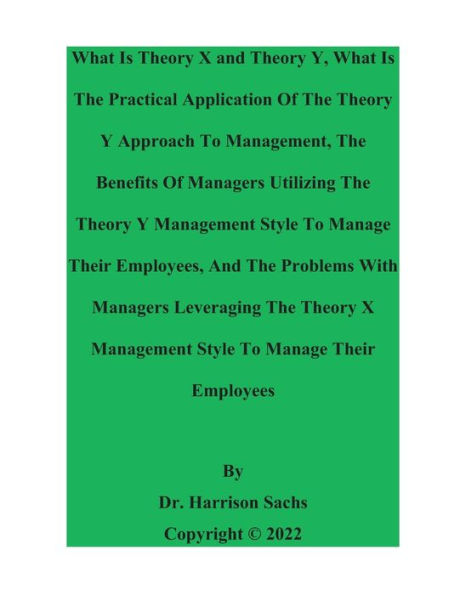
What Is Theory X And Y The Practical Application Of Approach To Management in Chattanooga, TN
Current price: $21.99
Barnes and Noble
What Is Theory X And Y The Practical Application Of Approach To Management in Chattanooga, TN
Current price: $21.99
Loading Inventory...
Size: Paperback
This essay sheds light on what is "Theory X and Theory Y", explicates what is the practical application of "the Theory Y approach to management", reveals the benefits of managers utilizing "the Theory Y management style" to manage their employees, and demystifies the problems with managers leveraging "the Theory X management style" to manage their employees in this essay. Succinctly stated, "Theory X and Theory Y" greatly differ from one another and are contrasting motivational theories. "Theory X and Theory Y" are also able to serve as contrasting management theories. "Theory X and Theory Y" shed light on two different management styles that managers can leverage in order to amplify employee productivity levels. "The approach to management" which is utilized by managers can vastly vary between authoritative managers and participative managers. Managers who leverage "the Theory X management style" utilize a hand-on approach to management, whereas managers who leverage "the Theory Y management style" utilize a hands-off approach to management. It is not easy to motivate people who work real private sector jobs based on voluntary demand to exert maximum productivity levels, especially since most real private sector jobs based on voluntary demand are often deemed to be most real private sector employee jobs based on most real private sector employee jobs based on voluntary demand are deemed to be dead end, highly time consuming, debilitating, minimum wage, dispiriting, unfulfilling, undesirable, harrowing, distressful, brutally wretched, ineffably agonizing jobs that not only drain almost all of your sacrosanct time and that do not pay anything close to 1/4 of a subsistence wage for affording housing, but are jobs that also induce chronic stress, chronic fatigue, chronic burnout, an undermined well-being, and poor health. Most of the real private sector employee jobs based on voluntary demand dispossess employees of almost all of their waken hours, provides them with minimal compensation at a minimum wage, and do not provide them with any income generating assets, benefits, nor pension. Lamentably, most real private sector employers do not care furnish their employees with anywhere close to a subsistence wage since they are on keen on minimizing their labor costs at all costs. Almost all of the profits that companies generate are reserved for its executives and shareholders. It is less cumbersome for companies to offer massive compensation to their executives when they are able to minimize their labor costs. It is also less arduous for the companies to be able to offer sizeable retainer fees to their external directors when they are able to are able to minimize their labor costs. People often grossly underestimate how lucrative it can be to a Chief Executive Officer of a highly profitable company. The pay grade that the board of directors set forth for the Chief Executive Officer's compensation is enormously lofty. An exorbitant amount of Chief Executive Officer earn over $165,000,000 in compensation. If a Chief Executive Officer for instance earned $165,000,000 per year in compensation then he would be receiving about $22.035 per second which is also $79,326.92 per hour. In the event that a company paid an assistant manager $10 per hour which is $20,800 per year and paid a Chief Executive Officer $165,000,000 per year in compensation then it would denote that the board of directors the CEO's time to be worth 793,169% more than their company's assistant managers based on their pay grades which they believe are commensurate with their productively levels. If companies paid a livable wage to their employees then the Chief Executive Officer who earns about $22.035 per second, $165,000,000 per year may possible need to take a pay cut to render it possible for the employees to receive a livable wage. The CEO earns about 793,169% more per hour than an assistant manager who for instance earns an hourly gross rate of $10 per hour at the company. The average CEO is often unwilling to take even a modicum of a pay cut if it was the only way to offer the employees a livable wage. The needs of a real private sector employer and employee are often diametrically opposed to one another. The real private sector employer often voraciously yearns to provide the real private sector employee with the absolute minimum amount of emolument for the maximum amount of time worked, whereas the real private sector employee voraciously yearns to receive the absolute maximum amount of remuneration for the minimum amount of time worked.
People who work real private sector jobs based on voluntary demand are reticent about exerting maximum productivity levels at a company's jobsite, especially in contexts in which the real private sector's employee's remuneration is so egregiously low and is commensurate to minimum wage even though their real private sector employer can easily afford to pay them a livable wage, but chooses to forgo doing so.
People who work real private sector jobs based on voluntary demand are reticent about exerting maximum productivity levels at a company's jobsite, especially in contexts in which the real private sector's employee's remuneration is so egregiously low and is commensurate to minimum wage even though their real private sector employer can easily afford to pay them a livable wage, but chooses to forgo doing so.
This essay sheds light on what is "Theory X and Theory Y", explicates what is the practical application of "the Theory Y approach to management", reveals the benefits of managers utilizing "the Theory Y management style" to manage their employees, and demystifies the problems with managers leveraging "the Theory X management style" to manage their employees in this essay. Succinctly stated, "Theory X and Theory Y" greatly differ from one another and are contrasting motivational theories. "Theory X and Theory Y" are also able to serve as contrasting management theories. "Theory X and Theory Y" shed light on two different management styles that managers can leverage in order to amplify employee productivity levels. "The approach to management" which is utilized by managers can vastly vary between authoritative managers and participative managers. Managers who leverage "the Theory X management style" utilize a hand-on approach to management, whereas managers who leverage "the Theory Y management style" utilize a hands-off approach to management. It is not easy to motivate people who work real private sector jobs based on voluntary demand to exert maximum productivity levels, especially since most real private sector jobs based on voluntary demand are often deemed to be most real private sector employee jobs based on most real private sector employee jobs based on voluntary demand are deemed to be dead end, highly time consuming, debilitating, minimum wage, dispiriting, unfulfilling, undesirable, harrowing, distressful, brutally wretched, ineffably agonizing jobs that not only drain almost all of your sacrosanct time and that do not pay anything close to 1/4 of a subsistence wage for affording housing, but are jobs that also induce chronic stress, chronic fatigue, chronic burnout, an undermined well-being, and poor health. Most of the real private sector employee jobs based on voluntary demand dispossess employees of almost all of their waken hours, provides them with minimal compensation at a minimum wage, and do not provide them with any income generating assets, benefits, nor pension. Lamentably, most real private sector employers do not care furnish their employees with anywhere close to a subsistence wage since they are on keen on minimizing their labor costs at all costs. Almost all of the profits that companies generate are reserved for its executives and shareholders. It is less cumbersome for companies to offer massive compensation to their executives when they are able to minimize their labor costs. It is also less arduous for the companies to be able to offer sizeable retainer fees to their external directors when they are able to are able to minimize their labor costs. People often grossly underestimate how lucrative it can be to a Chief Executive Officer of a highly profitable company. The pay grade that the board of directors set forth for the Chief Executive Officer's compensation is enormously lofty. An exorbitant amount of Chief Executive Officer earn over $165,000,000 in compensation. If a Chief Executive Officer for instance earned $165,000,000 per year in compensation then he would be receiving about $22.035 per second which is also $79,326.92 per hour. In the event that a company paid an assistant manager $10 per hour which is $20,800 per year and paid a Chief Executive Officer $165,000,000 per year in compensation then it would denote that the board of directors the CEO's time to be worth 793,169% more than their company's assistant managers based on their pay grades which they believe are commensurate with their productively levels. If companies paid a livable wage to their employees then the Chief Executive Officer who earns about $22.035 per second, $165,000,000 per year may possible need to take a pay cut to render it possible for the employees to receive a livable wage. The CEO earns about 793,169% more per hour than an assistant manager who for instance earns an hourly gross rate of $10 per hour at the company. The average CEO is often unwilling to take even a modicum of a pay cut if it was the only way to offer the employees a livable wage. The needs of a real private sector employer and employee are often diametrically opposed to one another. The real private sector employer often voraciously yearns to provide the real private sector employee with the absolute minimum amount of emolument for the maximum amount of time worked, whereas the real private sector employee voraciously yearns to receive the absolute maximum amount of remuneration for the minimum amount of time worked.
People who work real private sector jobs based on voluntary demand are reticent about exerting maximum productivity levels at a company's jobsite, especially in contexts in which the real private sector's employee's remuneration is so egregiously low and is commensurate to minimum wage even though their real private sector employer can easily afford to pay them a livable wage, but chooses to forgo doing so.
People who work real private sector jobs based on voluntary demand are reticent about exerting maximum productivity levels at a company's jobsite, especially in contexts in which the real private sector's employee's remuneration is so egregiously low and is commensurate to minimum wage even though their real private sector employer can easily afford to pay them a livable wage, but chooses to forgo doing so.
You May Also Like















More About Barnes and Noble at Hamilton Place
Barnes & Noble is the world’s largest retail bookseller and a leading retailer of content, digital media and educational products. Our Nook Digital business offers a lineup of NOOK® tablets and e-Readers and an expansive collection of digital reading content through the NOOK Store®. Barnes & Noble’s mission is to operate the best omni-channel specialty retail business in America, helping both our customers and booksellers reach their aspirations, while being a credit to the communities we serve.
2100 Hamilton Pl Blvd, Chattanooga, TN 37421, United States
Find Barnes and Noble at Hamilton Place in Chattanooga, TN
Visit Barnes and Noble at Hamilton Place in Chattanooga, TN
