
Home
We Fight To Win: Inequality and the Politics of Youth Activism
Barnes and Noble
Loading Inventory...

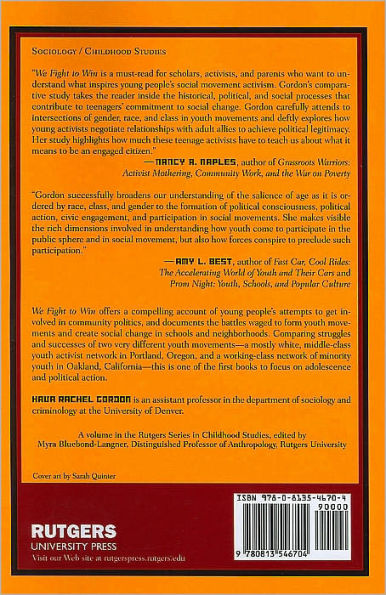
We Fight To Win: Inequality and the Politics of Youth Activism in Chattanooga, TN
Current price: $38.95
Barnes and Noble
We Fight To Win: Inequality and the Politics of Youth Activism in Chattanooga, TN
Current price: $38.95
Loading Inventory...
Size: Paperback
In an adultdominated society, teenagers are often shut out of participation in politics.
We Fight to Win
offers a compelling account of young people's attempts to get involved in community politics, and documents the battles waged to form youth movements and create social change in schools and neighborhoods.
Hava Rachel Gordon compares the struggles and successes of two very different youth movements: a mostly white, middleclass youth activist network in Portland, Oregon, and a workingclass network of minority youth in Oakland, California. She examines how these young activists navigate schools, families, community organizations, and the mainstream media, and employ a variety of strategies to make their voices heard on some of today's most pressing issueswar, school funding, the environmental crisis, the prison industrial complex, standardized testing, corporate accountability, and educational reform.
is one of the first books to focus on adolescence and political action and deftly explore the ways that the politics of youth activism are structured by age inequality as well as race, class, and gender.
We Fight to Win
offers a compelling account of young people's attempts to get involved in community politics, and documents the battles waged to form youth movements and create social change in schools and neighborhoods.
Hava Rachel Gordon compares the struggles and successes of two very different youth movements: a mostly white, middleclass youth activist network in Portland, Oregon, and a workingclass network of minority youth in Oakland, California. She examines how these young activists navigate schools, families, community organizations, and the mainstream media, and employ a variety of strategies to make their voices heard on some of today's most pressing issueswar, school funding, the environmental crisis, the prison industrial complex, standardized testing, corporate accountability, and educational reform.
is one of the first books to focus on adolescence and political action and deftly explore the ways that the politics of youth activism are structured by age inequality as well as race, class, and gender.
In an adultdominated society, teenagers are often shut out of participation in politics.
We Fight to Win
offers a compelling account of young people's attempts to get involved in community politics, and documents the battles waged to form youth movements and create social change in schools and neighborhoods.
Hava Rachel Gordon compares the struggles and successes of two very different youth movements: a mostly white, middleclass youth activist network in Portland, Oregon, and a workingclass network of minority youth in Oakland, California. She examines how these young activists navigate schools, families, community organizations, and the mainstream media, and employ a variety of strategies to make their voices heard on some of today's most pressing issueswar, school funding, the environmental crisis, the prison industrial complex, standardized testing, corporate accountability, and educational reform.
is one of the first books to focus on adolescence and political action and deftly explore the ways that the politics of youth activism are structured by age inequality as well as race, class, and gender.
We Fight to Win
offers a compelling account of young people's attempts to get involved in community politics, and documents the battles waged to form youth movements and create social change in schools and neighborhoods.
Hava Rachel Gordon compares the struggles and successes of two very different youth movements: a mostly white, middleclass youth activist network in Portland, Oregon, and a workingclass network of minority youth in Oakland, California. She examines how these young activists navigate schools, families, community organizations, and the mainstream media, and employ a variety of strategies to make their voices heard on some of today's most pressing issueswar, school funding, the environmental crisis, the prison industrial complex, standardized testing, corporate accountability, and educational reform.
is one of the first books to focus on adolescence and political action and deftly explore the ways that the politics of youth activism are structured by age inequality as well as race, class, and gender.
You May Also Like












More About Barnes and Noble at Hamilton Place
Barnes & Noble is the world’s largest retail bookseller and a leading retailer of content, digital media and educational products. Our Nook Digital business offers a lineup of NOOK® tablets and e-Readers and an expansive collection of digital reading content through the NOOK Store®. Barnes & Noble’s mission is to operate the best omni-channel specialty retail business in America, helping both our customers and booksellers reach their aspirations, while being a credit to the communities we serve.
2100 Hamilton Pl Blvd, Chattanooga, TN 37421, United States
Find Barnes and Noble at Hamilton Place in Chattanooga, TN
Visit Barnes and Noble at Hamilton Place in Chattanooga, TN