
Home
Visual Domain Adaptation in the Deep Learning Era
Barnes and Noble
Loading Inventory...
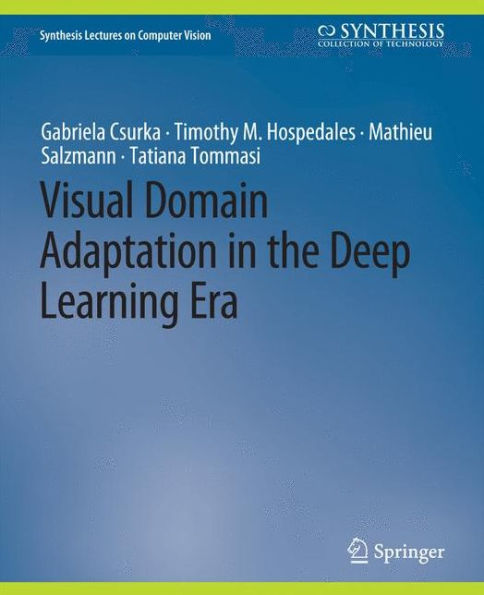
Visual Domain Adaptation in the Deep Learning Era in Chattanooga, TN
Current price: $59.99
Barnes and Noble
Visual Domain Adaptation in the Deep Learning Era in Chattanooga, TN
Current price: $59.99
Loading Inventory...
Size: OS
Solving problems with deep neural networks typically relies on massive amounts of labeled training data to achieve high performance. While in many situations huge volumes of unlabeled data can be and often are generated and available, the cost of acquiring data labels remains high. Transfer learning (TL), and in particular domain adaptation (DA), has emerged as an effective solution to overcome the burden of annotation, exploiting the unlabeled data available from the target domain together with labeled data or pre-trained models from similar, yet different source domains. The aim of this book is to provide an overview of such DA/TL methods applied to computer vision, a field whose popularity has increased significantly in the last few years. We set the stage by revisiting the theoretical background and some of the historical shallow methods before discussing and comparing different domain adaptation strategies that exploit deep architectures for visual recognition. We introduce the space of self-training-based methods that draw inspiration from the related fields of deep semi-supervised and self-supervised learning in solving the deep domain adaptation. Going beyond the classic domain adaptation problem, we then explore the rich space of problem settings that arise when applying domain adaptation in practice such as partial or open-set DA, where source and target data categories do not fully overlap, continuous DA where the target data comes as a stream, and so on. We next consider the least restrictive setting of domain generalization (DG), as an extreme case where neither labeled nor unlabeled target data are available during training. Finally, we close by considering the emerging area of learning-to-learn and how it can be applied to further improve existing approaches to cross domain learning problems such as DA and DG.
Solving problems with deep neural networks typically relies on massive amounts of labeled training data to achieve high performance. While in many situations huge volumes of unlabeled data can be and often are generated and available, the cost of acquiring data labels remains high. Transfer learning (TL), and in particular domain adaptation (DA), has emerged as an effective solution to overcome the burden of annotation, exploiting the unlabeled data available from the target domain together with labeled data or pre-trained models from similar, yet different source domains. The aim of this book is to provide an overview of such DA/TL methods applied to computer vision, a field whose popularity has increased significantly in the last few years. We set the stage by revisiting the theoretical background and some of the historical shallow methods before discussing and comparing different domain adaptation strategies that exploit deep architectures for visual recognition. We introduce the space of self-training-based methods that draw inspiration from the related fields of deep semi-supervised and self-supervised learning in solving the deep domain adaptation. Going beyond the classic domain adaptation problem, we then explore the rich space of problem settings that arise when applying domain adaptation in practice such as partial or open-set DA, where source and target data categories do not fully overlap, continuous DA where the target data comes as a stream, and so on. We next consider the least restrictive setting of domain generalization (DG), as an extreme case where neither labeled nor unlabeled target data are available during training. Finally, we close by considering the emerging area of learning-to-learn and how it can be applied to further improve existing approaches to cross domain learning problems such as DA and DG.
You May Also Like









More About Barnes and Noble at Hamilton Place
Barnes & Noble is the world’s largest retail bookseller and a leading retailer of content, digital media and educational products. Our Nook Digital business offers a lineup of NOOK® tablets and e-Readers and an expansive collection of digital reading content through the NOOK Store®. Barnes & Noble’s mission is to operate the best omni-channel specialty retail business in America, helping both our customers and booksellers reach their aspirations, while being a credit to the communities we serve.
2100 Hamilton Pl Blvd, Chattanooga, TN 37421, United States
Find Barnes and Noble at Hamilton Place in Chattanooga, TN
Visit Barnes and Noble at Hamilton Place in Chattanooga, TN
