
Home
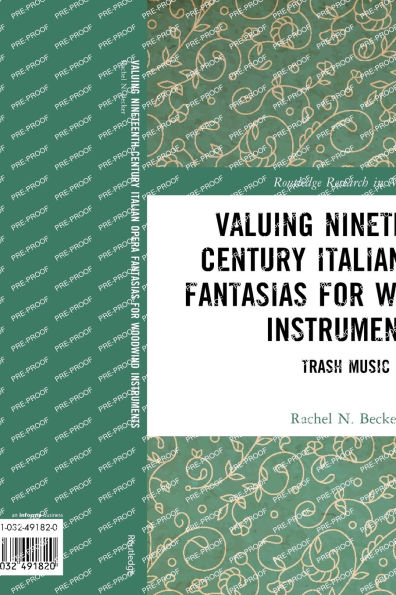
Valuing Nineteenth-Century Italian Opera Fantasias for Woodwind Instruments: Trash Music
Barnes and Noble
Loading Inventory...
Valuing Nineteenth-Century Italian Opera Fantasias for Woodwind Instruments: Trash Music in Chattanooga, TN
Current price: $190.00
Barnes and Noble
Valuing Nineteenth-Century Italian Opera Fantasias for Woodwind Instruments: Trash Music in Chattanooga, TN
Current price: $190.00
Loading Inventory...
Size: Hardcover
This book approaches opera fantasias – instrumental works that use themes from a single opera as the body of their virtuosic and flamboyant material – both historically and theoretically, concentrating on compositions for and by woodwind-instrument performers in Italy in the nineteenth century.
Important overlapping strands include the concept of virtuosity and its gradual demonization, the strong gendered overtones of individual woodwind instruments and of virtuosity, the distinct Italian context of these fantasias, the presentation and alteration of opera narratives in opera fantasias, and the technical and social development of woodwind instruments. Like opera itself, the opera fantasia is a popular art form, stylistically predictable yet formally flexible, based heavily on past operatic tradition and prefabricated materials. Through archival research in Italy, theoretical analysis, and exploration of European cultural contexts, this book clarifies a genre that has been consciously stifled and societal resonances that still impact music reception and performance today.
Important overlapping strands include the concept of virtuosity and its gradual demonization, the strong gendered overtones of individual woodwind instruments and of virtuosity, the distinct Italian context of these fantasias, the presentation and alteration of opera narratives in opera fantasias, and the technical and social development of woodwind instruments. Like opera itself, the opera fantasia is a popular art form, stylistically predictable yet formally flexible, based heavily on past operatic tradition and prefabricated materials. Through archival research in Italy, theoretical analysis, and exploration of European cultural contexts, this book clarifies a genre that has been consciously stifled and societal resonances that still impact music reception and performance today.
This book approaches opera fantasias – instrumental works that use themes from a single opera as the body of their virtuosic and flamboyant material – both historically and theoretically, concentrating on compositions for and by woodwind-instrument performers in Italy in the nineteenth century.
Important overlapping strands include the concept of virtuosity and its gradual demonization, the strong gendered overtones of individual woodwind instruments and of virtuosity, the distinct Italian context of these fantasias, the presentation and alteration of opera narratives in opera fantasias, and the technical and social development of woodwind instruments. Like opera itself, the opera fantasia is a popular art form, stylistically predictable yet formally flexible, based heavily on past operatic tradition and prefabricated materials. Through archival research in Italy, theoretical analysis, and exploration of European cultural contexts, this book clarifies a genre that has been consciously stifled and societal resonances that still impact music reception and performance today.
Important overlapping strands include the concept of virtuosity and its gradual demonization, the strong gendered overtones of individual woodwind instruments and of virtuosity, the distinct Italian context of these fantasias, the presentation and alteration of opera narratives in opera fantasias, and the technical and social development of woodwind instruments. Like opera itself, the opera fantasia is a popular art form, stylistically predictable yet formally flexible, based heavily on past operatic tradition and prefabricated materials. Through archival research in Italy, theoretical analysis, and exploration of European cultural contexts, this book clarifies a genre that has been consciously stifled and societal resonances that still impact music reception and performance today.
You May Also Like













More About Barnes and Noble at Hamilton Place
Barnes & Noble is the world’s largest retail bookseller and a leading retailer of content, digital media and educational products. Our Nook Digital business offers a lineup of NOOK® tablets and e-Readers and an expansive collection of digital reading content through the NOOK Store®. Barnes & Noble’s mission is to operate the best omni-channel specialty retail business in America, helping both our customers and booksellers reach their aspirations, while being a credit to the communities we serve.
2100 Hamilton Pl Blvd, Chattanooga, TN 37421, United States
Find Barnes and Noble at Hamilton Place in Chattanooga, TN
Visit Barnes and Noble at Hamilton Place in Chattanooga, TN
