
Home
Two Lectures on the Checks to Population
Barnes and Noble
Loading Inventory...
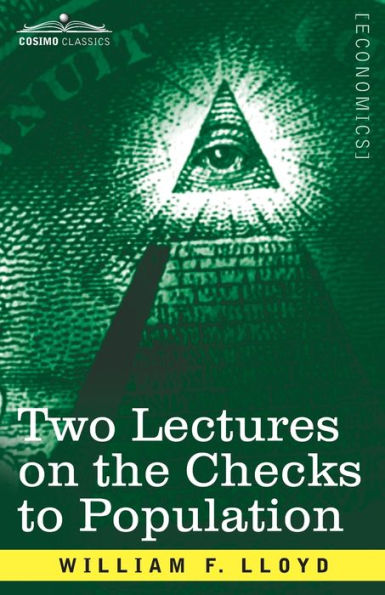
Two Lectures on the Checks to Population in Chattanooga, TN
Current price: $10.99
Barnes and Noble
Two Lectures on the Checks to Population in Chattanooga, TN
Current price: $10.99
Loading Inventory...
Size: OS
“….
If a person puts more cattle into his own field, the amount of the subsistence which they consume is all deducted from that which was at the command, of his original stock ; and if, before, there was no more than a sufficiency of pasture, he reaps no benefit from the additional cattle, what is gained in one way being lost in another. But if he puts more cattle on a common, the food which they consume forms a deduction which is shared between all the cattle, as well that of others as his own, in proportion to their number, and only a small part of it is taken from his own cattle. In an enclosed pasture, there is a point of saturation, if I may so call it, beyond which no prudent man will add to his stock. In a common, also, there is in like manner a point of saturation. But the position of the point in the two cases is obviously different. Were a number of adjoining pastures, already fully stocked, to be at once thrown open, and converted into one vast common, the position of the point of saturation would immediately be changed….” —
William F. Lloyd, 1833
In
Two Lectures on the Checks to Population
(1833), William F. Lloyd introduced the concept of the overuse of a common by its commoners. As quoted above, Lloyd explained that individual cattle-owners have a short-term interest in increasing the size of their herds. However, the size of the herds on the commons will soon exceed its carrying capacity and the commons will be doomed by overgrazing. This argument countered Adam Smith's idea of the “invisible hand,” that individual self-interest coincided with the common good. In the 20
th
century, Lloyd’s concept of overuse of a common became known as “the tragedy of the commons.”
If a person puts more cattle into his own field, the amount of the subsistence which they consume is all deducted from that which was at the command, of his original stock ; and if, before, there was no more than a sufficiency of pasture, he reaps no benefit from the additional cattle, what is gained in one way being lost in another. But if he puts more cattle on a common, the food which they consume forms a deduction which is shared between all the cattle, as well that of others as his own, in proportion to their number, and only a small part of it is taken from his own cattle. In an enclosed pasture, there is a point of saturation, if I may so call it, beyond which no prudent man will add to his stock. In a common, also, there is in like manner a point of saturation. But the position of the point in the two cases is obviously different. Were a number of adjoining pastures, already fully stocked, to be at once thrown open, and converted into one vast common, the position of the point of saturation would immediately be changed….” —
William F. Lloyd, 1833
In
Two Lectures on the Checks to Population
(1833), William F. Lloyd introduced the concept of the overuse of a common by its commoners. As quoted above, Lloyd explained that individual cattle-owners have a short-term interest in increasing the size of their herds. However, the size of the herds on the commons will soon exceed its carrying capacity and the commons will be doomed by overgrazing. This argument countered Adam Smith's idea of the “invisible hand,” that individual self-interest coincided with the common good. In the 20
th
century, Lloyd’s concept of overuse of a common became known as “the tragedy of the commons.”
“….
If a person puts more cattle into his own field, the amount of the subsistence which they consume is all deducted from that which was at the command, of his original stock ; and if, before, there was no more than a sufficiency of pasture, he reaps no benefit from the additional cattle, what is gained in one way being lost in another. But if he puts more cattle on a common, the food which they consume forms a deduction which is shared between all the cattle, as well that of others as his own, in proportion to their number, and only a small part of it is taken from his own cattle. In an enclosed pasture, there is a point of saturation, if I may so call it, beyond which no prudent man will add to his stock. In a common, also, there is in like manner a point of saturation. But the position of the point in the two cases is obviously different. Were a number of adjoining pastures, already fully stocked, to be at once thrown open, and converted into one vast common, the position of the point of saturation would immediately be changed….” —
William F. Lloyd, 1833
In
Two Lectures on the Checks to Population
(1833), William F. Lloyd introduced the concept of the overuse of a common by its commoners. As quoted above, Lloyd explained that individual cattle-owners have a short-term interest in increasing the size of their herds. However, the size of the herds on the commons will soon exceed its carrying capacity and the commons will be doomed by overgrazing. This argument countered Adam Smith's idea of the “invisible hand,” that individual self-interest coincided with the common good. In the 20
th
century, Lloyd’s concept of overuse of a common became known as “the tragedy of the commons.”
If a person puts more cattle into his own field, the amount of the subsistence which they consume is all deducted from that which was at the command, of his original stock ; and if, before, there was no more than a sufficiency of pasture, he reaps no benefit from the additional cattle, what is gained in one way being lost in another. But if he puts more cattle on a common, the food which they consume forms a deduction which is shared between all the cattle, as well that of others as his own, in proportion to their number, and only a small part of it is taken from his own cattle. In an enclosed pasture, there is a point of saturation, if I may so call it, beyond which no prudent man will add to his stock. In a common, also, there is in like manner a point of saturation. But the position of the point in the two cases is obviously different. Were a number of adjoining pastures, already fully stocked, to be at once thrown open, and converted into one vast common, the position of the point of saturation would immediately be changed….” —
William F. Lloyd, 1833
In
Two Lectures on the Checks to Population
(1833), William F. Lloyd introduced the concept of the overuse of a common by its commoners. As quoted above, Lloyd explained that individual cattle-owners have a short-term interest in increasing the size of their herds. However, the size of the herds on the commons will soon exceed its carrying capacity and the commons will be doomed by overgrazing. This argument countered Adam Smith's idea of the “invisible hand,” that individual self-interest coincided with the common good. In the 20
th
century, Lloyd’s concept of overuse of a common became known as “the tragedy of the commons.”
You May Also Like









More About Barnes and Noble at Hamilton Place
Barnes & Noble is the world’s largest retail bookseller and a leading retailer of content, digital media and educational products. Our Nook Digital business offers a lineup of NOOK® tablets and e-Readers and an expansive collection of digital reading content through the NOOK Store®. Barnes & Noble’s mission is to operate the best omni-channel specialty retail business in America, helping both our customers and booksellers reach their aspirations, while being a credit to the communities we serve.
2100 Hamilton Pl Blvd, Chattanooga, TN 37421, United States
Find Barnes and Noble at Hamilton Place in Chattanooga, TN
Visit Barnes and Noble at Hamilton Place in Chattanooga, TN