
Home
Transmitting and Gaining Data: Rudolf Ahlswede's Lectures on Information Theory 2
Barnes and Noble
Loading Inventory...
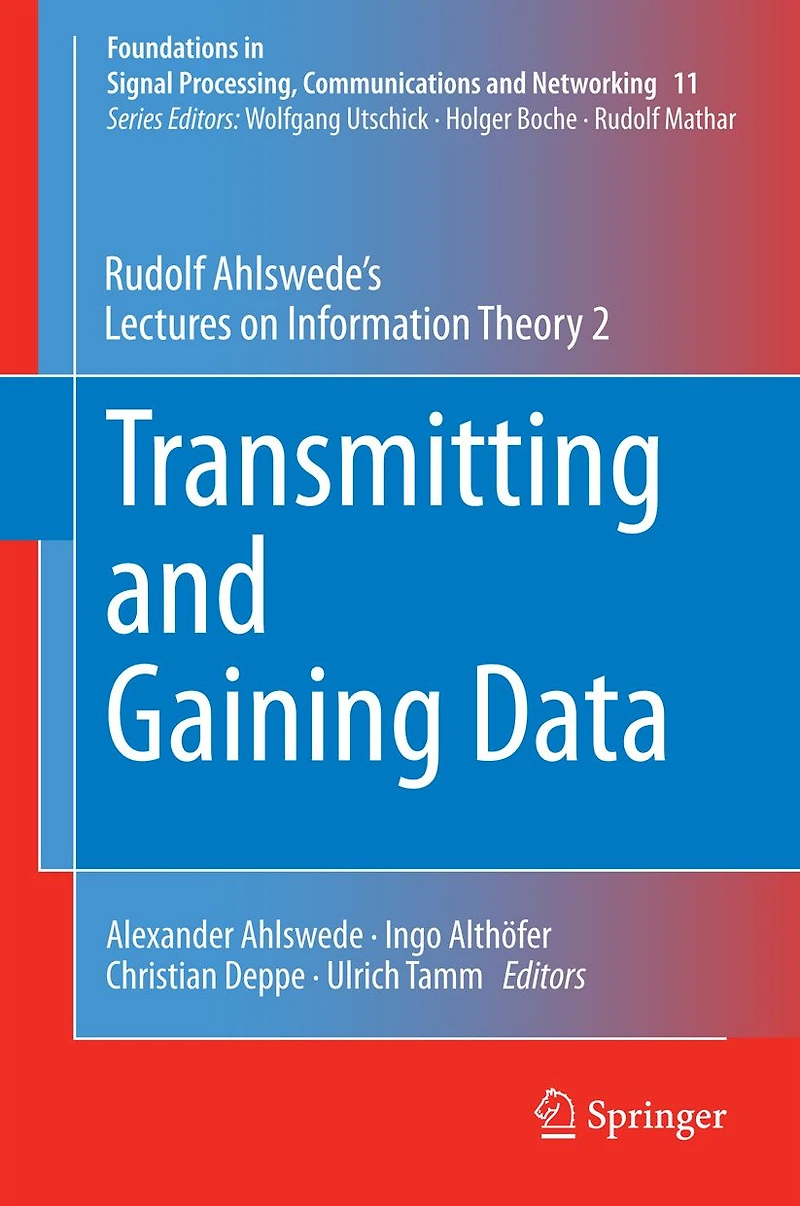
Transmitting and Gaining Data: Rudolf Ahlswede's Lectures on Information Theory 2 in Chattanooga, TN
By Barnes & Noble
Current price: $54.99
Barnes and Noble
Transmitting and Gaining Data: Rudolf Ahlswede's Lectures on Information Theory 2 in Chattanooga, TN
By Barnes & Noble
Current price: $54.99
Loading Inventory...
Size: EBook
The calculation of channel capacities was one of Rudolf Ahlswede's specialties and is the main topic of this second volume of his Lectures on Information Theory. Here we find a detailed account of some very classical material from the early days of Information Theory, including developments from the USA, Russia, Hungary and (which Ahlswede was probably in a unique position to describe) the German school centered around his supervisor Konrad Jacobs. These lectures made an approach to a rigorous justification of the foundations of Information Theory. This is the second of several volumes documenting Rudolf Ahlswede's lectures on Information Theory. Each volume includes comments from an invited well-known expert. In the supplement to the present volume, Gerhard Kramer contributes his insights. Classical information processing concerns the main tasks of gaining knowledge and the storage, transmission and hiding of data. The first task is the prime goal of Statistics. For transmission and hiding data, Shannon developed an impressive mathematical theory called Information Theory, which he based on probabilistic models. The theory largely involves the concept of codes with small error probabilities in spite of noise in the transmission, which is modeled by channels. The lectures presented in this work are suitable for graduate students in Mathematics, and also for those working in Theoretical Computer Science, Physics, and Electrical Engineering with a background in basic Mathematics. The lectures can be used as the basis for courses or to supplement courses in many ways. Ph.D. students will also find research problems, often with conjectures, that offer potential subjects for a thesis. More advanced researchers may find questions which form the basis of entire research programs.
The calculation of channel capacities was one of Rudolf Ahlswede's specialties and is the main topic of this second volume of his Lectures on Information Theory. Here we find a detailed account of some very classical material from the early days of Information Theory, including developments from the USA, Russia, Hungary and (which Ahlswede was probably in a unique position to describe) the German school centered around his supervisor Konrad Jacobs. These lectures made an approach to a rigorous justification of the foundations of Information Theory. This is the second of several volumes documenting Rudolf Ahlswede's lectures on Information Theory. Each volume includes comments from an invited well-known expert. In the supplement to the present volume, Gerhard Kramer contributes his insights. Classical information processing concerns the main tasks of gaining knowledge and the storage, transmission and hiding of data. The first task is the prime goal of Statistics. For transmission and hiding data, Shannon developed an impressive mathematical theory called Information Theory, which he based on probabilistic models. The theory largely involves the concept of codes with small error probabilities in spite of noise in the transmission, which is modeled by channels. The lectures presented in this work are suitable for graduate students in Mathematics, and also for those working in Theoretical Computer Science, Physics, and Electrical Engineering with a background in basic Mathematics. The lectures can be used as the basis for courses or to supplement courses in many ways. Ph.D. students will also find research problems, often with conjectures, that offer potential subjects for a thesis. More advanced researchers may find questions which form the basis of entire research programs.
You May Also Like








More About Barnes and Noble at Hamilton Place
Barnes & Noble is the world’s largest retail bookseller and a leading retailer of content, digital media and educational products. Our Nook Digital business offers a lineup of NOOK® tablets and e-Readers and an expansive collection of digital reading content through the NOOK Store®. Barnes & Noble’s mission is to operate the best omni-channel specialty retail business in America, helping both our customers and booksellers reach their aspirations, while being a credit to the communities we serve.
2100 Hamilton Pl Blvd, Chattanooga, TN 37421, United States
Find Barnes and Noble at Hamilton Place in Chattanooga, TN
Visit Barnes and Noble at Hamilton Place in Chattanooga, TN
