
Home
Through the Night
Barnes and Noble
Loading Inventory...
Through the Night in Chattanooga, TN
Current price: $23.99
Barnes and Noble
Through the Night in Chattanooga, TN
Current price: $23.99
Loading Inventory...
Size: OS
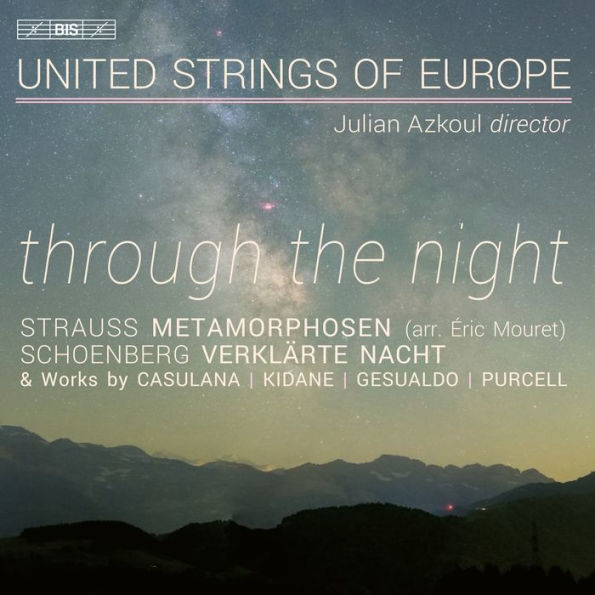
Night has been the subject of countless works of art in every genre imaginable, and it is the journey through the dark to the dawn that is woven into this program by the
United Strings of Europe
and its director,
Julian Azkoul
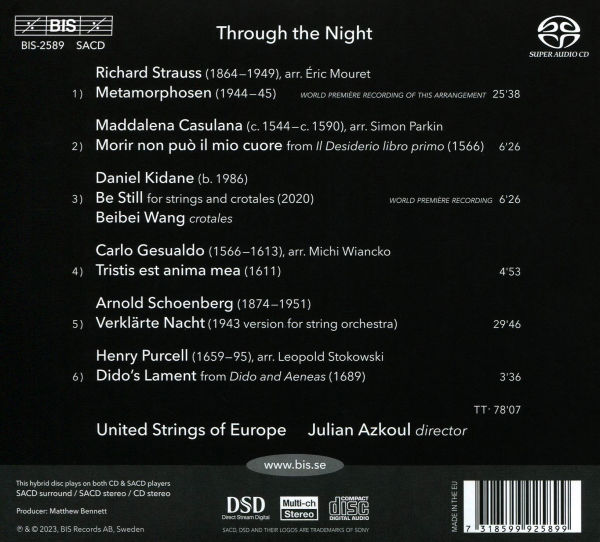
. Two familiar works make up nearly the entirety of the program:
Schoenberg
's
Verklärte Nacht, Op. 4
, in the composer's version for string orchestra, and
Richard Strauss
'
Metamorphosen
, in an intriguing arrangement by
Éric Mouret
.
Mouret
pares the work down only slightly from 23 players (ten violins, five violas and cellos, and three basses) to 16 (eight violins, four violas and cellos, and one bass). While this keeps the distribution percentage of instruments nearly identical, it allows the viola and cello lines to come through more naturally without forcing the issue. Written as the Second World War was nearing its conclusion, there is a natural sense of awakening from the horrors of the war with dawn and optimism for a future after one of the darkest periods in our collective history. The ensemble's phrasing and cohesion are undeniable, and there is little wonder that it fits perfectly into a program of this nature. So, too, does the newest piece on this program,
Daniel Kidane
Be Still
, written in late 2020, following months of lockdowns and uncertainty caused by the first year of the COVID-19 pandemic. While it easily falls into the program's subject, the ensemble's playing is not quite in lockstep as it is elsewhere. The arrangements of Renaissance works by
Maddelena Casulana
and
Carlo Gesualdo
are done and performed well; the
Casulana
is worth consideration as
Simon Parkin
's arrangement begins with a fantasy on the original madrigal before segueing and concluding with the source. The ensemble is once more up to the task in the
, passionately and precisely played. While lovely,
Stokowski
's arrangement of "Dido's Lament" from
Purcell
Dido and Aeneas
seems like an odd addition. It may be best considered an encore at a live performance of this program. ~ Keith Finke
United Strings of Europe
and its director,
Julian Azkoul
. Two familiar works make up nearly the entirety of the program:
Schoenberg
's
Verklärte Nacht, Op. 4
, in the composer's version for string orchestra, and
Richard Strauss
'
Metamorphosen
, in an intriguing arrangement by
Éric Mouret
.
Mouret
pares the work down only slightly from 23 players (ten violins, five violas and cellos, and three basses) to 16 (eight violins, four violas and cellos, and one bass). While this keeps the distribution percentage of instruments nearly identical, it allows the viola and cello lines to come through more naturally without forcing the issue. Written as the Second World War was nearing its conclusion, there is a natural sense of awakening from the horrors of the war with dawn and optimism for a future after one of the darkest periods in our collective history. The ensemble's phrasing and cohesion are undeniable, and there is little wonder that it fits perfectly into a program of this nature. So, too, does the newest piece on this program,
Daniel Kidane
Be Still
, written in late 2020, following months of lockdowns and uncertainty caused by the first year of the COVID-19 pandemic. While it easily falls into the program's subject, the ensemble's playing is not quite in lockstep as it is elsewhere. The arrangements of Renaissance works by
Maddelena Casulana
and
Carlo Gesualdo
are done and performed well; the
Casulana
is worth consideration as
Simon Parkin
's arrangement begins with a fantasy on the original madrigal before segueing and concluding with the source. The ensemble is once more up to the task in the
, passionately and precisely played. While lovely,
Stokowski
's arrangement of "Dido's Lament" from
Purcell
Dido and Aeneas
seems like an odd addition. It may be best considered an encore at a live performance of this program. ~ Keith Finke
Night has been the subject of countless works of art in every genre imaginable, and it is the journey through the dark to the dawn that is woven into this program by the
United Strings of Europe
and its director,
Julian Azkoul
. Two familiar works make up nearly the entirety of the program:
Schoenberg
's
Verklärte Nacht, Op. 4
, in the composer's version for string orchestra, and
Richard Strauss
'
Metamorphosen
, in an intriguing arrangement by
Éric Mouret
.
Mouret
pares the work down only slightly from 23 players (ten violins, five violas and cellos, and three basses) to 16 (eight violins, four violas and cellos, and one bass). While this keeps the distribution percentage of instruments nearly identical, it allows the viola and cello lines to come through more naturally without forcing the issue. Written as the Second World War was nearing its conclusion, there is a natural sense of awakening from the horrors of the war with dawn and optimism for a future after one of the darkest periods in our collective history. The ensemble's phrasing and cohesion are undeniable, and there is little wonder that it fits perfectly into a program of this nature. So, too, does the newest piece on this program,
Daniel Kidane
Be Still
, written in late 2020, following months of lockdowns and uncertainty caused by the first year of the COVID-19 pandemic. While it easily falls into the program's subject, the ensemble's playing is not quite in lockstep as it is elsewhere. The arrangements of Renaissance works by
Maddelena Casulana
and
Carlo Gesualdo
are done and performed well; the
Casulana
is worth consideration as
Simon Parkin
's arrangement begins with a fantasy on the original madrigal before segueing and concluding with the source. The ensemble is once more up to the task in the
, passionately and precisely played. While lovely,
Stokowski
's arrangement of "Dido's Lament" from
Purcell
Dido and Aeneas
seems like an odd addition. It may be best considered an encore at a live performance of this program. ~ Keith Finke
United Strings of Europe
and its director,
Julian Azkoul
. Two familiar works make up nearly the entirety of the program:
Schoenberg
's
Verklärte Nacht, Op. 4
, in the composer's version for string orchestra, and
Richard Strauss
'
Metamorphosen
, in an intriguing arrangement by
Éric Mouret
.
Mouret
pares the work down only slightly from 23 players (ten violins, five violas and cellos, and three basses) to 16 (eight violins, four violas and cellos, and one bass). While this keeps the distribution percentage of instruments nearly identical, it allows the viola and cello lines to come through more naturally without forcing the issue. Written as the Second World War was nearing its conclusion, there is a natural sense of awakening from the horrors of the war with dawn and optimism for a future after one of the darkest periods in our collective history. The ensemble's phrasing and cohesion are undeniable, and there is little wonder that it fits perfectly into a program of this nature. So, too, does the newest piece on this program,
Daniel Kidane
Be Still
, written in late 2020, following months of lockdowns and uncertainty caused by the first year of the COVID-19 pandemic. While it easily falls into the program's subject, the ensemble's playing is not quite in lockstep as it is elsewhere. The arrangements of Renaissance works by
Maddelena Casulana
and
Carlo Gesualdo
are done and performed well; the
Casulana
is worth consideration as
Simon Parkin
's arrangement begins with a fantasy on the original madrigal before segueing and concluding with the source. The ensemble is once more up to the task in the
, passionately and precisely played. While lovely,
Stokowski
's arrangement of "Dido's Lament" from
Purcell
Dido and Aeneas
seems like an odd addition. It may be best considered an encore at a live performance of this program. ~ Keith Finke
You May Also Like














More About Barnes and Noble at Hamilton Place
Barnes & Noble is the world’s largest retail bookseller and a leading retailer of content, digital media and educational products. Our Nook Digital business offers a lineup of NOOK® tablets and e-Readers and an expansive collection of digital reading content through the NOOK Store®. Barnes & Noble’s mission is to operate the best omni-channel specialty retail business in America, helping both our customers and booksellers reach their aspirations, while being a credit to the communities we serve.
2100 Hamilton Pl Blvd, Chattanooga, TN 37421, United States
Find Barnes and Noble at Hamilton Place in Chattanooga, TN
Visit Barnes and Noble at Hamilton Place in Chattanooga, TN
