
Home
Theorizing Discrimination an Era of Contested Prejudice: the United States
Barnes and Noble
Loading Inventory...
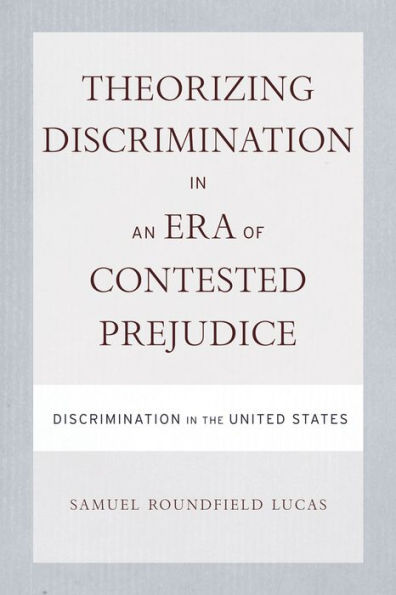
Theorizing Discrimination an Era of Contested Prejudice: the United States in Chattanooga, TN
Current price: $34.95
Barnes and Noble
Theorizing Discrimination an Era of Contested Prejudice: the United States in Chattanooga, TN
Current price: $34.95
Loading Inventory...
Size: Paperback
In this landmark work, Samuel Lucas shows how discrimination is not simply an action that one person performs in relation to another individual, but something far more insidious: a pervasive dynamic that permeates the environment in which we live and work.
Lucas makes a clear distinction between prejudice and discrimination. He maintains that when an era of "condoned exploitation" ended, the era of "contested prejudice," as he terms it, began. Drawing on critical race theory, feminist theory, and a critique of dominant perspectives in the social sciences and law, Lucas offers a new understanding of racial and sexual discrimination that can guide our actions and laws into a more just future.
Lucas makes a clear distinction between prejudice and discrimination. He maintains that when an era of "condoned exploitation" ended, the era of "contested prejudice," as he terms it, began. Drawing on critical race theory, feminist theory, and a critique of dominant perspectives in the social sciences and law, Lucas offers a new understanding of racial and sexual discrimination that can guide our actions and laws into a more just future.
In this landmark work, Samuel Lucas shows how discrimination is not simply an action that one person performs in relation to another individual, but something far more insidious: a pervasive dynamic that permeates the environment in which we live and work.
Lucas makes a clear distinction between prejudice and discrimination. He maintains that when an era of "condoned exploitation" ended, the era of "contested prejudice," as he terms it, began. Drawing on critical race theory, feminist theory, and a critique of dominant perspectives in the social sciences and law, Lucas offers a new understanding of racial and sexual discrimination that can guide our actions and laws into a more just future.
Lucas makes a clear distinction between prejudice and discrimination. He maintains that when an era of "condoned exploitation" ended, the era of "contested prejudice," as he terms it, began. Drawing on critical race theory, feminist theory, and a critique of dominant perspectives in the social sciences and law, Lucas offers a new understanding of racial and sexual discrimination that can guide our actions and laws into a more just future.
You May Also Like











More About Barnes and Noble at Hamilton Place
Barnes & Noble is the world’s largest retail bookseller and a leading retailer of content, digital media and educational products. Our Nook Digital business offers a lineup of NOOK® tablets and e-Readers and an expansive collection of digital reading content through the NOOK Store®. Barnes & Noble’s mission is to operate the best omni-channel specialty retail business in America, helping both our customers and booksellers reach their aspirations, while being a credit to the communities we serve.
2100 Hamilton Pl Blvd, Chattanooga, TN 37421, United States
Find Barnes and Noble at Hamilton Place in Chattanooga, TN
Visit Barnes and Noble at Hamilton Place in Chattanooga, TN