
Home
The Watson Glaser Inference Questions Tiny Handbook: Passing Critical Thinking Tests, Verbal/Logical Reasoning Assessments
Barnes and Noble
Loading Inventory...
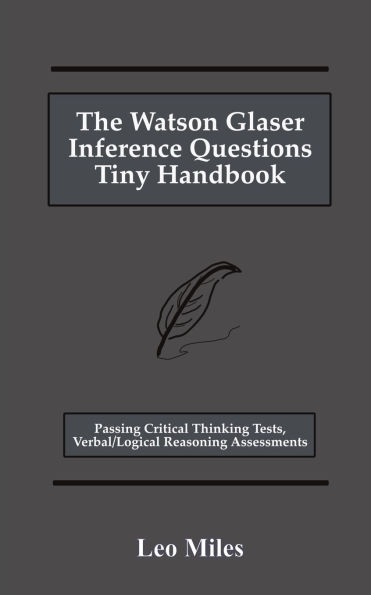
The Watson Glaser Inference Questions Tiny Handbook: Passing Critical Thinking Tests, Verbal/Logical Reasoning Assessments in Chattanooga, TN
Current price: $16.00
Barnes and Noble
The Watson Glaser Inference Questions Tiny Handbook: Passing Critical Thinking Tests, Verbal/Logical Reasoning Assessments in Chattanooga, TN
Current price: $16.00
Loading Inventory...
Size: OS
Do you want to work at a large commercial law firm and have to take the Watson Glaser Test? Do you have trouble working through inference or critical reasoning questions during admissions or psychometric tests?
Your answer is: Yes!
So, what should you know?
Inference questions are one of the hardest types of questions when testing verbal reasoning or reading comprehension skills. If you are confused, you are definitely not alone!
But here's the secret.
The reason you are struggling is not that you cannot read carefully. It is because you do not know how to approach the question correctly.
How you intuitively think about inferences skews you away from finding the correct answer.
The Watson Glaser Inference Questions Tiny Handbook
will help you develop the right framework to analyse critical thinking questions. By understanding what the questions are testing you on, you will learn to confidently choose your answers and use your time more efficiently. Never again will you struggle with picking an answer when you know what section of the text the question targets.
Some elements this book covers:
- How to identify key words and skim text efficiently
- The nuances between Probably True/False and Insufficient Data answers
- The different ways to analyse common question types relating to
conditional reasoning, quantity indicators, strong/weak language
, and more.
---
focuses on the inference questions commonly found on the Watson Glaser Test. However, the skills you develop will also help with other verbal reasoning assessments (SHL, Cappfinity, GRE, GMAT, etc) and law-based entrance exams (LNAT, LSAT). This is because this book helps you understand the degrees of support for answer choices.
This book has information sourced from years of experience with legal assessment centres and verbal reasoning assessments. The tips and strategies have been curated after speaking with assessors and successful applicants to investment banks and commercial law firms. It is meant to be concise, clear, and a point of reference as you prepare for your legal journey.
Your answer is: Yes!
So, what should you know?
Inference questions are one of the hardest types of questions when testing verbal reasoning or reading comprehension skills. If you are confused, you are definitely not alone!
But here's the secret.
The reason you are struggling is not that you cannot read carefully. It is because you do not know how to approach the question correctly.
How you intuitively think about inferences skews you away from finding the correct answer.
The Watson Glaser Inference Questions Tiny Handbook
will help you develop the right framework to analyse critical thinking questions. By understanding what the questions are testing you on, you will learn to confidently choose your answers and use your time more efficiently. Never again will you struggle with picking an answer when you know what section of the text the question targets.
Some elements this book covers:
- How to identify key words and skim text efficiently
- The nuances between Probably True/False and Insufficient Data answers
- The different ways to analyse common question types relating to
conditional reasoning, quantity indicators, strong/weak language
, and more.
---
focuses on the inference questions commonly found on the Watson Glaser Test. However, the skills you develop will also help with other verbal reasoning assessments (SHL, Cappfinity, GRE, GMAT, etc) and law-based entrance exams (LNAT, LSAT). This is because this book helps you understand the degrees of support for answer choices.
This book has information sourced from years of experience with legal assessment centres and verbal reasoning assessments. The tips and strategies have been curated after speaking with assessors and successful applicants to investment banks and commercial law firms. It is meant to be concise, clear, and a point of reference as you prepare for your legal journey.
Do you want to work at a large commercial law firm and have to take the Watson Glaser Test? Do you have trouble working through inference or critical reasoning questions during admissions or psychometric tests?
Your answer is: Yes!
So, what should you know?
Inference questions are one of the hardest types of questions when testing verbal reasoning or reading comprehension skills. If you are confused, you are definitely not alone!
But here's the secret.
The reason you are struggling is not that you cannot read carefully. It is because you do not know how to approach the question correctly.
How you intuitively think about inferences skews you away from finding the correct answer.
The Watson Glaser Inference Questions Tiny Handbook
will help you develop the right framework to analyse critical thinking questions. By understanding what the questions are testing you on, you will learn to confidently choose your answers and use your time more efficiently. Never again will you struggle with picking an answer when you know what section of the text the question targets.
Some elements this book covers:
- How to identify key words and skim text efficiently
- The nuances between Probably True/False and Insufficient Data answers
- The different ways to analyse common question types relating to
conditional reasoning, quantity indicators, strong/weak language
, and more.
---
focuses on the inference questions commonly found on the Watson Glaser Test. However, the skills you develop will also help with other verbal reasoning assessments (SHL, Cappfinity, GRE, GMAT, etc) and law-based entrance exams (LNAT, LSAT). This is because this book helps you understand the degrees of support for answer choices.
This book has information sourced from years of experience with legal assessment centres and verbal reasoning assessments. The tips and strategies have been curated after speaking with assessors and successful applicants to investment banks and commercial law firms. It is meant to be concise, clear, and a point of reference as you prepare for your legal journey.
Your answer is: Yes!
So, what should you know?
Inference questions are one of the hardest types of questions when testing verbal reasoning or reading comprehension skills. If you are confused, you are definitely not alone!
But here's the secret.
The reason you are struggling is not that you cannot read carefully. It is because you do not know how to approach the question correctly.
How you intuitively think about inferences skews you away from finding the correct answer.
The Watson Glaser Inference Questions Tiny Handbook
will help you develop the right framework to analyse critical thinking questions. By understanding what the questions are testing you on, you will learn to confidently choose your answers and use your time more efficiently. Never again will you struggle with picking an answer when you know what section of the text the question targets.
Some elements this book covers:
- How to identify key words and skim text efficiently
- The nuances between Probably True/False and Insufficient Data answers
- The different ways to analyse common question types relating to
conditional reasoning, quantity indicators, strong/weak language
, and more.
---
focuses on the inference questions commonly found on the Watson Glaser Test. However, the skills you develop will also help with other verbal reasoning assessments (SHL, Cappfinity, GRE, GMAT, etc) and law-based entrance exams (LNAT, LSAT). This is because this book helps you understand the degrees of support for answer choices.
This book has information sourced from years of experience with legal assessment centres and verbal reasoning assessments. The tips and strategies have been curated after speaking with assessors and successful applicants to investment banks and commercial law firms. It is meant to be concise, clear, and a point of reference as you prepare for your legal journey.
You May Also Like







More About Barnes and Noble at Hamilton Place
Barnes & Noble is the world’s largest retail bookseller and a leading retailer of content, digital media and educational products. Our Nook Digital business offers a lineup of NOOK® tablets and e-Readers and an expansive collection of digital reading content through the NOOK Store®. Barnes & Noble’s mission is to operate the best omni-channel specialty retail business in America, helping both our customers and booksellers reach their aspirations, while being a credit to the communities we serve.
2100 Hamilton Pl Blvd, Chattanooga, TN 37421, United States
Find Barnes and Noble at Hamilton Place in Chattanooga, TN
Visit Barnes and Noble at Hamilton Place in Chattanooga, TN
