
Home
The Proximity Paradox: How to Create Distance from Business as Usual and Do Something Truly Innovative
Barnes and Noble
Loading Inventory...
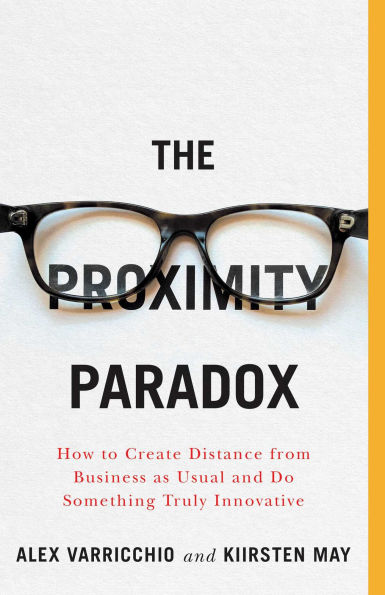
The Proximity Paradox: How to Create Distance from Business as Usual and Do Something Truly Innovative in Chattanooga, TN
Current price: $18.95
Barnes and Noble
The Proximity Paradox: How to Create Distance from Business as Usual and Do Something Truly Innovative in Chattanooga, TN
Current price: $18.95
Loading Inventory...
Size: Paperback
The
Proximity Paradox
will show you how to step back from your business to focus your creativity and meet your clients’ needs
“Innovative … It’s a much-needed perspective on how to escape inside-the-box thinking.” —
Publishers Weekly
Traditional business structures love stability and predictability. Yet many organizations believe the two essential ingredients for long-term success are creativity and innovation. Kiirsten May and Alex Varricchio, founders of the marketing agency UpHouse, call the relationship between these two opposing expectations the Proximity Paradox™ — the belief that those who are closest to a subject are best qualified to innovate for it when, in reality, intense proximity limits creativity. Instead, people need to create distance from challenges in order to see the best way forward. May and Varricchio believe that until we can separate innovation and execution within ourselves, we will only innovate to the level at which we can execute the idea. To be effective, we need to create distance between our innovation brain and our execution brain.
Unpacking ten common examples of the Proximity Paradox that affect a company’s people, processes, and industry, the authors share some practical ideas to create the distance necessary for your next great idea. An especially valuable book for creatives, and non-creatives in creative industries, but equally applicable to all businesses that depend on innovation,
The Proximity Paradox
encourages us to ask hard questions about how we work, how our businesses are structured, and why we routinely find our creativity at odds with what’s asked of us as executors and stewards of the bottom line.
Proximity Paradox
will show you how to step back from your business to focus your creativity and meet your clients’ needs
“Innovative … It’s a much-needed perspective on how to escape inside-the-box thinking.” —
Publishers Weekly
Traditional business structures love stability and predictability. Yet many organizations believe the two essential ingredients for long-term success are creativity and innovation. Kiirsten May and Alex Varricchio, founders of the marketing agency UpHouse, call the relationship between these two opposing expectations the Proximity Paradox™ — the belief that those who are closest to a subject are best qualified to innovate for it when, in reality, intense proximity limits creativity. Instead, people need to create distance from challenges in order to see the best way forward. May and Varricchio believe that until we can separate innovation and execution within ourselves, we will only innovate to the level at which we can execute the idea. To be effective, we need to create distance between our innovation brain and our execution brain.
Unpacking ten common examples of the Proximity Paradox that affect a company’s people, processes, and industry, the authors share some practical ideas to create the distance necessary for your next great idea. An especially valuable book for creatives, and non-creatives in creative industries, but equally applicable to all businesses that depend on innovation,
The Proximity Paradox
encourages us to ask hard questions about how we work, how our businesses are structured, and why we routinely find our creativity at odds with what’s asked of us as executors and stewards of the bottom line.
The
Proximity Paradox
will show you how to step back from your business to focus your creativity and meet your clients’ needs
“Innovative … It’s a much-needed perspective on how to escape inside-the-box thinking.” —
Publishers Weekly
Traditional business structures love stability and predictability. Yet many organizations believe the two essential ingredients for long-term success are creativity and innovation. Kiirsten May and Alex Varricchio, founders of the marketing agency UpHouse, call the relationship between these two opposing expectations the Proximity Paradox™ — the belief that those who are closest to a subject are best qualified to innovate for it when, in reality, intense proximity limits creativity. Instead, people need to create distance from challenges in order to see the best way forward. May and Varricchio believe that until we can separate innovation and execution within ourselves, we will only innovate to the level at which we can execute the idea. To be effective, we need to create distance between our innovation brain and our execution brain.
Unpacking ten common examples of the Proximity Paradox that affect a company’s people, processes, and industry, the authors share some practical ideas to create the distance necessary for your next great idea. An especially valuable book for creatives, and non-creatives in creative industries, but equally applicable to all businesses that depend on innovation,
The Proximity Paradox
encourages us to ask hard questions about how we work, how our businesses are structured, and why we routinely find our creativity at odds with what’s asked of us as executors and stewards of the bottom line.
Proximity Paradox
will show you how to step back from your business to focus your creativity and meet your clients’ needs
“Innovative … It’s a much-needed perspective on how to escape inside-the-box thinking.” —
Publishers Weekly
Traditional business structures love stability and predictability. Yet many organizations believe the two essential ingredients for long-term success are creativity and innovation. Kiirsten May and Alex Varricchio, founders of the marketing agency UpHouse, call the relationship between these two opposing expectations the Proximity Paradox™ — the belief that those who are closest to a subject are best qualified to innovate for it when, in reality, intense proximity limits creativity. Instead, people need to create distance from challenges in order to see the best way forward. May and Varricchio believe that until we can separate innovation and execution within ourselves, we will only innovate to the level at which we can execute the idea. To be effective, we need to create distance between our innovation brain and our execution brain.
Unpacking ten common examples of the Proximity Paradox that affect a company’s people, processes, and industry, the authors share some practical ideas to create the distance necessary for your next great idea. An especially valuable book for creatives, and non-creatives in creative industries, but equally applicable to all businesses that depend on innovation,
The Proximity Paradox
encourages us to ask hard questions about how we work, how our businesses are structured, and why we routinely find our creativity at odds with what’s asked of us as executors and stewards of the bottom line.
You May Also Like











More About Barnes and Noble at Hamilton Place
Barnes & Noble is the world’s largest retail bookseller and a leading retailer of content, digital media and educational products. Our Nook Digital business offers a lineup of NOOK® tablets and e-Readers and an expansive collection of digital reading content through the NOOK Store®. Barnes & Noble’s mission is to operate the best omni-channel specialty retail business in America, helping both our customers and booksellers reach their aspirations, while being a credit to the communities we serve.
2100 Hamilton Pl Blvd, Chattanooga, TN 37421, United States
Find Barnes and Noble at Hamilton Place in Chattanooga, TN
Visit Barnes and Noble at Hamilton Place in Chattanooga, TN
