
Home
The Ponzi Factor: The Simple Truth About Investment Profits
Barnes and Noble
Loading Inventory...
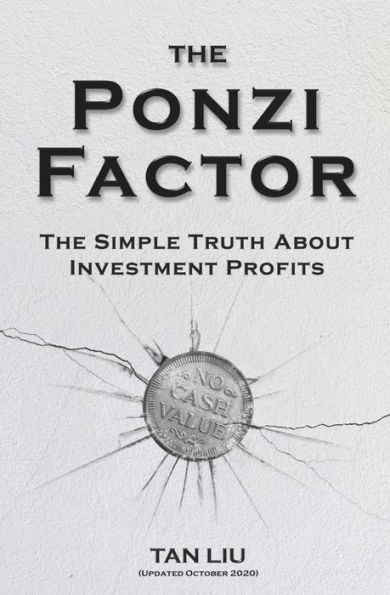
The Ponzi Factor: The Simple Truth About Investment Profits in Chattanooga, TN
Current price: $12.99
Barnes and Noble
The Ponzi Factor: The Simple Truth About Investment Profits in Chattanooga, TN
Current price: $12.99
Loading Inventory...
Size: OS
"All truth passes through three stages. First, it is ridiculed. Second, it is violently opposed. Third, it is accepted as self-evident."
--Arthur Schopenhauer
The Ponzi Factor is the most comprehensive research ever compiled on the negative-sum nature of capital gains (non-dividend stocks). The book shows why, as a whole, ALL investors will lose money from buying and selling stocks.
Most people don't realize that profits from buying and selling stocks come from other investors who are also buying and selling stocks. When one investor buys low and sells high, another investor is also buying high and needs to sell for even higher. Companies like Google, Telsa, Facebook never pay their investors. Their investors' profits are dependent on the inflow of money from new investors, which by definition, is how a Ponzi scheme works.
This book is not for everyone. If you are a finance junkie who wants to rationalize why companies don't have to pay their investors and believe a system that shuffles money between investor can magically create more money than people contribute, then this book is not for you. On the other hand, if you understand why we can't create money by shuffling it with imaginary paper, and that investors invest because they want
money
, not
value
, then you will learn something you will never forget: The mechanics of how the stock market works and what really makes a stock price move.
A stock without dividends is a Ponzi asset. It's not how equity instruments were designed to work historically and not how ownership instruments are supposed to work logically. The Ponzi Factor is not a perspective or an opinion. It is a proof that is based on definition, logic, and it is supported by observable facts and history. This is not a story that will disappear after another market crash. It is an idea that will remain relevant for as long as the stock market exists.
Lastly, to critics, the naysayer, and the finance junkies who think the imaginary value = cash. The author will award $20,000 to anyone who can show why non-dividend stocks DO NOT meet the definition of a Ponzi scheme. That's $20,000 in cash, not value. (Details on this book's website. The Ponzi Factor. Proof by Definition.)
--Arthur Schopenhauer
The Ponzi Factor is the most comprehensive research ever compiled on the negative-sum nature of capital gains (non-dividend stocks). The book shows why, as a whole, ALL investors will lose money from buying and selling stocks.
Most people don't realize that profits from buying and selling stocks come from other investors who are also buying and selling stocks. When one investor buys low and sells high, another investor is also buying high and needs to sell for even higher. Companies like Google, Telsa, Facebook never pay their investors. Their investors' profits are dependent on the inflow of money from new investors, which by definition, is how a Ponzi scheme works.
This book is not for everyone. If you are a finance junkie who wants to rationalize why companies don't have to pay their investors and believe a system that shuffles money between investor can magically create more money than people contribute, then this book is not for you. On the other hand, if you understand why we can't create money by shuffling it with imaginary paper, and that investors invest because they want
money
, not
value
, then you will learn something you will never forget: The mechanics of how the stock market works and what really makes a stock price move.
A stock without dividends is a Ponzi asset. It's not how equity instruments were designed to work historically and not how ownership instruments are supposed to work logically. The Ponzi Factor is not a perspective or an opinion. It is a proof that is based on definition, logic, and it is supported by observable facts and history. This is not a story that will disappear after another market crash. It is an idea that will remain relevant for as long as the stock market exists.
Lastly, to critics, the naysayer, and the finance junkies who think the imaginary value = cash. The author will award $20,000 to anyone who can show why non-dividend stocks DO NOT meet the definition of a Ponzi scheme. That's $20,000 in cash, not value. (Details on this book's website. The Ponzi Factor. Proof by Definition.)
"All truth passes through three stages. First, it is ridiculed. Second, it is violently opposed. Third, it is accepted as self-evident."
--Arthur Schopenhauer
The Ponzi Factor is the most comprehensive research ever compiled on the negative-sum nature of capital gains (non-dividend stocks). The book shows why, as a whole, ALL investors will lose money from buying and selling stocks.
Most people don't realize that profits from buying and selling stocks come from other investors who are also buying and selling stocks. When one investor buys low and sells high, another investor is also buying high and needs to sell for even higher. Companies like Google, Telsa, Facebook never pay their investors. Their investors' profits are dependent on the inflow of money from new investors, which by definition, is how a Ponzi scheme works.
This book is not for everyone. If you are a finance junkie who wants to rationalize why companies don't have to pay their investors and believe a system that shuffles money between investor can magically create more money than people contribute, then this book is not for you. On the other hand, if you understand why we can't create money by shuffling it with imaginary paper, and that investors invest because they want
money
, not
value
, then you will learn something you will never forget: The mechanics of how the stock market works and what really makes a stock price move.
A stock without dividends is a Ponzi asset. It's not how equity instruments were designed to work historically and not how ownership instruments are supposed to work logically. The Ponzi Factor is not a perspective or an opinion. It is a proof that is based on definition, logic, and it is supported by observable facts and history. This is not a story that will disappear after another market crash. It is an idea that will remain relevant for as long as the stock market exists.
Lastly, to critics, the naysayer, and the finance junkies who think the imaginary value = cash. The author will award $20,000 to anyone who can show why non-dividend stocks DO NOT meet the definition of a Ponzi scheme. That's $20,000 in cash, not value. (Details on this book's website. The Ponzi Factor. Proof by Definition.)
--Arthur Schopenhauer
The Ponzi Factor is the most comprehensive research ever compiled on the negative-sum nature of capital gains (non-dividend stocks). The book shows why, as a whole, ALL investors will lose money from buying and selling stocks.
Most people don't realize that profits from buying and selling stocks come from other investors who are also buying and selling stocks. When one investor buys low and sells high, another investor is also buying high and needs to sell for even higher. Companies like Google, Telsa, Facebook never pay their investors. Their investors' profits are dependent on the inflow of money from new investors, which by definition, is how a Ponzi scheme works.
This book is not for everyone. If you are a finance junkie who wants to rationalize why companies don't have to pay their investors and believe a system that shuffles money between investor can magically create more money than people contribute, then this book is not for you. On the other hand, if you understand why we can't create money by shuffling it with imaginary paper, and that investors invest because they want
money
, not
value
, then you will learn something you will never forget: The mechanics of how the stock market works and what really makes a stock price move.
A stock without dividends is a Ponzi asset. It's not how equity instruments were designed to work historically and not how ownership instruments are supposed to work logically. The Ponzi Factor is not a perspective or an opinion. It is a proof that is based on definition, logic, and it is supported by observable facts and history. This is not a story that will disappear after another market crash. It is an idea that will remain relevant for as long as the stock market exists.
Lastly, to critics, the naysayer, and the finance junkies who think the imaginary value = cash. The author will award $20,000 to anyone who can show why non-dividend stocks DO NOT meet the definition of a Ponzi scheme. That's $20,000 in cash, not value. (Details on this book's website. The Ponzi Factor. Proof by Definition.)
You May Also Like














More About Barnes and Noble at Hamilton Place
Barnes & Noble is the world’s largest retail bookseller and a leading retailer of content, digital media and educational products. Our Nook Digital business offers a lineup of NOOK® tablets and e-Readers and an expansive collection of digital reading content through the NOOK Store®. Barnes & Noble’s mission is to operate the best omni-channel specialty retail business in America, helping both our customers and booksellers reach their aspirations, while being a credit to the communities we serve.
2100 Hamilton Pl Blvd, Chattanooga, TN 37421, United States
Find Barnes and Noble at Hamilton Place in Chattanooga, TN
Visit Barnes and Noble at Hamilton Place in Chattanooga, TN
