
Home
the Politics of Elite: Ideological Orientations, Mothering, and Social Mobilities Neoliberal Chile
Barnes and Noble
Loading Inventory...
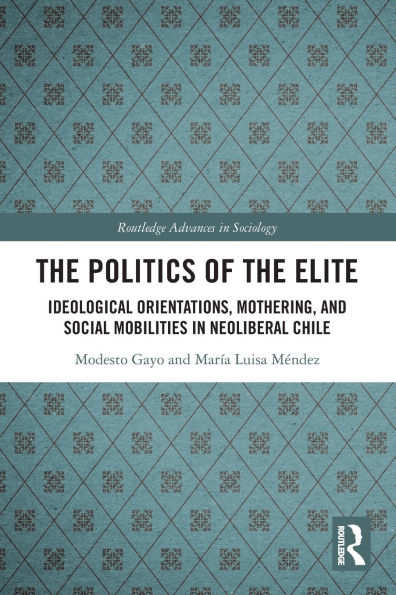
the Politics of Elite: Ideological Orientations, Mothering, and Social Mobilities Neoliberal Chile in Chattanooga, TN
Current price: $190.00
Barnes and Noble
the Politics of Elite: Ideological Orientations, Mothering, and Social Mobilities Neoliberal Chile in Chattanooga, TN
Current price: $190.00
Loading Inventory...
Size: Hardcover
This book is a study of class formation at the top of the social hierarchies during the turbulent and changing early twenty-first century. Contrary to perceptions that privileged individuals exist according to little more than market and economic logics, the book provides evidence that they are by no means absent from politics and civic engagement. Adopting a focus on reproduction, distinction, and politics, it delves into the complex relationship between cohesion and fragmentation that exists within the most privileged groups formed over the course of the contemporary neoliberal period.
By knitting a dialogue between spatial analysis, multiple correspondence analysis, and in-depth interviews, the book provides insights into the intricate relations between institutions and political subjectivities, and the role of space and mothering in the political socialisation of Chile’s most privileged families. The result is a dense description of a social class fragmented by subtle ideological lines based upon economic inheritance, socialisation within homogeneous family environments, paths into the labour market, and social and political activities.
This book will constitute a much-needed research resource for academics, students, and professionals in areas such as elite studies, social stratification, inequality, social reproduction, accumulation, political socialisation, and contemporary conservative/progressive views.
By knitting a dialogue between spatial analysis, multiple correspondence analysis, and in-depth interviews, the book provides insights into the intricate relations between institutions and political subjectivities, and the role of space and mothering in the political socialisation of Chile’s most privileged families. The result is a dense description of a social class fragmented by subtle ideological lines based upon economic inheritance, socialisation within homogeneous family environments, paths into the labour market, and social and political activities.
This book will constitute a much-needed research resource for academics, students, and professionals in areas such as elite studies, social stratification, inequality, social reproduction, accumulation, political socialisation, and contemporary conservative/progressive views.
This book is a study of class formation at the top of the social hierarchies during the turbulent and changing early twenty-first century. Contrary to perceptions that privileged individuals exist according to little more than market and economic logics, the book provides evidence that they are by no means absent from politics and civic engagement. Adopting a focus on reproduction, distinction, and politics, it delves into the complex relationship between cohesion and fragmentation that exists within the most privileged groups formed over the course of the contemporary neoliberal period.
By knitting a dialogue between spatial analysis, multiple correspondence analysis, and in-depth interviews, the book provides insights into the intricate relations between institutions and political subjectivities, and the role of space and mothering in the political socialisation of Chile’s most privileged families. The result is a dense description of a social class fragmented by subtle ideological lines based upon economic inheritance, socialisation within homogeneous family environments, paths into the labour market, and social and political activities.
This book will constitute a much-needed research resource for academics, students, and professionals in areas such as elite studies, social stratification, inequality, social reproduction, accumulation, political socialisation, and contemporary conservative/progressive views.
By knitting a dialogue between spatial analysis, multiple correspondence analysis, and in-depth interviews, the book provides insights into the intricate relations between institutions and political subjectivities, and the role of space and mothering in the political socialisation of Chile’s most privileged families. The result is a dense description of a social class fragmented by subtle ideological lines based upon economic inheritance, socialisation within homogeneous family environments, paths into the labour market, and social and political activities.
This book will constitute a much-needed research resource for academics, students, and professionals in areas such as elite studies, social stratification, inequality, social reproduction, accumulation, political socialisation, and contemporary conservative/progressive views.
You May Also Like







More About Barnes and Noble at Hamilton Place
Barnes & Noble is the world’s largest retail bookseller and a leading retailer of content, digital media and educational products. Our Nook Digital business offers a lineup of NOOK® tablets and e-Readers and an expansive collection of digital reading content through the NOOK Store®. Barnes & Noble’s mission is to operate the best omni-channel specialty retail business in America, helping both our customers and booksellers reach their aspirations, while being a credit to the communities we serve.
2100 Hamilton Pl Blvd, Chattanooga, TN 37421, United States
Find Barnes and Noble at Hamilton Place in Chattanooga, TN
Visit Barnes and Noble at Hamilton Place in Chattanooga, TN
