
Home
The Paradox of Progress: Economic Change, Individual Enterprise, and Politic Culture in Michigan, 1837-1878
Barnes and Noble
Loading Inventory...
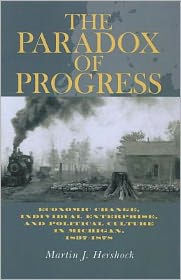
The Paradox of Progress: Economic Change, Individual Enterprise, and Politic Culture in Michigan, 1837-1878 in Chattanooga, TN
Current price: $28.95
Barnes and Noble
The Paradox of Progress: Economic Change, Individual Enterprise, and Politic Culture in Michigan, 1837-1878 in Chattanooga, TN
Current price: $28.95
Loading Inventory...
Size: OS
Americans have long recognized the central importance of the nineteenth-century Republican party in preserving the Union, ending slavery, and opening the way for industrial capitalism. On the surface, the story seems straightforward the party's “free labor” ethos, embracing the opportunity that free soil presented for social and economic mobility, and condemning the danger that slavery in the territories posed for that mobility, foreshadowed the GOP's later devotion to unfettered enterprise and industrial capitalism. In reality, however, the narrative thread is not so linear. This work examines the contradiction that lay at the heart of the supremely influential ideology of the early Republican party.
The Paradox of Progress
explores one of the most profound changes in American history the transition from the anti-market, anti-monopoly, and democratic ideology of Jacksonian America to the business-dominated politics and unregulated excesses of Gilded Age capitalism.
Guiding this transformation was the nineteenth-century Republican party. Drawing heavily from both the pro-market commitments of the early Whig party and the anti-capitalist culture of Jackson's Democratic party, the early Republican party found itself torn between these competing values. Nowhere was this contested process more obvious or more absorbing than in Civil War-era Michigan, the birthplace of the Republican party.
In
, a fascinating look at the central factors underlying the history of the GOP, Martin Hershock reveals how in their determination to resolve their ideological dilemma, Republicans of the Civil War era struggled to contrive a formula that wo uld enable them to win popular elections and to model America's acceptance of Gilded Age capitalism.
The Paradox of Progress
explores one of the most profound changes in American history the transition from the anti-market, anti-monopoly, and democratic ideology of Jacksonian America to the business-dominated politics and unregulated excesses of Gilded Age capitalism.
Guiding this transformation was the nineteenth-century Republican party. Drawing heavily from both the pro-market commitments of the early Whig party and the anti-capitalist culture of Jackson's Democratic party, the early Republican party found itself torn between these competing values. Nowhere was this contested process more obvious or more absorbing than in Civil War-era Michigan, the birthplace of the Republican party.
In
, a fascinating look at the central factors underlying the history of the GOP, Martin Hershock reveals how in their determination to resolve their ideological dilemma, Republicans of the Civil War era struggled to contrive a formula that wo uld enable them to win popular elections and to model America's acceptance of Gilded Age capitalism.
Americans have long recognized the central importance of the nineteenth-century Republican party in preserving the Union, ending slavery, and opening the way for industrial capitalism. On the surface, the story seems straightforward the party's “free labor” ethos, embracing the opportunity that free soil presented for social and economic mobility, and condemning the danger that slavery in the territories posed for that mobility, foreshadowed the GOP's later devotion to unfettered enterprise and industrial capitalism. In reality, however, the narrative thread is not so linear. This work examines the contradiction that lay at the heart of the supremely influential ideology of the early Republican party.
The Paradox of Progress
explores one of the most profound changes in American history the transition from the anti-market, anti-monopoly, and democratic ideology of Jacksonian America to the business-dominated politics and unregulated excesses of Gilded Age capitalism.
Guiding this transformation was the nineteenth-century Republican party. Drawing heavily from both the pro-market commitments of the early Whig party and the anti-capitalist culture of Jackson's Democratic party, the early Republican party found itself torn between these competing values. Nowhere was this contested process more obvious or more absorbing than in Civil War-era Michigan, the birthplace of the Republican party.
In
, a fascinating look at the central factors underlying the history of the GOP, Martin Hershock reveals how in their determination to resolve their ideological dilemma, Republicans of the Civil War era struggled to contrive a formula that wo uld enable them to win popular elections and to model America's acceptance of Gilded Age capitalism.
The Paradox of Progress
explores one of the most profound changes in American history the transition from the anti-market, anti-monopoly, and democratic ideology of Jacksonian America to the business-dominated politics and unregulated excesses of Gilded Age capitalism.
Guiding this transformation was the nineteenth-century Republican party. Drawing heavily from both the pro-market commitments of the early Whig party and the anti-capitalist culture of Jackson's Democratic party, the early Republican party found itself torn between these competing values. Nowhere was this contested process more obvious or more absorbing than in Civil War-era Michigan, the birthplace of the Republican party.
In
, a fascinating look at the central factors underlying the history of the GOP, Martin Hershock reveals how in their determination to resolve their ideological dilemma, Republicans of the Civil War era struggled to contrive a formula that wo uld enable them to win popular elections and to model America's acceptance of Gilded Age capitalism.
You May Also Like














More About Barnes and Noble at Hamilton Place
Barnes & Noble is the world’s largest retail bookseller and a leading retailer of content, digital media and educational products. Our Nook Digital business offers a lineup of NOOK® tablets and e-Readers and an expansive collection of digital reading content through the NOOK Store®. Barnes & Noble’s mission is to operate the best omni-channel specialty retail business in America, helping both our customers and booksellers reach their aspirations, while being a credit to the communities we serve.
2100 Hamilton Pl Blvd, Chattanooga, TN 37421, United States
Find Barnes and Noble at Hamilton Place in Chattanooga, TN
Visit Barnes and Noble at Hamilton Place in Chattanooga, TN
