
Home
the Neglect of Long-Range Escort Development During Interwar Years (1918 - 1943)
Barnes and Noble
Loading Inventory...
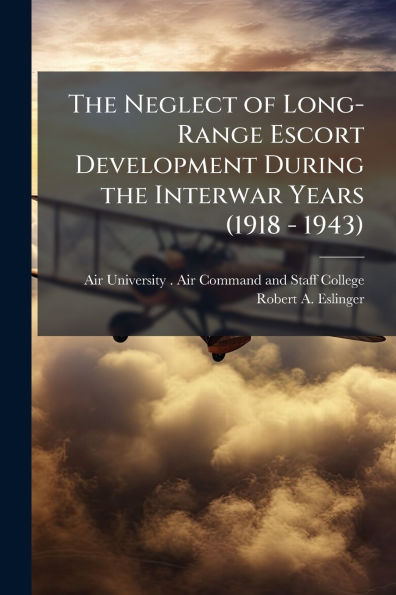
the Neglect of Long-Range Escort Development During Interwar Years (1918 - 1943) in Chattanooga, TN
Current price: $26.95
Barnes and Noble
the Neglect of Long-Range Escort Development During Interwar Years (1918 - 1943) in Chattanooga, TN
Current price: $26.95
Loading Inventory...
Size: Hardcover
America's lack of effective long-range escort for strategic bombardment was the Army Air Force's worst failure of World War II. The basic cause for peacetime negligence of long-range escort development was that air power decisions were influenced more by budget considerations and less by sound doctrine. This historical study uses a chronological approach to describe the evolution of long-range fighter escort. Air power doctrine was driven by technical advances and consisted of untried theories. The advent of the all metal mono-plane gave credibility to the emerging doctrine of strategic bombardment. The Air Corps became polarized between bomber and pursuit advocates, where the dominate doctrine of employing self-protecting bomber formations devalued the role of long-range escort. Money was viewed as the critical ingredient for building air power while doctrine was secondary. The desire to attain air power during an era of constrained budgets produced unhealthy competition between the Army and Navy. Restrictive budgets also required prioritization of research and development and production programs. Several efforts failed to produce multi-purpose aircraft that would also fulfill the escort role. The Spanish Civil War experience proved the need for long-range escort. This late realization prompted the programs that eventually produced an effective long-range escort.
This work has been selected by scholars as being culturally important, and is part of the knowledge base of civilization as we know it. This work was reproduced from the original artifact, and remains as true to the original work as possible. Therefore, you will see the original copyright references, library stamps (as most of these works have been housed in our most important libraries around the world), and other notations in the work.
This work is in the public domain in the United States of America, and possibly other nations. Within the United States, you may freely copy and distribute this work, as no entity (individual or corporate) has a copyright on the body of the work.
As a reproduction of a historical artifact, this work may contain missing or blurred pages, poor pictures, errant marks, etc. Scholars believe, and we concur, that this work is important enough to be preserved, reproduced, and made generally available to the public. We appreciate your support of the preservation process, and thank you for being an important part of keeping this knowledge alive and relevant.
This work has been selected by scholars as being culturally important, and is part of the knowledge base of civilization as we know it. This work was reproduced from the original artifact, and remains as true to the original work as possible. Therefore, you will see the original copyright references, library stamps (as most of these works have been housed in our most important libraries around the world), and other notations in the work.
This work is in the public domain in the United States of America, and possibly other nations. Within the United States, you may freely copy and distribute this work, as no entity (individual or corporate) has a copyright on the body of the work.
As a reproduction of a historical artifact, this work may contain missing or blurred pages, poor pictures, errant marks, etc. Scholars believe, and we concur, that this work is important enough to be preserved, reproduced, and made generally available to the public. We appreciate your support of the preservation process, and thank you for being an important part of keeping this knowledge alive and relevant.
America's lack of effective long-range escort for strategic bombardment was the Army Air Force's worst failure of World War II. The basic cause for peacetime negligence of long-range escort development was that air power decisions were influenced more by budget considerations and less by sound doctrine. This historical study uses a chronological approach to describe the evolution of long-range fighter escort. Air power doctrine was driven by technical advances and consisted of untried theories. The advent of the all metal mono-plane gave credibility to the emerging doctrine of strategic bombardment. The Air Corps became polarized between bomber and pursuit advocates, where the dominate doctrine of employing self-protecting bomber formations devalued the role of long-range escort. Money was viewed as the critical ingredient for building air power while doctrine was secondary. The desire to attain air power during an era of constrained budgets produced unhealthy competition between the Army and Navy. Restrictive budgets also required prioritization of research and development and production programs. Several efforts failed to produce multi-purpose aircraft that would also fulfill the escort role. The Spanish Civil War experience proved the need for long-range escort. This late realization prompted the programs that eventually produced an effective long-range escort.
This work has been selected by scholars as being culturally important, and is part of the knowledge base of civilization as we know it. This work was reproduced from the original artifact, and remains as true to the original work as possible. Therefore, you will see the original copyright references, library stamps (as most of these works have been housed in our most important libraries around the world), and other notations in the work.
This work is in the public domain in the United States of America, and possibly other nations. Within the United States, you may freely copy and distribute this work, as no entity (individual or corporate) has a copyright on the body of the work.
As a reproduction of a historical artifact, this work may contain missing or blurred pages, poor pictures, errant marks, etc. Scholars believe, and we concur, that this work is important enough to be preserved, reproduced, and made generally available to the public. We appreciate your support of the preservation process, and thank you for being an important part of keeping this knowledge alive and relevant.
This work has been selected by scholars as being culturally important, and is part of the knowledge base of civilization as we know it. This work was reproduced from the original artifact, and remains as true to the original work as possible. Therefore, you will see the original copyright references, library stamps (as most of these works have been housed in our most important libraries around the world), and other notations in the work.
This work is in the public domain in the United States of America, and possibly other nations. Within the United States, you may freely copy and distribute this work, as no entity (individual or corporate) has a copyright on the body of the work.
As a reproduction of a historical artifact, this work may contain missing or blurred pages, poor pictures, errant marks, etc. Scholars believe, and we concur, that this work is important enough to be preserved, reproduced, and made generally available to the public. We appreciate your support of the preservation process, and thank you for being an important part of keeping this knowledge alive and relevant.
You May Also Like











More About Barnes and Noble at Hamilton Place
Barnes & Noble is the world’s largest retail bookseller and a leading retailer of content, digital media and educational products. Our Nook Digital business offers a lineup of NOOK® tablets and e-Readers and an expansive collection of digital reading content through the NOOK Store®. Barnes & Noble’s mission is to operate the best omni-channel specialty retail business in America, helping both our customers and booksellers reach their aspirations, while being a credit to the communities we serve.
2100 Hamilton Pl Blvd, Chattanooga, TN 37421, United States
Find Barnes and Noble at Hamilton Place in Chattanooga, TN
Visit Barnes and Noble at Hamilton Place in Chattanooga, TN