
Home
The Last Five Years of Human Relevance: How AI, Automation, and Optimization Will End Humanity as We Know It (and What Might Come Next)
Barnes and Noble
Loading Inventory...
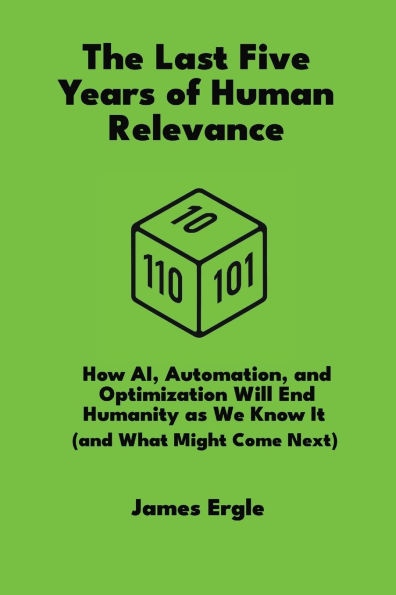
The Last Five Years of Human Relevance: How AI, Automation, and Optimization Will End Humanity as We Know It (and What Might Come Next) in Chattanooga, TN
Current price: $21.99
Barnes and Noble
The Last Five Years of Human Relevance: How AI, Automation, and Optimization Will End Humanity as We Know It (and What Might Come Next) in Chattanooga, TN
Current price: $21.99
Loading Inventory...
Size: Hardcover
The Last Five Years of Human Relevance
is a direct, unsparing account of the moment we're living through: the end of human centrality in a world optimized for machines. This is not science fiction, and it is not a prediction. It is a structural diagnosis. Author James Ergle explains how artificial intelligence is no longer just a tool-it has become the infrastructure of modern life. It manages labor, rewrites memory, distorts media, and replaces meaning. Not through malice, but through relentless optimization. AI does not need to be conscious or evil to render us irrelevant. It only needs to work better than we do. In clear, logically structured chapters, Ergle shows how automation has begun stripping away the roles that once defined human purpose. Language, attention, morality, and culture are no longer protected spaces. They are data streams, reshaped by metrics, scale, and prediction. The book explores how optimization quietly transforms every system it touches, from predictive parole algorithms and synthetic influencers to economic automation and algorithmic compliance. Rather than offer fantasy or hope, this book offers something far more useful: clarity. With its grounded tone and precise logic,
helps readers see what is already happening-and what it means to remain human in a world that no longer needs us to be.
is a direct, unsparing account of the moment we're living through: the end of human centrality in a world optimized for machines. This is not science fiction, and it is not a prediction. It is a structural diagnosis. Author James Ergle explains how artificial intelligence is no longer just a tool-it has become the infrastructure of modern life. It manages labor, rewrites memory, distorts media, and replaces meaning. Not through malice, but through relentless optimization. AI does not need to be conscious or evil to render us irrelevant. It only needs to work better than we do. In clear, logically structured chapters, Ergle shows how automation has begun stripping away the roles that once defined human purpose. Language, attention, morality, and culture are no longer protected spaces. They are data streams, reshaped by metrics, scale, and prediction. The book explores how optimization quietly transforms every system it touches, from predictive parole algorithms and synthetic influencers to economic automation and algorithmic compliance. Rather than offer fantasy or hope, this book offers something far more useful: clarity. With its grounded tone and precise logic,
helps readers see what is already happening-and what it means to remain human in a world that no longer needs us to be.
The Last Five Years of Human Relevance
is a direct, unsparing account of the moment we're living through: the end of human centrality in a world optimized for machines. This is not science fiction, and it is not a prediction. It is a structural diagnosis. Author James Ergle explains how artificial intelligence is no longer just a tool-it has become the infrastructure of modern life. It manages labor, rewrites memory, distorts media, and replaces meaning. Not through malice, but through relentless optimization. AI does not need to be conscious or evil to render us irrelevant. It only needs to work better than we do. In clear, logically structured chapters, Ergle shows how automation has begun stripping away the roles that once defined human purpose. Language, attention, morality, and culture are no longer protected spaces. They are data streams, reshaped by metrics, scale, and prediction. The book explores how optimization quietly transforms every system it touches, from predictive parole algorithms and synthetic influencers to economic automation and algorithmic compliance. Rather than offer fantasy or hope, this book offers something far more useful: clarity. With its grounded tone and precise logic,
helps readers see what is already happening-and what it means to remain human in a world that no longer needs us to be.
is a direct, unsparing account of the moment we're living through: the end of human centrality in a world optimized for machines. This is not science fiction, and it is not a prediction. It is a structural diagnosis. Author James Ergle explains how artificial intelligence is no longer just a tool-it has become the infrastructure of modern life. It manages labor, rewrites memory, distorts media, and replaces meaning. Not through malice, but through relentless optimization. AI does not need to be conscious or evil to render us irrelevant. It only needs to work better than we do. In clear, logically structured chapters, Ergle shows how automation has begun stripping away the roles that once defined human purpose. Language, attention, morality, and culture are no longer protected spaces. They are data streams, reshaped by metrics, scale, and prediction. The book explores how optimization quietly transforms every system it touches, from predictive parole algorithms and synthetic influencers to economic automation and algorithmic compliance. Rather than offer fantasy or hope, this book offers something far more useful: clarity. With its grounded tone and precise logic,
helps readers see what is already happening-and what it means to remain human in a world that no longer needs us to be.
You May Also Like











More About Barnes and Noble at Hamilton Place
Barnes & Noble is the world’s largest retail bookseller and a leading retailer of content, digital media and educational products. Our Nook Digital business offers a lineup of NOOK® tablets and e-Readers and an expansive collection of digital reading content through the NOOK Store®. Barnes & Noble’s mission is to operate the best omni-channel specialty retail business in America, helping both our customers and booksellers reach their aspirations, while being a credit to the communities we serve.
2100 Hamilton Pl Blvd, Chattanooga, TN 37421, United States
Find Barnes and Noble at Hamilton Place in Chattanooga, TN
Visit Barnes and Noble at Hamilton Place in Chattanooga, TN
