
Home
the Impact of Air Corps Tactical School on Development Strategic Doctrine
Barnes and Noble
Loading Inventory...
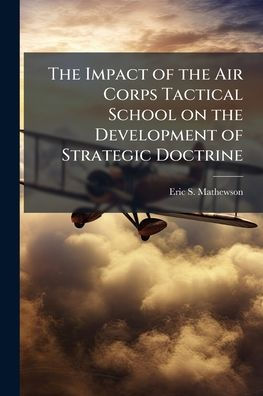
the Impact of Air Corps Tactical School on Development Strategic Doctrine in Chattanooga, TN
Current price: $26.95
Barnes and Noble
the Impact of Air Corps Tactical School on Development Strategic Doctrine in Chattanooga, TN
Current price: $26.95
Loading Inventory...
Size: Hardcover
It may be argued that the Air Corps Tactical School was not the "birthplace of strategic air power doctrine." Strategic doctrine, in fact, already existed when the School was founded. Additionally, during the inter-war years, it was the Army Air Corps at large, and not the School, which modified the doctrine to fit the contemporary economic, political, and technological contextual realities. The instructors and students at the School may have contributed to the development of strategic doctrine, but their contribution was no greater than that of any other airmen. During the years between World Wars, the American people did not, as a rule, want to hear about any development of offensive means or methods of war. Neither did they, or their political representatives, want to maintain a large military. President Wilson's "war to end all wars" meant, to many, exactly that, and little money was forthcoming to the military establishment. The War Department, and the Army and the Navy, did not want to share the shrinking pot of money with an upstart service - politics and economics argued against not only an independent Air Force, but also against the development of its requisite tools. The contemporary contextual elements shaped the way in which strategic air power doctrine could be formalized. A large variety of primary and secondary source materials must be studied in order to understand the realities and limitations that shaped the development of strategic air power doctrine.Early theorists imagined air power as an independent and decisive arm of the military that would destroy the enemy's hostile will and ability through the selective and methodical application of strategic air power. Their ideas did not stop at theory, but in fact, included a framework for strategic air power doctrine.
This work has been selected by scholars as being culturally important, and is part of the knowledge base of civilization as we know it. This work was reproduced from the original artifact, and remains as true to the original work as possible. Therefore, you will see the original copyright references, library stamps (as most of these works have been housed in our most important libraries around the world), and other notations in the work.
This work is in the public domain in the United States of America, and possibly other nations. Within the United States, you may freely copy and distribute this work, as no entity (individual or corporate) has a copyright on the body of the work.
As a reproduction of a historical artifact, this work may contain missing or blurred pages, poor pictures, errant marks, etc. Scholars believe, and we concur, that this work is important enough to be preserved, reproduced, and made generally available to the public. We appreciate your support of the preservation process, and thank you for being an important part of keeping this knowledge alive and relevant.
This work has been selected by scholars as being culturally important, and is part of the knowledge base of civilization as we know it. This work was reproduced from the original artifact, and remains as true to the original work as possible. Therefore, you will see the original copyright references, library stamps (as most of these works have been housed in our most important libraries around the world), and other notations in the work.
This work is in the public domain in the United States of America, and possibly other nations. Within the United States, you may freely copy and distribute this work, as no entity (individual or corporate) has a copyright on the body of the work.
As a reproduction of a historical artifact, this work may contain missing or blurred pages, poor pictures, errant marks, etc. Scholars believe, and we concur, that this work is important enough to be preserved, reproduced, and made generally available to the public. We appreciate your support of the preservation process, and thank you for being an important part of keeping this knowledge alive and relevant.
It may be argued that the Air Corps Tactical School was not the "birthplace of strategic air power doctrine." Strategic doctrine, in fact, already existed when the School was founded. Additionally, during the inter-war years, it was the Army Air Corps at large, and not the School, which modified the doctrine to fit the contemporary economic, political, and technological contextual realities. The instructors and students at the School may have contributed to the development of strategic doctrine, but their contribution was no greater than that of any other airmen. During the years between World Wars, the American people did not, as a rule, want to hear about any development of offensive means or methods of war. Neither did they, or their political representatives, want to maintain a large military. President Wilson's "war to end all wars" meant, to many, exactly that, and little money was forthcoming to the military establishment. The War Department, and the Army and the Navy, did not want to share the shrinking pot of money with an upstart service - politics and economics argued against not only an independent Air Force, but also against the development of its requisite tools. The contemporary contextual elements shaped the way in which strategic air power doctrine could be formalized. A large variety of primary and secondary source materials must be studied in order to understand the realities and limitations that shaped the development of strategic air power doctrine.Early theorists imagined air power as an independent and decisive arm of the military that would destroy the enemy's hostile will and ability through the selective and methodical application of strategic air power. Their ideas did not stop at theory, but in fact, included a framework for strategic air power doctrine.
This work has been selected by scholars as being culturally important, and is part of the knowledge base of civilization as we know it. This work was reproduced from the original artifact, and remains as true to the original work as possible. Therefore, you will see the original copyright references, library stamps (as most of these works have been housed in our most important libraries around the world), and other notations in the work.
This work is in the public domain in the United States of America, and possibly other nations. Within the United States, you may freely copy and distribute this work, as no entity (individual or corporate) has a copyright on the body of the work.
As a reproduction of a historical artifact, this work may contain missing or blurred pages, poor pictures, errant marks, etc. Scholars believe, and we concur, that this work is important enough to be preserved, reproduced, and made generally available to the public. We appreciate your support of the preservation process, and thank you for being an important part of keeping this knowledge alive and relevant.
This work has been selected by scholars as being culturally important, and is part of the knowledge base of civilization as we know it. This work was reproduced from the original artifact, and remains as true to the original work as possible. Therefore, you will see the original copyright references, library stamps (as most of these works have been housed in our most important libraries around the world), and other notations in the work.
This work is in the public domain in the United States of America, and possibly other nations. Within the United States, you may freely copy and distribute this work, as no entity (individual or corporate) has a copyright on the body of the work.
As a reproduction of a historical artifact, this work may contain missing or blurred pages, poor pictures, errant marks, etc. Scholars believe, and we concur, that this work is important enough to be preserved, reproduced, and made generally available to the public. We appreciate your support of the preservation process, and thank you for being an important part of keeping this knowledge alive and relevant.
You May Also Like














More About Barnes and Noble at Hamilton Place
Barnes & Noble is the world’s largest retail bookseller and a leading retailer of content, digital media and educational products. Our Nook Digital business offers a lineup of NOOK® tablets and e-Readers and an expansive collection of digital reading content through the NOOK Store®. Barnes & Noble’s mission is to operate the best omni-channel specialty retail business in America, helping both our customers and booksellers reach their aspirations, while being a credit to the communities we serve.
2100 Hamilton Pl Blvd, Chattanooga, TN 37421, United States
Find Barnes and Noble at Hamilton Place in Chattanooga, TN
Visit Barnes and Noble at Hamilton Place in Chattanooga, TN
