
Home
The Handbook of Emotion and Memory: Research Theory
Barnes and Noble
Loading Inventory...
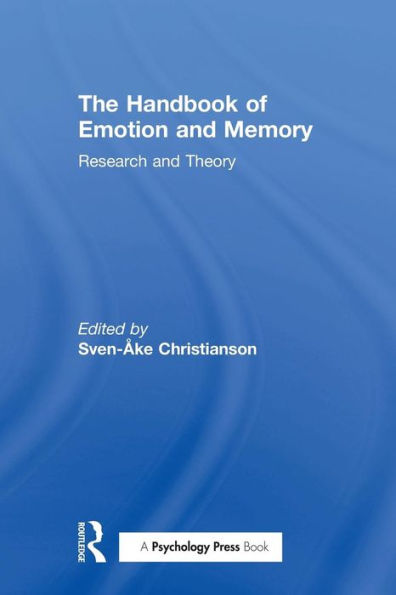
The Handbook of Emotion and Memory: Research Theory in Chattanooga, TN
Current price: $290.00
Barnes and Noble
The Handbook of Emotion and Memory: Research Theory in Chattanooga, TN
Current price: $290.00
Loading Inventory...
Size: Hardcover
This important volume defines the state of the art in the field of emotion and memory by offering a blend of research review, unpublished findings, and theory on topics related to its study. As the first contemporary reference source in this area, it summarizes findings on implicit and explicit aspects of emotion and memory, addresses conceptual and methodological difficulties associated with different paradigms and current procedures, and presents broad theoretical perspectives to guide further research. This volume articulates the accomplishments of the field and the points of disagreement, and gives the brain, clinical, and cognitive sciences an invaluable resource for 21st-century researchers.
Citing and analyzing the results of experiments as well as field and case studies, the chapters are organized around methodological approaches, biological-evolutionary perspectives, and clinical perspectives, and bring together experts in neuroscience, and both cognitive and clinical psychology. Questions addressed include:
* What is the nature of emotional events and what do we retain from them?
* Is there something about emotional events that causes them to be processed differently in memory?
* Do emotional memories have special characteristics that differ from those produced by "ordinary" memory mechanisms or systems?
* Do people with emotional disturbances remember differently than normal people?
* Which factors play the most crucial role in functional amnesia?
Citing and analyzing the results of experiments as well as field and case studies, the chapters are organized around methodological approaches, biological-evolutionary perspectives, and clinical perspectives, and bring together experts in neuroscience, and both cognitive and clinical psychology. Questions addressed include:
* What is the nature of emotional events and what do we retain from them?
* Is there something about emotional events that causes them to be processed differently in memory?
* Do emotional memories have special characteristics that differ from those produced by "ordinary" memory mechanisms or systems?
* Do people with emotional disturbances remember differently than normal people?
* Which factors play the most crucial role in functional amnesia?
This important volume defines the state of the art in the field of emotion and memory by offering a blend of research review, unpublished findings, and theory on topics related to its study. As the first contemporary reference source in this area, it summarizes findings on implicit and explicit aspects of emotion and memory, addresses conceptual and methodological difficulties associated with different paradigms and current procedures, and presents broad theoretical perspectives to guide further research. This volume articulates the accomplishments of the field and the points of disagreement, and gives the brain, clinical, and cognitive sciences an invaluable resource for 21st-century researchers.
Citing and analyzing the results of experiments as well as field and case studies, the chapters are organized around methodological approaches, biological-evolutionary perspectives, and clinical perspectives, and bring together experts in neuroscience, and both cognitive and clinical psychology. Questions addressed include:
* What is the nature of emotional events and what do we retain from them?
* Is there something about emotional events that causes them to be processed differently in memory?
* Do emotional memories have special characteristics that differ from those produced by "ordinary" memory mechanisms or systems?
* Do people with emotional disturbances remember differently than normal people?
* Which factors play the most crucial role in functional amnesia?
Citing and analyzing the results of experiments as well as field and case studies, the chapters are organized around methodological approaches, biological-evolutionary perspectives, and clinical perspectives, and bring together experts in neuroscience, and both cognitive and clinical psychology. Questions addressed include:
* What is the nature of emotional events and what do we retain from them?
* Is there something about emotional events that causes them to be processed differently in memory?
* Do emotional memories have special characteristics that differ from those produced by "ordinary" memory mechanisms or systems?
* Do people with emotional disturbances remember differently than normal people?
* Which factors play the most crucial role in functional amnesia?
You May Also Like









More About Barnes and Noble at Hamilton Place
Barnes & Noble is the world’s largest retail bookseller and a leading retailer of content, digital media and educational products. Our Nook Digital business offers a lineup of NOOK® tablets and e-Readers and an expansive collection of digital reading content through the NOOK Store®. Barnes & Noble’s mission is to operate the best omni-channel specialty retail business in America, helping both our customers and booksellers reach their aspirations, while being a credit to the communities we serve.
2100 Hamilton Pl Blvd, Chattanooga, TN 37421, United States
Find Barnes and Noble at Hamilton Place in Chattanooga, TN
Visit Barnes and Noble at Hamilton Place in Chattanooga, TN
