
Home
The Greatest Comets in History: Broom Stars and Celestial Scimitars
Barnes and Noble
Loading Inventory...
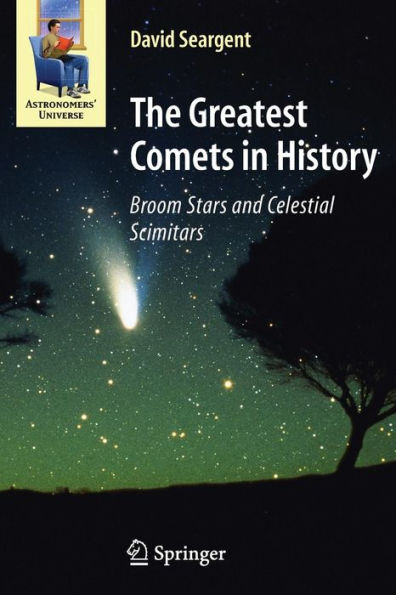
The Greatest Comets in History: Broom Stars and Celestial Scimitars in Chattanooga, TN
Current price: $49.99
Barnes and Noble
The Greatest Comets in History: Broom Stars and Celestial Scimitars in Chattanooga, TN
Current price: $49.99
Loading Inventory...
Size: OS
Naked-eye comets are far from uncommon. As a rough average, one appears every 18 months or thereabouts, and it is not very unusual to see more than two in a single year. The record so far seems to have been 2004, with a total of five comets visible without optical aid. But 2006, 1970, and 1911 were not far behind with a total of four apiece. Yet, the majority of these pass unnoticed by the general public. Most simply look like fuzzy stars with tails that are either faint or below the naked-eye threshold. The ‘classical’ comet – a bright star-like object with a long flowing tail – is a sight that graces our skies about once per decade, on average. These ‘great comets’ are surely among the most beautiful objects that we can see in the heavens, and it is no wonder that they created such fear in earlier times. Just what makes a comet ‘‘great’’ is not easy to define. It is neither just about brightness nor only a matter of size. Some comets can sport prodigiously long tails and yet not be regarded as great. Others can become very bright, but hardly anyone other than a handful of enthusiastic astronomers will ever see them. Much depends on their separation from the Sun, the intensity of the tail, and so forth.
Naked-eye comets are far from uncommon. As a rough average, one appears every 18 months or thereabouts, and it is not very unusual to see more than two in a single year. The record so far seems to have been 2004, with a total of five comets visible without optical aid. But 2006, 1970, and 1911 were not far behind with a total of four apiece. Yet, the majority of these pass unnoticed by the general public. Most simply look like fuzzy stars with tails that are either faint or below the naked-eye threshold. The ‘classical’ comet – a bright star-like object with a long flowing tail – is a sight that graces our skies about once per decade, on average. These ‘great comets’ are surely among the most beautiful objects that we can see in the heavens, and it is no wonder that they created such fear in earlier times. Just what makes a comet ‘‘great’’ is not easy to define. It is neither just about brightness nor only a matter of size. Some comets can sport prodigiously long tails and yet not be regarded as great. Others can become very bright, but hardly anyone other than a handful of enthusiastic astronomers will ever see them. Much depends on their separation from the Sun, the intensity of the tail, and so forth.
You May Also Like
![Greatest Hits [Highlighter Yellow Vinyl] [Barnes & Noble Exclusive]](https://prodimage.images-bn.com/pimages/0715187768406_p0_v3_s600x595.jpg)














More About Barnes and Noble at Hamilton Place
Barnes & Noble is the world’s largest retail bookseller and a leading retailer of content, digital media and educational products. Our Nook Digital business offers a lineup of NOOK® tablets and e-Readers and an expansive collection of digital reading content through the NOOK Store®. Barnes & Noble’s mission is to operate the best omni-channel specialty retail business in America, helping both our customers and booksellers reach their aspirations, while being a credit to the communities we serve.
2100 Hamilton Pl Blvd, Chattanooga, TN 37421, United States
Find Barnes and Noble at Hamilton Place in Chattanooga, TN
Visit Barnes and Noble at Hamilton Place in Chattanooga, TN
