
Home
The German Perfect: its semantic composition and interactions with temporal adverbials
Barnes and Noble
Loading Inventory...
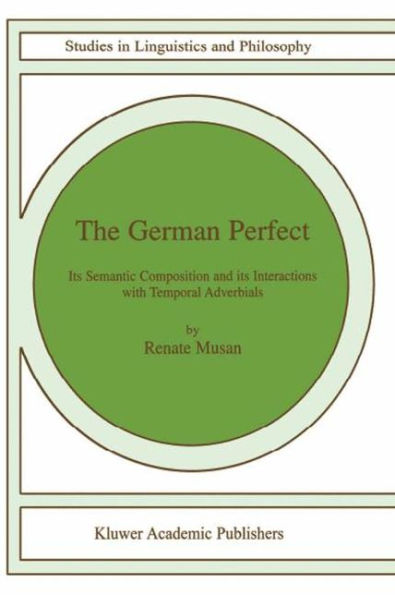
The German Perfect: its semantic composition and interactions with temporal adverbials in Chattanooga, TN
Current price: $109.99
Barnes and Noble
The German Perfect: its semantic composition and interactions with temporal adverbials in Chattanooga, TN
Current price: $109.99
Loading Inventory...
Size: Paperback
1. OUTLINE German has the three main perfect constructions which are illustrated in (1. 1). 1 In each of these constructions, the verb appears in the past participial form and is combined with an auxiliary - in this case, haben ('have'); other verbs form their perfect constructions with the auxiliary sein ('be'). 2 The auxiliary can then be com bined with a tense -Le. the present tense as in (Ua), the past tense as in (b), or the future tense as in (c). 3 (1. 1) a. PRESENT PERFECT: Die Eule hat die Schule verlassen. the owl has the school left b. PAST PERFECT: Die Eule hatte die Schule verlassen. the owl had the school left c. FUTURE PERFECT: Die Eule wird die Schule verlassen haben. the owl will the school left have As will shortly become clear, the present perfect is the most intricate of the perfect constructions in German. It has been investigated intensely in the past, with the result that today there is little doubt about what the core problems concerning its semantics are.
1. OUTLINE German has the three main perfect constructions which are illustrated in (1. 1). 1 In each of these constructions, the verb appears in the past participial form and is combined with an auxiliary - in this case, haben ('have'); other verbs form their perfect constructions with the auxiliary sein ('be'). 2 The auxiliary can then be com bined with a tense -Le. the present tense as in (Ua), the past tense as in (b), or the future tense as in (c). 3 (1. 1) a. PRESENT PERFECT: Die Eule hat die Schule verlassen. the owl has the school left b. PAST PERFECT: Die Eule hatte die Schule verlassen. the owl had the school left c. FUTURE PERFECT: Die Eule wird die Schule verlassen haben. the owl will the school left have As will shortly become clear, the present perfect is the most intricate of the perfect constructions in German. It has been investigated intensely in the past, with the result that today there is little doubt about what the core problems concerning its semantics are.
You May Also Like










More About Barnes and Noble at Hamilton Place
Barnes & Noble is the world’s largest retail bookseller and a leading retailer of content, digital media and educational products. Our Nook Digital business offers a lineup of NOOK® tablets and e-Readers and an expansive collection of digital reading content through the NOOK Store®. Barnes & Noble’s mission is to operate the best omni-channel specialty retail business in America, helping both our customers and booksellers reach their aspirations, while being a credit to the communities we serve.
2100 Hamilton Pl Blvd, Chattanooga, TN 37421, United States
Find Barnes and Noble at Hamilton Place in Chattanooga, TN
Visit Barnes and Noble at Hamilton Place in Chattanooga, TN
