
Home
The Forgotten Revolution: How Science Was Born 300 BC and Why it Had to Be Reborn
Barnes and Noble
Loading Inventory...
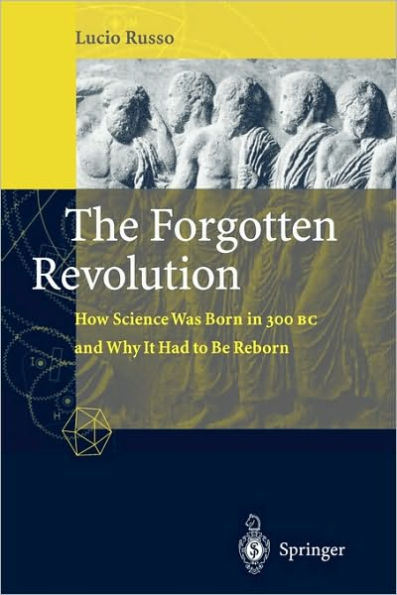
The Forgotten Revolution: How Science Was Born 300 BC and Why it Had to Be Reborn in Chattanooga, TN
Current price: $169.00
Barnes and Noble
The Forgotten Revolution: How Science Was Born 300 BC and Why it Had to Be Reborn in Chattanooga, TN
Current price: $169.00
Loading Inventory...
Size: Hardcover
The period from the late fourth to the late second century B. C. witnessed, in Greek-speaking countries, an explosion of objective knowledge about the external world. WhileGreek culture had reached great heights in art, literature and philosophyalreadyin the earlier classical era, it is in the so-called Hellenistic period that we see for the first time — anywhere in the world — the appearance of science as we understand it now: not an accumulation of facts or philosophically based speculations, but an or- nized effort to model nature and apply such models, or scientifictheories in a sense we will make precise, to the solution of practical problems and to a growing understanding of nature. We owe this new approach to scientists such as Archimedes, Euclid, Eratosthenes and many others less familiar todaybut no less remarkable. Yet, not long after this golden period, much of this extraordinary dev- opment had been reversed. Rome borrowed what it was capable of from the Greeks and kept it for a little while yet, but created very little science of its own. Europe was soon smothered in theobscurantism and stasis that blocked most avenues of intellectual development for a thousand years — until, as is well known, the rediscovery of ancient culture in its fullness paved the way to the modern age.
The period from the late fourth to the late second century B. C. witnessed, in Greek-speaking countries, an explosion of objective knowledge about the external world. WhileGreek culture had reached great heights in art, literature and philosophyalreadyin the earlier classical era, it is in the so-called Hellenistic period that we see for the first time — anywhere in the world — the appearance of science as we understand it now: not an accumulation of facts or philosophically based speculations, but an or- nized effort to model nature and apply such models, or scientifictheories in a sense we will make precise, to the solution of practical problems and to a growing understanding of nature. We owe this new approach to scientists such as Archimedes, Euclid, Eratosthenes and many others less familiar todaybut no less remarkable. Yet, not long after this golden period, much of this extraordinary dev- opment had been reversed. Rome borrowed what it was capable of from the Greeks and kept it for a little while yet, but created very little science of its own. Europe was soon smothered in theobscurantism and stasis that blocked most avenues of intellectual development for a thousand years — until, as is well known, the rediscovery of ancient culture in its fullness paved the way to the modern age.
You May Also Like

















More About Barnes and Noble at Hamilton Place
Barnes & Noble is the world’s largest retail bookseller and a leading retailer of content, digital media and educational products. Our Nook Digital business offers a lineup of NOOK® tablets and e-Readers and an expansive collection of digital reading content through the NOOK Store®. Barnes & Noble’s mission is to operate the best omni-channel specialty retail business in America, helping both our customers and booksellers reach their aspirations, while being a credit to the communities we serve.
2100 Hamilton Pl Blvd, Chattanooga, TN 37421, United States
Find Barnes and Noble at Hamilton Place in Chattanooga, TN
Visit Barnes and Noble at Hamilton Place in Chattanooga, TN
