
Home
The Failure of the Criminal Procedure Revolution
Barnes and Noble
Loading Inventory...
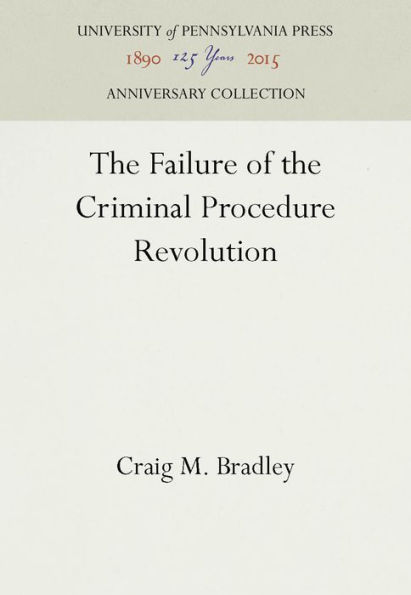
The Failure of the Criminal Procedure Revolution in Chattanooga, TN
Current price: $84.95
Barnes and Noble
The Failure of the Criminal Procedure Revolution in Chattanooga, TN
Current price: $84.95
Loading Inventory...
Size: OS
In a series of landmark decisions in the early 1960s, the United States Supreme Court revolutionized police procedures by imposing stricter requirements, such as search warrants, Miranda warnings, and the exclusion of improperly obtained evidence from trial. Today, these innovations remain largely intact and form the basis of current American criminal procedure law, even in the face of considerable criticism and an increasing conservative domination of the Court. But despite the survival of the Warren Court doctrine, everyone involved in the system--police, prosecutors, crime victims, academic commentators, and judges, including the Supreme Court Justices themselves—regard the current body of Supreme Court law in this area as a failure.
In
The Failure of the Criminal Procedure Revolution
, Craig M. Bradley persuasively argues that no shift in ideology, no commitment of resources, and no refinement of Supreme Court jurisprudence would resolve the inadequacies of the current system. These problems arose from a constitutional system that has allowed the United States to develop its rules of criminal procedure on a piecemeal, case-by-case basis, rather than through a unified code of criminal procedure, as other countries have done. Only the United States expects its police to follow a set of rules so cumbersome, and so complex, that one area of criminal procedure alone—search and seizure—requires a four-volume treatise to explicate.
Bradley proposes that the United States should, in keeping with the international trend, regulate police procedures through a comprehensive and nationally applicable code. He examines why the present system is a failure and how other countries have developed their criminal procedure law. He further argues that a national code would be constitutional and outlines what its features should be, how it would function, and what alternative approaches are possible and practicable.
is a groundbreaking effort to advocate systematic and essential reform in America's court system. It will be of compelling interest to students and scholars in law, political science, and criminology.
In
The Failure of the Criminal Procedure Revolution
, Craig M. Bradley persuasively argues that no shift in ideology, no commitment of resources, and no refinement of Supreme Court jurisprudence would resolve the inadequacies of the current system. These problems arose from a constitutional system that has allowed the United States to develop its rules of criminal procedure on a piecemeal, case-by-case basis, rather than through a unified code of criminal procedure, as other countries have done. Only the United States expects its police to follow a set of rules so cumbersome, and so complex, that one area of criminal procedure alone—search and seizure—requires a four-volume treatise to explicate.
Bradley proposes that the United States should, in keeping with the international trend, regulate police procedures through a comprehensive and nationally applicable code. He examines why the present system is a failure and how other countries have developed their criminal procedure law. He further argues that a national code would be constitutional and outlines what its features should be, how it would function, and what alternative approaches are possible and practicable.
is a groundbreaking effort to advocate systematic and essential reform in America's court system. It will be of compelling interest to students and scholars in law, political science, and criminology.
In a series of landmark decisions in the early 1960s, the United States Supreme Court revolutionized police procedures by imposing stricter requirements, such as search warrants, Miranda warnings, and the exclusion of improperly obtained evidence from trial. Today, these innovations remain largely intact and form the basis of current American criminal procedure law, even in the face of considerable criticism and an increasing conservative domination of the Court. But despite the survival of the Warren Court doctrine, everyone involved in the system--police, prosecutors, crime victims, academic commentators, and judges, including the Supreme Court Justices themselves—regard the current body of Supreme Court law in this area as a failure.
In
The Failure of the Criminal Procedure Revolution
, Craig M. Bradley persuasively argues that no shift in ideology, no commitment of resources, and no refinement of Supreme Court jurisprudence would resolve the inadequacies of the current system. These problems arose from a constitutional system that has allowed the United States to develop its rules of criminal procedure on a piecemeal, case-by-case basis, rather than through a unified code of criminal procedure, as other countries have done. Only the United States expects its police to follow a set of rules so cumbersome, and so complex, that one area of criminal procedure alone—search and seizure—requires a four-volume treatise to explicate.
Bradley proposes that the United States should, in keeping with the international trend, regulate police procedures through a comprehensive and nationally applicable code. He examines why the present system is a failure and how other countries have developed their criminal procedure law. He further argues that a national code would be constitutional and outlines what its features should be, how it would function, and what alternative approaches are possible and practicable.
is a groundbreaking effort to advocate systematic and essential reform in America's court system. It will be of compelling interest to students and scholars in law, political science, and criminology.
In
The Failure of the Criminal Procedure Revolution
, Craig M. Bradley persuasively argues that no shift in ideology, no commitment of resources, and no refinement of Supreme Court jurisprudence would resolve the inadequacies of the current system. These problems arose from a constitutional system that has allowed the United States to develop its rules of criminal procedure on a piecemeal, case-by-case basis, rather than through a unified code of criminal procedure, as other countries have done. Only the United States expects its police to follow a set of rules so cumbersome, and so complex, that one area of criminal procedure alone—search and seizure—requires a four-volume treatise to explicate.
Bradley proposes that the United States should, in keeping with the international trend, regulate police procedures through a comprehensive and nationally applicable code. He examines why the present system is a failure and how other countries have developed their criminal procedure law. He further argues that a national code would be constitutional and outlines what its features should be, how it would function, and what alternative approaches are possible and practicable.
is a groundbreaking effort to advocate systematic and essential reform in America's court system. It will be of compelling interest to students and scholars in law, political science, and criminology.
You May Also Like








More About Barnes and Noble at Hamilton Place
Barnes & Noble is the world’s largest retail bookseller and a leading retailer of content, digital media and educational products. Our Nook Digital business offers a lineup of NOOK® tablets and e-Readers and an expansive collection of digital reading content through the NOOK Store®. Barnes & Noble’s mission is to operate the best omni-channel specialty retail business in America, helping both our customers and booksellers reach their aspirations, while being a credit to the communities we serve.
2100 Hamilton Pl Blvd, Chattanooga, TN 37421, United States
Find Barnes and Noble at Hamilton Place in Chattanooga, TN
Visit Barnes and Noble at Hamilton Place in Chattanooga, TN
