
Home
TEACHING KIDS ABOUT APOSTROPHE "S" IN POSSESSIVES
Barnes and Noble
Loading Inventory...
TEACHING KIDS ABOUT APOSTROPHE "S" IN POSSESSIVES in Chattanooga, TN
Current price: $14.99
Barnes and Noble
TEACHING KIDS ABOUT APOSTROPHE "S" IN POSSESSIVES in Chattanooga, TN
Current price: $14.99
Loading Inventory...
Size: OS
TEACHING KIDS ABOUT APOSTROPHE "S" IN POSSESSIVES
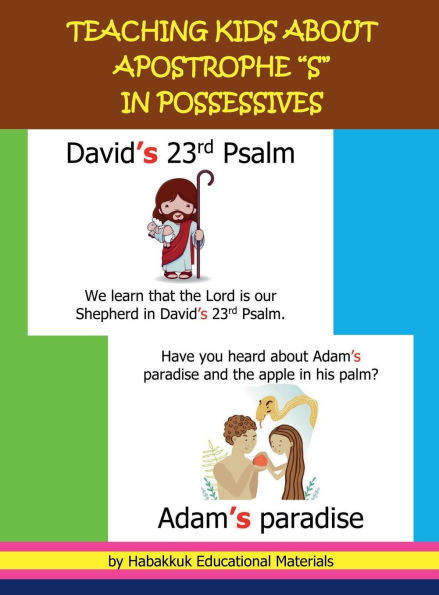
helps students to learn that an apostrophe
s
is added to nouns and to some pronouns to show ownership. The book begins with a chart that summarizes how to form the possessive of singular nouns, of singular nouns that end with
, and of plurals that end with -
and -
es
.
After reviewing the chart at the beginning of the book, the teacher reads the words at the top and bottom of a page, leaving out the apostrophe
sound. Instead of saying "Aaron's bowl," for example, the teacher would say "Aaron bowl." (Students will likely note that it doesn't sound right without the apostrophe
sound.) Children then repeat the same words with the apostrophe
added—"Aaron's bowl." The apostrophe
shows that the bowl belongs to Aaron. Under the illustration, there is a sentence where the name with the apostrophe
is used in context. While this is not a storybook, the sentences on a page do relate and even rhyme. A few pages are educational in other ways besides teaching about apostrophe
. For instance, one page lists the order of the colors of a rainbow and includes the acronym for memorizing them. At the end of the book, you will find several reproducible worksheets that can be used for individual practice.
This book is a part of the Habakkuk Educational Materials Reading Program, designed to teach primary grade students how to read. As such, the purpose of this resource is not only to teach children about possessives but also to help them learn to recognize various names and words they will encounter in other reading materials in this program, namely
Bible History for Children and Youth (Text and Study Guide)
,
Old Testament Textbook and Study Guides for Students
, and
New Testament Textbook and Study Guides for Students
To contact Habakkuk Educational Materials, please visit the business website.
helps students to learn that an apostrophe
s
is added to nouns and to some pronouns to show ownership. The book begins with a chart that summarizes how to form the possessive of singular nouns, of singular nouns that end with
, and of plurals that end with -
and -
es
.
After reviewing the chart at the beginning of the book, the teacher reads the words at the top and bottom of a page, leaving out the apostrophe
sound. Instead of saying "Aaron's bowl," for example, the teacher would say "Aaron bowl." (Students will likely note that it doesn't sound right without the apostrophe
sound.) Children then repeat the same words with the apostrophe
added—"Aaron's bowl." The apostrophe
shows that the bowl belongs to Aaron. Under the illustration, there is a sentence where the name with the apostrophe
is used in context. While this is not a storybook, the sentences on a page do relate and even rhyme. A few pages are educational in other ways besides teaching about apostrophe
. For instance, one page lists the order of the colors of a rainbow and includes the acronym for memorizing them. At the end of the book, you will find several reproducible worksheets that can be used for individual practice.
This book is a part of the Habakkuk Educational Materials Reading Program, designed to teach primary grade students how to read. As such, the purpose of this resource is not only to teach children about possessives but also to help them learn to recognize various names and words they will encounter in other reading materials in this program, namely
Bible History for Children and Youth (Text and Study Guide)
,
Old Testament Textbook and Study Guides for Students
, and
New Testament Textbook and Study Guides for Students
To contact Habakkuk Educational Materials, please visit the business website.
TEACHING KIDS ABOUT APOSTROPHE "S" IN POSSESSIVES
helps students to learn that an apostrophe
s
is added to nouns and to some pronouns to show ownership. The book begins with a chart that summarizes how to form the possessive of singular nouns, of singular nouns that end with
, and of plurals that end with -
and -
es
.
After reviewing the chart at the beginning of the book, the teacher reads the words at the top and bottom of a page, leaving out the apostrophe
sound. Instead of saying "Aaron's bowl," for example, the teacher would say "Aaron bowl." (Students will likely note that it doesn't sound right without the apostrophe
sound.) Children then repeat the same words with the apostrophe
added—"Aaron's bowl." The apostrophe
shows that the bowl belongs to Aaron. Under the illustration, there is a sentence where the name with the apostrophe
is used in context. While this is not a storybook, the sentences on a page do relate and even rhyme. A few pages are educational in other ways besides teaching about apostrophe
. For instance, one page lists the order of the colors of a rainbow and includes the acronym for memorizing them. At the end of the book, you will find several reproducible worksheets that can be used for individual practice.
This book is a part of the Habakkuk Educational Materials Reading Program, designed to teach primary grade students how to read. As such, the purpose of this resource is not only to teach children about possessives but also to help them learn to recognize various names and words they will encounter in other reading materials in this program, namely
Bible History for Children and Youth (Text and Study Guide)
,
Old Testament Textbook and Study Guides for Students
, and
New Testament Textbook and Study Guides for Students
To contact Habakkuk Educational Materials, please visit the business website.
helps students to learn that an apostrophe
s
is added to nouns and to some pronouns to show ownership. The book begins with a chart that summarizes how to form the possessive of singular nouns, of singular nouns that end with
, and of plurals that end with -
and -
es
.
After reviewing the chart at the beginning of the book, the teacher reads the words at the top and bottom of a page, leaving out the apostrophe
sound. Instead of saying "Aaron's bowl," for example, the teacher would say "Aaron bowl." (Students will likely note that it doesn't sound right without the apostrophe
sound.) Children then repeat the same words with the apostrophe
added—"Aaron's bowl." The apostrophe
shows that the bowl belongs to Aaron. Under the illustration, there is a sentence where the name with the apostrophe
is used in context. While this is not a storybook, the sentences on a page do relate and even rhyme. A few pages are educational in other ways besides teaching about apostrophe
. For instance, one page lists the order of the colors of a rainbow and includes the acronym for memorizing them. At the end of the book, you will find several reproducible worksheets that can be used for individual practice.
This book is a part of the Habakkuk Educational Materials Reading Program, designed to teach primary grade students how to read. As such, the purpose of this resource is not only to teach children about possessives but also to help them learn to recognize various names and words they will encounter in other reading materials in this program, namely
Bible History for Children and Youth (Text and Study Guide)
,
Old Testament Textbook and Study Guides for Students
, and
New Testament Textbook and Study Guides for Students
To contact Habakkuk Educational Materials, please visit the business website.
You May Also Like
![About A Woman [Black Ice Vinyl] [Barnes & Noble Exclusive]](https://prodimage.images-bn.com/pimages/0843930112449_p0_v1_s600x595.jpg)








More About Barnes and Noble at Hamilton Place
Barnes & Noble is the world’s largest retail bookseller and a leading retailer of content, digital media and educational products. Our Nook Digital business offers a lineup of NOOK® tablets and e-Readers and an expansive collection of digital reading content through the NOOK Store®. Barnes & Noble’s mission is to operate the best omni-channel specialty retail business in America, helping both our customers and booksellers reach their aspirations, while being a credit to the communities we serve.
2100 Hamilton Pl Blvd, Chattanooga, TN 37421, United States
Find Barnes and Noble at Hamilton Place in Chattanooga, TN
Visit Barnes and Noble at Hamilton Place in Chattanooga, TN
