
Home
Six Ethics: A Rights-Based Approach to Establishing an Objective Common Morality
Barnes and Noble
Loading Inventory...
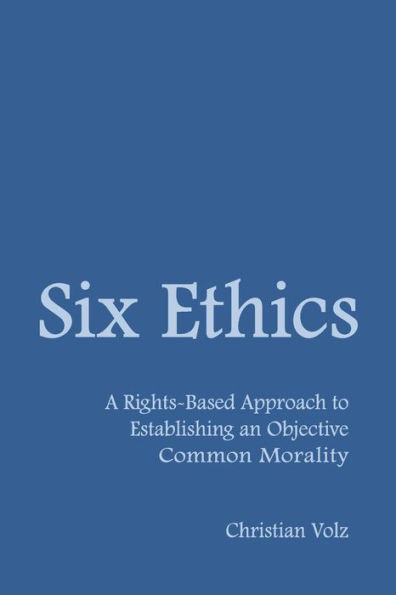
Six Ethics: A Rights-Based Approach to Establishing an Objective Common Morality in Chattanooga, TN
Current price: $24.95
Barnes and Noble
Six Ethics: A Rights-Based Approach to Establishing an Objective Common Morality in Chattanooga, TN
Current price: $24.95
Loading Inventory...
Size: Paperback
New Book Addresses Crippling Nature of Irrational Belief in the 21st Century Christian Volz's Six Ethics takes both a philosophical and a pragmatic approach to addressing the dangers posed by irrational belief, and proposes a framework for creating a legal and social environment where rationality and spirituality might be reconciled. In the 21st century, as international business continues to expand and the Internet and other means of global communications, as well as immigration, continue to bring people from different cultures and groups into contact, individuals need to be prepared to live side-by-side with others who have very different belief systems as well as be self-aware of the sources and principles of their own beliefs. Six Ethics: A Rights-Based Approach to Establishing an Objective Common Morality is the result of author Christian Volz's quest to understand the nature of belief and the relationship of beliefs and ethics in the face of 21st century issues. Volz explains that the late nineteenth century intellectual revolution known as modernism is characterized by the maturing of the concepts of human rights, civil liberties, personal freedoms and, most especially, the constituents of essential human dignity. This new, modern approach has defined these concepts based on science and the cumulative history of human ethics guided by reason and compassion, and has largely enshrined them in the U.N. Universal Declaration of Human Rights. "I believe," Volz says, "that there is a dangerous underestimation of the peril posed to the world's democratic societies and institutions by religious radicals and fundamentalists, of all stripes, who believe that they retain the moral authority to selectively edit these evolved concepts of human rights and dignity. Many conservative people of faith continue to reject science and reason as the basis whereby we measure, evaluate, and make decisions about the material world and the temporal relations among human beings, with potentially disastrous consequences for the future of our planet. If we are to effectively counter these religious, authoritarian-conservative movements, it is helpful to understand how we got to where we are." Citing numerous contemporary and historical sources--from Christopher Hitchens and Richard Dawkins to John Locke and Alexis de Tocqueville--Six Ethics addresses a broad range of topics, interrelated by their essential relationship to human dignity and rights. These include: the origins and development of ethical, religious and scientific thought; how otherwise rational people can be so easily seduced to embrace irrational beliefs and the societal consequences when they do so; and why anyone believes anything. In doing so, he touches on many fields of study, including a consideration of genetic, psychological, sociological and political influences upon how people think within the context of a group. Six Ethics proposes what Volz refers to as Rational Progressivism as a framework within which societies might advance toward genuine equality and true freedom of conscience for a diverse population.
New Book Addresses Crippling Nature of Irrational Belief in the 21st Century Christian Volz's Six Ethics takes both a philosophical and a pragmatic approach to addressing the dangers posed by irrational belief, and proposes a framework for creating a legal and social environment where rationality and spirituality might be reconciled. In the 21st century, as international business continues to expand and the Internet and other means of global communications, as well as immigration, continue to bring people from different cultures and groups into contact, individuals need to be prepared to live side-by-side with others who have very different belief systems as well as be self-aware of the sources and principles of their own beliefs. Six Ethics: A Rights-Based Approach to Establishing an Objective Common Morality is the result of author Christian Volz's quest to understand the nature of belief and the relationship of beliefs and ethics in the face of 21st century issues. Volz explains that the late nineteenth century intellectual revolution known as modernism is characterized by the maturing of the concepts of human rights, civil liberties, personal freedoms and, most especially, the constituents of essential human dignity. This new, modern approach has defined these concepts based on science and the cumulative history of human ethics guided by reason and compassion, and has largely enshrined them in the U.N. Universal Declaration of Human Rights. "I believe," Volz says, "that there is a dangerous underestimation of the peril posed to the world's democratic societies and institutions by religious radicals and fundamentalists, of all stripes, who believe that they retain the moral authority to selectively edit these evolved concepts of human rights and dignity. Many conservative people of faith continue to reject science and reason as the basis whereby we measure, evaluate, and make decisions about the material world and the temporal relations among human beings, with potentially disastrous consequences for the future of our planet. If we are to effectively counter these religious, authoritarian-conservative movements, it is helpful to understand how we got to where we are." Citing numerous contemporary and historical sources--from Christopher Hitchens and Richard Dawkins to John Locke and Alexis de Tocqueville--Six Ethics addresses a broad range of topics, interrelated by their essential relationship to human dignity and rights. These include: the origins and development of ethical, religious and scientific thought; how otherwise rational people can be so easily seduced to embrace irrational beliefs and the societal consequences when they do so; and why anyone believes anything. In doing so, he touches on many fields of study, including a consideration of genetic, psychological, sociological and political influences upon how people think within the context of a group. Six Ethics proposes what Volz refers to as Rational Progressivism as a framework within which societies might advance toward genuine equality and true freedom of conscience for a diverse population.
You May Also Like














More About Barnes and Noble at Hamilton Place
Barnes & Noble is the world’s largest retail bookseller and a leading retailer of content, digital media and educational products. Our Nook Digital business offers a lineup of NOOK® tablets and e-Readers and an expansive collection of digital reading content through the NOOK Store®. Barnes & Noble’s mission is to operate the best omni-channel specialty retail business in America, helping both our customers and booksellers reach their aspirations, while being a credit to the communities we serve.
2100 Hamilton Pl Blvd, Chattanooga, TN 37421, United States
Find Barnes and Noble at Hamilton Place in Chattanooga, TN
Visit Barnes and Noble at Hamilton Place in Chattanooga, TN
