
Home
Seattle's Streetcar Era: An Illustrated History, 1884-1941
Barnes and Noble
Loading Inventory...
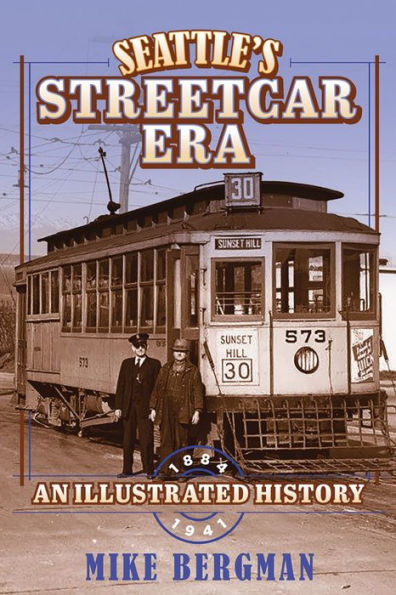
Seattle's Streetcar Era: An Illustrated History, 1884-1941 in Chattanooga, TN
Current price: $40.00
Barnes and Noble
Seattle's Streetcar Era: An Illustrated History, 1884-1941 in Chattanooga, TN
Current price: $40.00
Loading Inventory...
Size: OS
Seattle's population was growing rapidly during the 1880s, but steep hills and shorelines impeded residential development, pushing expansion northward and creating a long, narrow corridor ideal for a public transportation route. Frank Osgood arrived from Boston in 1883, recognized the potential, and opened Seattle's first street railway the following year, operating from Pioneer Square north on Second Avenue to Pike Street. The tiny streetcars were pulled by horses.
Motivated by potential increases in real estate values, by 1896 thirteen private companies ran streetcar lines in the Emerald City. Horse-drawn streetcars were gone, replaced by electric trolleys and cable cars. But many of the lines were cheaply built or spaced too close together, and small, independent companies lacked economies of scale. Consolidation began, and the Seattle Electric Company acquired almost all of the independent street railways. The firm started a massive improvement and expansion program, and by 1910, ridership totaled 103 million annual passengersa number equivalent to every Seattleite boarding a streetcar 435 times that year.
Following voter approval, Seattle became one of the country's first large cities with a publicly owned transit system. The new Seattle Municipal Street Railway took over operations in April 1919, initially adding new bus routes and extending some existing streetcar lines. But a huge debt load, declining ridership, and the Great Depression caused severe financial troubles and maintenance issues. By 1938, Seattle and San Francisco were the nation's only cities still operating cable cars. Over the next three years, Seattle converted its entire transit system to trolley coaches and motor buses.
Utilizing narrative, maps, and many previously unpublished photographs, author Mike Bergman offers a detailed jaunt through Seattle's fascinating streetcar era.
Motivated by potential increases in real estate values, by 1896 thirteen private companies ran streetcar lines in the Emerald City. Horse-drawn streetcars were gone, replaced by electric trolleys and cable cars. But many of the lines were cheaply built or spaced too close together, and small, independent companies lacked economies of scale. Consolidation began, and the Seattle Electric Company acquired almost all of the independent street railways. The firm started a massive improvement and expansion program, and by 1910, ridership totaled 103 million annual passengersa number equivalent to every Seattleite boarding a streetcar 435 times that year.
Following voter approval, Seattle became one of the country's first large cities with a publicly owned transit system. The new Seattle Municipal Street Railway took over operations in April 1919, initially adding new bus routes and extending some existing streetcar lines. But a huge debt load, declining ridership, and the Great Depression caused severe financial troubles and maintenance issues. By 1938, Seattle and San Francisco were the nation's only cities still operating cable cars. Over the next three years, Seattle converted its entire transit system to trolley coaches and motor buses.
Utilizing narrative, maps, and many previously unpublished photographs, author Mike Bergman offers a detailed jaunt through Seattle's fascinating streetcar era.
Seattle's population was growing rapidly during the 1880s, but steep hills and shorelines impeded residential development, pushing expansion northward and creating a long, narrow corridor ideal for a public transportation route. Frank Osgood arrived from Boston in 1883, recognized the potential, and opened Seattle's first street railway the following year, operating from Pioneer Square north on Second Avenue to Pike Street. The tiny streetcars were pulled by horses.
Motivated by potential increases in real estate values, by 1896 thirteen private companies ran streetcar lines in the Emerald City. Horse-drawn streetcars were gone, replaced by electric trolleys and cable cars. But many of the lines were cheaply built or spaced too close together, and small, independent companies lacked economies of scale. Consolidation began, and the Seattle Electric Company acquired almost all of the independent street railways. The firm started a massive improvement and expansion program, and by 1910, ridership totaled 103 million annual passengersa number equivalent to every Seattleite boarding a streetcar 435 times that year.
Following voter approval, Seattle became one of the country's first large cities with a publicly owned transit system. The new Seattle Municipal Street Railway took over operations in April 1919, initially adding new bus routes and extending some existing streetcar lines. But a huge debt load, declining ridership, and the Great Depression caused severe financial troubles and maintenance issues. By 1938, Seattle and San Francisco were the nation's only cities still operating cable cars. Over the next three years, Seattle converted its entire transit system to trolley coaches and motor buses.
Utilizing narrative, maps, and many previously unpublished photographs, author Mike Bergman offers a detailed jaunt through Seattle's fascinating streetcar era.
Motivated by potential increases in real estate values, by 1896 thirteen private companies ran streetcar lines in the Emerald City. Horse-drawn streetcars were gone, replaced by electric trolleys and cable cars. But many of the lines were cheaply built or spaced too close together, and small, independent companies lacked economies of scale. Consolidation began, and the Seattle Electric Company acquired almost all of the independent street railways. The firm started a massive improvement and expansion program, and by 1910, ridership totaled 103 million annual passengersa number equivalent to every Seattleite boarding a streetcar 435 times that year.
Following voter approval, Seattle became one of the country's first large cities with a publicly owned transit system. The new Seattle Municipal Street Railway took over operations in April 1919, initially adding new bus routes and extending some existing streetcar lines. But a huge debt load, declining ridership, and the Great Depression caused severe financial troubles and maintenance issues. By 1938, Seattle and San Francisco were the nation's only cities still operating cable cars. Over the next three years, Seattle converted its entire transit system to trolley coaches and motor buses.
Utilizing narrative, maps, and many previously unpublished photographs, author Mike Bergman offers a detailed jaunt through Seattle's fascinating streetcar era.
You May Also Like










More About Barnes and Noble at Hamilton Place
Barnes & Noble is the world’s largest retail bookseller and a leading retailer of content, digital media and educational products. Our Nook Digital business offers a lineup of NOOK® tablets and e-Readers and an expansive collection of digital reading content through the NOOK Store®. Barnes & Noble’s mission is to operate the best omni-channel specialty retail business in America, helping both our customers and booksellers reach their aspirations, while being a credit to the communities we serve.
2100 Hamilton Pl Blvd, Chattanooga, TN 37421, United States
Find Barnes and Noble at Hamilton Place in Chattanooga, TN
Visit Barnes and Noble at Hamilton Place in Chattanooga, TN
