
Home
Review of Mental Health and Psychiatry for Nurses, Therapists, Counselors and other Mental Healthcare Professionals: (with 900 Practice Questions and their Rationale)
Barnes and Noble
Loading Inventory...
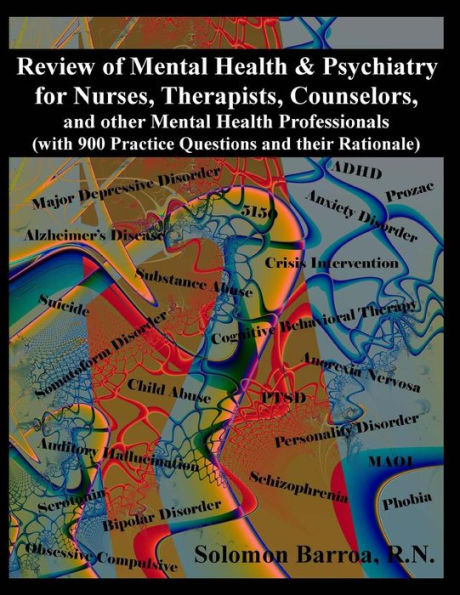
Review of Mental Health and Psychiatry for Nurses, Therapists, Counselors and other Mental Healthcare Professionals: (with 900 Practice Questions and their Rationale) in Chattanooga, TN
Current price: $140.99
Barnes and Noble
Review of Mental Health and Psychiatry for Nurses, Therapists, Counselors and other Mental Healthcare Professionals: (with 900 Practice Questions and their Rationale) in Chattanooga, TN
Current price: $140.99
Loading Inventory...
Size: OS
Mental disorders primarily occur due to overwhelming anxiety and stressful situations. Understanding the causation is never clear cut as different factors interplay in its development. Diagnostic methods have evolved and been utilized with the conceptualization, classification, and naming of different mental disorders. These methods and testing techniques are essential in forming diagnoses and possible treatment plans. The treatment for a specific mental disorder is often the combination of therapy and psychopharmacology. Therapy, like psychopharmacology, has evolved introducing more structured and systemic method for resolving mental disorders. Psychotropic medication alone is complex with further study continually being required as yet newer generations of drugs are introduced by the ever expanding pharmaceutical industry.
This book contains information on a topic-by-topic and chapter-by-chapter basis. The practice questions at the end of the book are presented for the readers with rationales broadly and explicitly covering mental health, behavioral science, and psychiatry. Topics presented in the chapters of the book include psychotropic medication, coping mechanisms, crisis intervention, neuropsychiatry, theories of growth and development, childhood and developmental disorders, anxiety disorders, affective disorders, cognitive disorders, mood disorders, personality disorders, eating disorders, substance abuse disorders, schizophrenia, sexual disorders, somatoform disorders, dissociative disorders, abuse, psychotherapy, therapeutic techniques of communication, legal and ethical issues, and other important topics.
Sample questions from the comprehensive test section of the book:
1. A female client with conversion disorder is attending therapy for the first time. She complained of right eye blindness. In developing a treatment plan for this client, which of the following should be considered? (a. permanent right eye blindness will occur unconsciously to the client if more stress is added b. the client lacks will power to resolve symptoms c. it is best to ignore the client's complaints d. the client's right eye blindness is an evidence of disturbed personality)
2. The mental health professional is assessing clients with somatoform disorders and psychophysiologic disorders. The clients have been cooperative with their treatment plans. Which of the following best differentiates psychophysiologic disorders from somatoform disorders? (a. actual tissue changes b. restriction of client's ability to perform activities c. the emotional cause d. the feeling of being ill or sick)
3. A client is at risk for alcohol withdrawal syndrome. She has been attempting to remain sober but has relapsed every year. The signs of alcohol withdrawal will be evident within which of the following time periods? (a. after 72 hours b. after 7 hours c. after 7 days d. after 2 to 3 weeks)
This book contains information on a topic-by-topic and chapter-by-chapter basis. The practice questions at the end of the book are presented for the readers with rationales broadly and explicitly covering mental health, behavioral science, and psychiatry. Topics presented in the chapters of the book include psychotropic medication, coping mechanisms, crisis intervention, neuropsychiatry, theories of growth and development, childhood and developmental disorders, anxiety disorders, affective disorders, cognitive disorders, mood disorders, personality disorders, eating disorders, substance abuse disorders, schizophrenia, sexual disorders, somatoform disorders, dissociative disorders, abuse, psychotherapy, therapeutic techniques of communication, legal and ethical issues, and other important topics.
Sample questions from the comprehensive test section of the book:
1. A female client with conversion disorder is attending therapy for the first time. She complained of right eye blindness. In developing a treatment plan for this client, which of the following should be considered? (a. permanent right eye blindness will occur unconsciously to the client if more stress is added b. the client lacks will power to resolve symptoms c. it is best to ignore the client's complaints d. the client's right eye blindness is an evidence of disturbed personality)
2. The mental health professional is assessing clients with somatoform disorders and psychophysiologic disorders. The clients have been cooperative with their treatment plans. Which of the following best differentiates psychophysiologic disorders from somatoform disorders? (a. actual tissue changes b. restriction of client's ability to perform activities c. the emotional cause d. the feeling of being ill or sick)
3. A client is at risk for alcohol withdrawal syndrome. She has been attempting to remain sober but has relapsed every year. The signs of alcohol withdrawal will be evident within which of the following time periods? (a. after 72 hours b. after 7 hours c. after 7 days d. after 2 to 3 weeks)
Mental disorders primarily occur due to overwhelming anxiety and stressful situations. Understanding the causation is never clear cut as different factors interplay in its development. Diagnostic methods have evolved and been utilized with the conceptualization, classification, and naming of different mental disorders. These methods and testing techniques are essential in forming diagnoses and possible treatment plans. The treatment for a specific mental disorder is often the combination of therapy and psychopharmacology. Therapy, like psychopharmacology, has evolved introducing more structured and systemic method for resolving mental disorders. Psychotropic medication alone is complex with further study continually being required as yet newer generations of drugs are introduced by the ever expanding pharmaceutical industry.
This book contains information on a topic-by-topic and chapter-by-chapter basis. The practice questions at the end of the book are presented for the readers with rationales broadly and explicitly covering mental health, behavioral science, and psychiatry. Topics presented in the chapters of the book include psychotropic medication, coping mechanisms, crisis intervention, neuropsychiatry, theories of growth and development, childhood and developmental disorders, anxiety disorders, affective disorders, cognitive disorders, mood disorders, personality disorders, eating disorders, substance abuse disorders, schizophrenia, sexual disorders, somatoform disorders, dissociative disorders, abuse, psychotherapy, therapeutic techniques of communication, legal and ethical issues, and other important topics.
Sample questions from the comprehensive test section of the book:
1. A female client with conversion disorder is attending therapy for the first time. She complained of right eye blindness. In developing a treatment plan for this client, which of the following should be considered? (a. permanent right eye blindness will occur unconsciously to the client if more stress is added b. the client lacks will power to resolve symptoms c. it is best to ignore the client's complaints d. the client's right eye blindness is an evidence of disturbed personality)
2. The mental health professional is assessing clients with somatoform disorders and psychophysiologic disorders. The clients have been cooperative with their treatment plans. Which of the following best differentiates psychophysiologic disorders from somatoform disorders? (a. actual tissue changes b. restriction of client's ability to perform activities c. the emotional cause d. the feeling of being ill or sick)
3. A client is at risk for alcohol withdrawal syndrome. She has been attempting to remain sober but has relapsed every year. The signs of alcohol withdrawal will be evident within which of the following time periods? (a. after 72 hours b. after 7 hours c. after 7 days d. after 2 to 3 weeks)
This book contains information on a topic-by-topic and chapter-by-chapter basis. The practice questions at the end of the book are presented for the readers with rationales broadly and explicitly covering mental health, behavioral science, and psychiatry. Topics presented in the chapters of the book include psychotropic medication, coping mechanisms, crisis intervention, neuropsychiatry, theories of growth and development, childhood and developmental disorders, anxiety disorders, affective disorders, cognitive disorders, mood disorders, personality disorders, eating disorders, substance abuse disorders, schizophrenia, sexual disorders, somatoform disorders, dissociative disorders, abuse, psychotherapy, therapeutic techniques of communication, legal and ethical issues, and other important topics.
Sample questions from the comprehensive test section of the book:
1. A female client with conversion disorder is attending therapy for the first time. She complained of right eye blindness. In developing a treatment plan for this client, which of the following should be considered? (a. permanent right eye blindness will occur unconsciously to the client if more stress is added b. the client lacks will power to resolve symptoms c. it is best to ignore the client's complaints d. the client's right eye blindness is an evidence of disturbed personality)
2. The mental health professional is assessing clients with somatoform disorders and psychophysiologic disorders. The clients have been cooperative with their treatment plans. Which of the following best differentiates psychophysiologic disorders from somatoform disorders? (a. actual tissue changes b. restriction of client's ability to perform activities c. the emotional cause d. the feeling of being ill or sick)
3. A client is at risk for alcohol withdrawal syndrome. She has been attempting to remain sober but has relapsed every year. The signs of alcohol withdrawal will be evident within which of the following time periods? (a. after 72 hours b. after 7 hours c. after 7 days d. after 2 to 3 weeks)
You May Also Like







![Psychiatric Mental Health Nurse Practitioner Exam Secrets Study Guide - Pmhnp Certification Review 2025-2026 with Practice Test Questions: [3rd Edition]](https://prodimage.images-bn.com/pimages/9781516727810_p0_v2_s600x595.jpg)








More About Barnes and Noble at Hamilton Place
Barnes & Noble is the world’s largest retail bookseller and a leading retailer of content, digital media and educational products. Our Nook Digital business offers a lineup of NOOK® tablets and e-Readers and an expansive collection of digital reading content through the NOOK Store®. Barnes & Noble’s mission is to operate the best omni-channel specialty retail business in America, helping both our customers and booksellers reach their aspirations, while being a credit to the communities we serve.
2100 Hamilton Pl Blvd, Chattanooga, TN 37421, United States
Find Barnes and Noble at Hamilton Place in Chattanooga, TN
Visit Barnes and Noble at Hamilton Place in Chattanooga, TN