
Home
Reserve Component Contribution to Imagery Intelligence
Barnes and Noble
Loading Inventory...
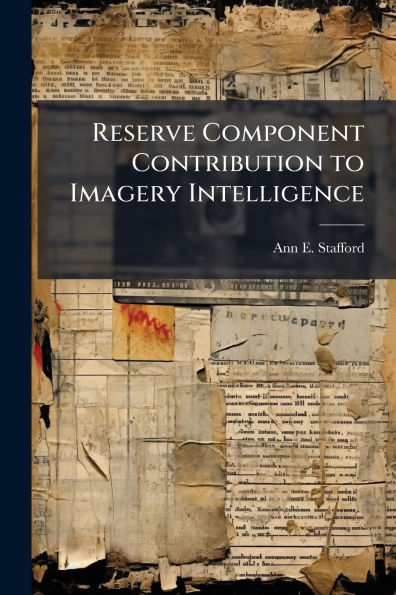
Reserve Component Contribution to Imagery Intelligence in Chattanooga, TN
Current price: $29.95
Barnes and Noble
Reserve Component Contribution to Imagery Intelligence in Chattanooga, TN
Current price: $29.95
Loading Inventory...
Size: Hardcover
In order to determine whether Reserve Component (RC) forces are essential to the task of exploiting imagery intelligence (IMINT) and geospatial information in support of combatant commanders'; operational and strategic intelligence requirements, it is important to examine IMINT within today's geopolitical and technological context. Currently, an identified shortage of imagery analysts (IA) relative to the amount of raw imagery needing exploitation has drawn national-level attention to IMINT. One of six primary intelligence disciplines, IMINT traditionally has accounted for the lion's share of intelligence-derived information since World War II. Largely due to its powerful role as an intelligence discipline, resources directed toward making technological advances in imagery collection capabilities have yielded increases in both volume and quality of imagery data. Because raw imagery has limited value until it has been exploited, the increased volume of raw imagery demands an enhanced ability for combatant commanders and the National Imagery and Mapping Agency (NIMA), the combat support agency responsible for IMINT, to effectively manage imagery exploitation assets in support of combatant commanders'; strategic and operational intelligence requirements. This monograph offers a tool, or model, that the intelligence community may use to determine and implement the most effective operational employment of RC intelligence elements in support of combatant commanders'; strategic and operational intelligence requirements. The model employs concepts from linear programming, which is an asset-optimization tool developed during World War II to satisfy Air Force logistical planning requirements. The model helps categorize imagery exploitation assets and their relative capabilities and most effectively assigns these assets to the task of exploiting vast amounts of available imagery to produce the IMINT, geospatial information and imagery-derived measurement and signatures intell
This work has been selected by scholars as being culturally important, and is part of the knowledge base of civilization as we know it. This work was reproduced from the original artifact, and remains as true to the original work as possible. Therefore, you will see the original copyright references, library stamps (as most of these works have been housed in our most important libraries around the world), and other notations in the work.
This work is in the public domain in the United States of America, and possibly other nations. Within the United States, you may freely copy and distribute this work, as no entity (individual or corporate) has a copyright on the body of the work.
As a reproduction of a historical artifact, this work may contain missing or blurred pages, poor pictures, errant marks, etc. Scholars believe, and we concur, that this work is important enough to be preserved, reproduced, and made generally available to the public. We appreciate your support of the preservation process, and thank you for being an important part of keeping this knowledge alive and relevant.
This work has been selected by scholars as being culturally important, and is part of the knowledge base of civilization as we know it. This work was reproduced from the original artifact, and remains as true to the original work as possible. Therefore, you will see the original copyright references, library stamps (as most of these works have been housed in our most important libraries around the world), and other notations in the work.
This work is in the public domain in the United States of America, and possibly other nations. Within the United States, you may freely copy and distribute this work, as no entity (individual or corporate) has a copyright on the body of the work.
As a reproduction of a historical artifact, this work may contain missing or blurred pages, poor pictures, errant marks, etc. Scholars believe, and we concur, that this work is important enough to be preserved, reproduced, and made generally available to the public. We appreciate your support of the preservation process, and thank you for being an important part of keeping this knowledge alive and relevant.
In order to determine whether Reserve Component (RC) forces are essential to the task of exploiting imagery intelligence (IMINT) and geospatial information in support of combatant commanders'; operational and strategic intelligence requirements, it is important to examine IMINT within today's geopolitical and technological context. Currently, an identified shortage of imagery analysts (IA) relative to the amount of raw imagery needing exploitation has drawn national-level attention to IMINT. One of six primary intelligence disciplines, IMINT traditionally has accounted for the lion's share of intelligence-derived information since World War II. Largely due to its powerful role as an intelligence discipline, resources directed toward making technological advances in imagery collection capabilities have yielded increases in both volume and quality of imagery data. Because raw imagery has limited value until it has been exploited, the increased volume of raw imagery demands an enhanced ability for combatant commanders and the National Imagery and Mapping Agency (NIMA), the combat support agency responsible for IMINT, to effectively manage imagery exploitation assets in support of combatant commanders'; strategic and operational intelligence requirements. This monograph offers a tool, or model, that the intelligence community may use to determine and implement the most effective operational employment of RC intelligence elements in support of combatant commanders'; strategic and operational intelligence requirements. The model employs concepts from linear programming, which is an asset-optimization tool developed during World War II to satisfy Air Force logistical planning requirements. The model helps categorize imagery exploitation assets and their relative capabilities and most effectively assigns these assets to the task of exploiting vast amounts of available imagery to produce the IMINT, geospatial information and imagery-derived measurement and signatures intell
This work has been selected by scholars as being culturally important, and is part of the knowledge base of civilization as we know it. This work was reproduced from the original artifact, and remains as true to the original work as possible. Therefore, you will see the original copyright references, library stamps (as most of these works have been housed in our most important libraries around the world), and other notations in the work.
This work is in the public domain in the United States of America, and possibly other nations. Within the United States, you may freely copy and distribute this work, as no entity (individual or corporate) has a copyright on the body of the work.
As a reproduction of a historical artifact, this work may contain missing or blurred pages, poor pictures, errant marks, etc. Scholars believe, and we concur, that this work is important enough to be preserved, reproduced, and made generally available to the public. We appreciate your support of the preservation process, and thank you for being an important part of keeping this knowledge alive and relevant.
This work has been selected by scholars as being culturally important, and is part of the knowledge base of civilization as we know it. This work was reproduced from the original artifact, and remains as true to the original work as possible. Therefore, you will see the original copyright references, library stamps (as most of these works have been housed in our most important libraries around the world), and other notations in the work.
This work is in the public domain in the United States of America, and possibly other nations. Within the United States, you may freely copy and distribute this work, as no entity (individual or corporate) has a copyright on the body of the work.
As a reproduction of a historical artifact, this work may contain missing or blurred pages, poor pictures, errant marks, etc. Scholars believe, and we concur, that this work is important enough to be preserved, reproduced, and made generally available to the public. We appreciate your support of the preservation process, and thank you for being an important part of keeping this knowledge alive and relevant.
You May Also Like













More About Barnes and Noble at Hamilton Place
Barnes & Noble is the world’s largest retail bookseller and a leading retailer of content, digital media and educational products. Our Nook Digital business offers a lineup of NOOK® tablets and e-Readers and an expansive collection of digital reading content through the NOOK Store®. Barnes & Noble’s mission is to operate the best omni-channel specialty retail business in America, helping both our customers and booksellers reach their aspirations, while being a credit to the communities we serve.
2100 Hamilton Pl Blvd, Chattanooga, TN 37421, United States
Find Barnes and Noble at Hamilton Place in Chattanooga, TN
Visit Barnes and Noble at Hamilton Place in Chattanooga, TN
