
Home
Regional Variation in the Material Culture of Hunter Gatherers: Social and Ecological Approaches to Ethnographic Objects from Queensland, Australia
Barnes and Noble
Loading Inventory...
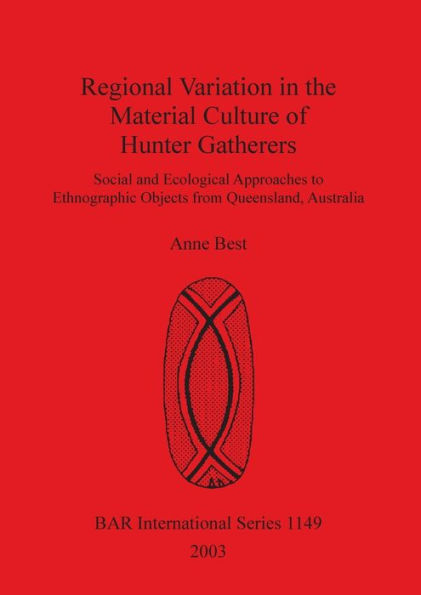
Regional Variation in the Material Culture of Hunter Gatherers: Social and Ecological Approaches to Ethnographic Objects from Queensland, Australia in Chattanooga, TN
Current price: $85.00
Barnes and Noble
Regional Variation in the Material Culture of Hunter Gatherers: Social and Ecological Approaches to Ethnographic Objects from Queensland, Australia in Chattanooga, TN
Current price: $85.00
Loading Inventory...
Size: OS
The author's concern in this volume is the spatial organisation of hunters and gatherers and how this is manifested through dissimilarities in the style of objects. Differences were tested in Queensland Aboriginal material culture, aiming to search for a regionalisation of style. The study is broad-scale and the results show a clear regionalisation in Queensland that broadly correlates with drainage divisions: the patterns are robust. The model presented is applicable to archaeological research which is concerned with distributions of style and how these are associated with the populations of past hunters and gatherers. The primary data are 813 artefacts (including bags, boomerangs, message sticks, shields, spears and spearthrowers) from selected UK and Australian museum collections. The objects date from the early contact period and were collected by explorers, colonial officials and anthropologists. Secondary sources include published and unpublished material, archaeology, rock art, early photographs and present-day Aboriginal spokesmen. Analysis of the data proceeds from the most broad-based presence/absence evidence and continues to examine and compare the morphological characteristics of the objects. At each stage, the findings are set against the regional model, whereby Queensland in divided into six geographical regions based on drainage divisions. The findings are considered against social and environmental models of style. The author evaluates the impact that ecology plays on stylistic traditionand discusses the social role of style as a means of transmitting social information. She also considers the 'open' and 'closed' model which, in a hunter-gatherer context, has been linked to environmental conditions. The conclusions of the analyses suggest that both environmental and social factors play an important part in stylistic tradition and stylistic choice.
The author's concern in this volume is the spatial organisation of hunters and gatherers and how this is manifested through dissimilarities in the style of objects. Differences were tested in Queensland Aboriginal material culture, aiming to search for a regionalisation of style. The study is broad-scale and the results show a clear regionalisation in Queensland that broadly correlates with drainage divisions: the patterns are robust. The model presented is applicable to archaeological research which is concerned with distributions of style and how these are associated with the populations of past hunters and gatherers. The primary data are 813 artefacts (including bags, boomerangs, message sticks, shields, spears and spearthrowers) from selected UK and Australian museum collections. The objects date from the early contact period and were collected by explorers, colonial officials and anthropologists. Secondary sources include published and unpublished material, archaeology, rock art, early photographs and present-day Aboriginal spokesmen. Analysis of the data proceeds from the most broad-based presence/absence evidence and continues to examine and compare the morphological characteristics of the objects. At each stage, the findings are set against the regional model, whereby Queensland in divided into six geographical regions based on drainage divisions. The findings are considered against social and environmental models of style. The author evaluates the impact that ecology plays on stylistic traditionand discusses the social role of style as a means of transmitting social information. She also considers the 'open' and 'closed' model which, in a hunter-gatherer context, has been linked to environmental conditions. The conclusions of the analyses suggest that both environmental and social factors play an important part in stylistic tradition and stylistic choice.
You May Also Like











More About Barnes and Noble at Hamilton Place
Barnes & Noble is the world’s largest retail bookseller and a leading retailer of content, digital media and educational products. Our Nook Digital business offers a lineup of NOOK® tablets and e-Readers and an expansive collection of digital reading content through the NOOK Store®. Barnes & Noble’s mission is to operate the best omni-channel specialty retail business in America, helping both our customers and booksellers reach their aspirations, while being a credit to the communities we serve.
2100 Hamilton Pl Blvd, Chattanooga, TN 37421, United States
Find Barnes and Noble at Hamilton Place in Chattanooga, TN
Visit Barnes and Noble at Hamilton Place in Chattanooga, TN
