
Home
Regimes of Derivation Syntax and Morphology
Barnes and Noble
Loading Inventory...
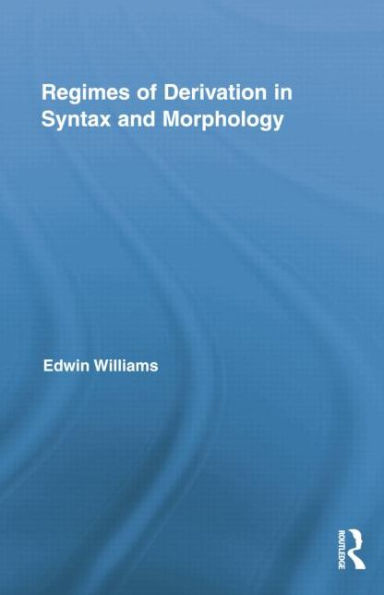
Regimes of Derivation Syntax and Morphology in Chattanooga, TN
Current price: $180.00
Barnes and Noble
Regimes of Derivation Syntax and Morphology in Chattanooga, TN
Current price: $180.00
Loading Inventory...
Size: Hardcover
Regimes of Derivation in Syntax and Morphology
presents a theory of the architecture of the human linguistic system that differs from all current theories on four key points. First, the theory rests on a modular separation of word syntax from phrasal syntax, where word syntax corresponds roughly to what has been called derivational morphology. Second, morphosyntax (corresponding to what is traditionally called "inflectional morphology") is the immediate spellout of the syntactic merge operation, and so there is no separate morphosyntactic component. There is no LF (logical form) derived; that is, there is no structure which 'mirrors' semantic interpretation ("LF"); instead, semantics interprets the derivation itself. And fourth, syntactic islands are derived purely as a consequence of the formal mechanics of syntactic derivation, and so there are no bounding nodes, no phases, no subjacency, and in fact no absolute islands. Lacking a morphosyntactic component and an LF representation are positive benefits as these provide temptations for theoretical mischief. The theory is a descendant of the author's "Representation Theory" and so inherits its other benefits as well, including explanations for properties of reconstruction, remnant movement, improper movement, and scrambling/scope interactions, and the different embedding regimes for clauses and DPs. Syntactic islands are added to this list as special cases of improper movement.
presents a theory of the architecture of the human linguistic system that differs from all current theories on four key points. First, the theory rests on a modular separation of word syntax from phrasal syntax, where word syntax corresponds roughly to what has been called derivational morphology. Second, morphosyntax (corresponding to what is traditionally called "inflectional morphology") is the immediate spellout of the syntactic merge operation, and so there is no separate morphosyntactic component. There is no LF (logical form) derived; that is, there is no structure which 'mirrors' semantic interpretation ("LF"); instead, semantics interprets the derivation itself. And fourth, syntactic islands are derived purely as a consequence of the formal mechanics of syntactic derivation, and so there are no bounding nodes, no phases, no subjacency, and in fact no absolute islands. Lacking a morphosyntactic component and an LF representation are positive benefits as these provide temptations for theoretical mischief. The theory is a descendant of the author's "Representation Theory" and so inherits its other benefits as well, including explanations for properties of reconstruction, remnant movement, improper movement, and scrambling/scope interactions, and the different embedding regimes for clauses and DPs. Syntactic islands are added to this list as special cases of improper movement.
Regimes of Derivation in Syntax and Morphology
presents a theory of the architecture of the human linguistic system that differs from all current theories on four key points. First, the theory rests on a modular separation of word syntax from phrasal syntax, where word syntax corresponds roughly to what has been called derivational morphology. Second, morphosyntax (corresponding to what is traditionally called "inflectional morphology") is the immediate spellout of the syntactic merge operation, and so there is no separate morphosyntactic component. There is no LF (logical form) derived; that is, there is no structure which 'mirrors' semantic interpretation ("LF"); instead, semantics interprets the derivation itself. And fourth, syntactic islands are derived purely as a consequence of the formal mechanics of syntactic derivation, and so there are no bounding nodes, no phases, no subjacency, and in fact no absolute islands. Lacking a morphosyntactic component and an LF representation are positive benefits as these provide temptations for theoretical mischief. The theory is a descendant of the author's "Representation Theory" and so inherits its other benefits as well, including explanations for properties of reconstruction, remnant movement, improper movement, and scrambling/scope interactions, and the different embedding regimes for clauses and DPs. Syntactic islands are added to this list as special cases of improper movement.
presents a theory of the architecture of the human linguistic system that differs from all current theories on four key points. First, the theory rests on a modular separation of word syntax from phrasal syntax, where word syntax corresponds roughly to what has been called derivational morphology. Second, morphosyntax (corresponding to what is traditionally called "inflectional morphology") is the immediate spellout of the syntactic merge operation, and so there is no separate morphosyntactic component. There is no LF (logical form) derived; that is, there is no structure which 'mirrors' semantic interpretation ("LF"); instead, semantics interprets the derivation itself. And fourth, syntactic islands are derived purely as a consequence of the formal mechanics of syntactic derivation, and so there are no bounding nodes, no phases, no subjacency, and in fact no absolute islands. Lacking a morphosyntactic component and an LF representation are positive benefits as these provide temptations for theoretical mischief. The theory is a descendant of the author's "Representation Theory" and so inherits its other benefits as well, including explanations for properties of reconstruction, remnant movement, improper movement, and scrambling/scope interactions, and the different embedding regimes for clauses and DPs. Syntactic islands are added to this list as special cases of improper movement.
You May Also Like
















More About Barnes and Noble at Hamilton Place
Barnes & Noble is the world’s largest retail bookseller and a leading retailer of content, digital media and educational products. Our Nook Digital business offers a lineup of NOOK® tablets and e-Readers and an expansive collection of digital reading content through the NOOK Store®. Barnes & Noble’s mission is to operate the best omni-channel specialty retail business in America, helping both our customers and booksellers reach their aspirations, while being a credit to the communities we serve.
2100 Hamilton Pl Blvd, Chattanooga, TN 37421, United States
Find Barnes and Noble at Hamilton Place in Chattanooga, TN
Visit Barnes and Noble at Hamilton Place in Chattanooga, TN
