
Home
Recent Object-Lessons in Penal Science: With a Biographical Introduction
Barnes and Noble
Loading Inventory...
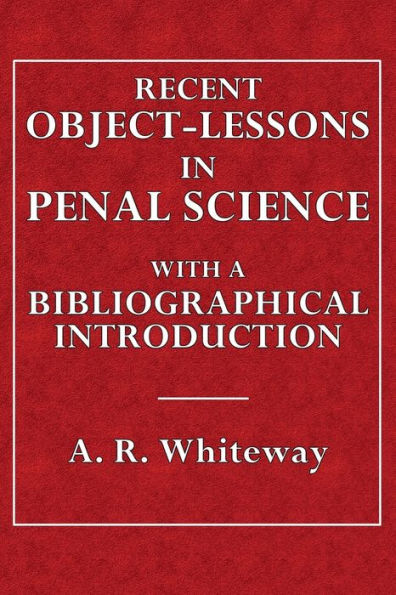
Recent Object-Lessons in Penal Science: With a Biographical Introduction in Chattanooga, TN
Current price: $8.99
Barnes and Noble
Recent Object-Lessons in Penal Science: With a Biographical Introduction in Chattanooga, TN
Current price: $8.99
Loading Inventory...
Size: OS
It is not at all easy to discover Mr. Whiteway's meaning. His intention is clear enough. He wishes to attack what he calls, not very appositely-"Pedantic Penology." Again and again he refers to this science, not without a fine scorn, as "Criminology," which, of course, is a very different matter. The volume, however, may be taken as a plea for a more scientific method of punishing criminals. He advances several main contentions, and from none of them will the social reformer be disposed to differ. He would reform the English court of first instance, and, indeed, the lay and unpaid magistracy of this country is the least creditable feature of our legal system; he would compensate those against whom crimes are committed; he would compensate the innocently accused; he would improve the assize system by more frequent gaol deliveries, presided over by a kind of commissioner something less in importance than the judge of assize. But all this is apart from penal science. Mr. Whiteway's main contention is that prisons should be moral hospitals, somewhat on the lines of the famous Elmira experiment. In his curious, half-flippant way, the author makes out a good case for a method of treating criminals, which is usually regarded as the dream of the sentimentalist rather than the suggestion of the scientist. Here is the pith of his proposal- "The chances of moralization (in the proposed moral hospitals) are increased by the use of the indeterminate sentence, which practically leaves it within fairly wide limits in the hands of the capable manager to choose how long the prisoner is to be detained and the exact date at which he shall be liberated on parole.
It is not at all easy to discover Mr. Whiteway's meaning. His intention is clear enough. He wishes to attack what he calls, not very appositely-"Pedantic Penology." Again and again he refers to this science, not without a fine scorn, as "Criminology," which, of course, is a very different matter. The volume, however, may be taken as a plea for a more scientific method of punishing criminals. He advances several main contentions, and from none of them will the social reformer be disposed to differ. He would reform the English court of first instance, and, indeed, the lay and unpaid magistracy of this country is the least creditable feature of our legal system; he would compensate those against whom crimes are committed; he would compensate the innocently accused; he would improve the assize system by more frequent gaol deliveries, presided over by a kind of commissioner something less in importance than the judge of assize. But all this is apart from penal science. Mr. Whiteway's main contention is that prisons should be moral hospitals, somewhat on the lines of the famous Elmira experiment. In his curious, half-flippant way, the author makes out a good case for a method of treating criminals, which is usually regarded as the dream of the sentimentalist rather than the suggestion of the scientist. Here is the pith of his proposal- "The chances of moralization (in the proposed moral hospitals) are increased by the use of the indeterminate sentence, which practically leaves it within fairly wide limits in the hands of the capable manager to choose how long the prisoner is to be detained and the exact date at which he shall be liberated on parole.
You May Also Like














More About Barnes and Noble at Hamilton Place
Barnes & Noble is the world’s largest retail bookseller and a leading retailer of content, digital media and educational products. Our Nook Digital business offers a lineup of NOOK® tablets and e-Readers and an expansive collection of digital reading content through the NOOK Store®. Barnes & Noble’s mission is to operate the best omni-channel specialty retail business in America, helping both our customers and booksellers reach their aspirations, while being a credit to the communities we serve.
2100 Hamilton Pl Blvd, Chattanooga, TN 37421, United States
Find Barnes and Noble at Hamilton Place in Chattanooga, TN
Visit Barnes and Noble at Hamilton Place in Chattanooga, TN