
Home
Railing, Reviling, and Invective English Literary Culture, 1588-1617: The Anti-Poetics of Theater Print
Barnes and Noble
Loading Inventory...
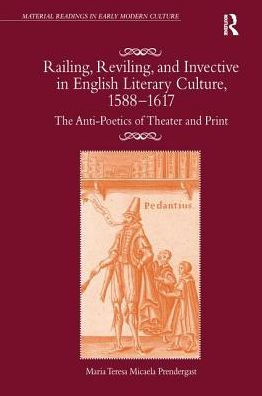
Railing, Reviling, and Invective English Literary Culture, 1588-1617: The Anti-Poetics of Theater Print in Chattanooga, TN
Current price: $69.99
Barnes and Noble
Railing, Reviling, and Invective English Literary Culture, 1588-1617: The Anti-Poetics of Theater Print in Chattanooga, TN
Current price: $69.99
Loading Inventory...
Size: Paperback
Railing, Reviling, and Invective in English Literary Culture, 1588-1617 is the first book to consider railing plays and pamphlets as participating in a coherent literary movement that dominated much of the English literary landscape during the late Elizabethan/early Jacobean period. Author Prendergast considers how these crisis-ridden texts on religious, gender, and aesthetic controversies were encouraged and supported by the emergence of the professional theater and print pamphlets. She argues that railing texts by Shakespeare, Nashe, Jonson, Jane Anger and others became sites for articulating anxious emotions-including fears about the stability of England after the death of Queen Elizabeth and the increasing factional splits between Protestant groups. But, given that railings about religious and political matters often led to censorship or even death, most railing writers chose to circumvent such possible repercussions by railing against unconventional gender identity, perverse sexual proclivities, and controversial aesthetics. In the process, Prendergast argues, railers shaped an anti-aesthetics that was itself dependent on the very expressions of perverse gender and sexuality that they discursively condemned, an aesthetics that created a conceptual third space in which bitter enemies-male or female, conformist or nonconformist-could bond by engaging in collaborative experiments with dialogical invective. By considering a literary mode of articulation that vehemently counters dominant literary discourse, this book changes the way that we look at late Elizabethan and early Jacobean literature, as it associates works that have been studied in isolation from each other with a larger, coherent literary movement.
Railing, Reviling, and Invective in English Literary Culture, 1588-1617 is the first book to consider railing plays and pamphlets as participating in a coherent literary movement that dominated much of the English literary landscape during the late Elizabethan/early Jacobean period. Author Prendergast considers how these crisis-ridden texts on religious, gender, and aesthetic controversies were encouraged and supported by the emergence of the professional theater and print pamphlets. She argues that railing texts by Shakespeare, Nashe, Jonson, Jane Anger and others became sites for articulating anxious emotions-including fears about the stability of England after the death of Queen Elizabeth and the increasing factional splits between Protestant groups. But, given that railings about religious and political matters often led to censorship or even death, most railing writers chose to circumvent such possible repercussions by railing against unconventional gender identity, perverse sexual proclivities, and controversial aesthetics. In the process, Prendergast argues, railers shaped an anti-aesthetics that was itself dependent on the very expressions of perverse gender and sexuality that they discursively condemned, an aesthetics that created a conceptual third space in which bitter enemies-male or female, conformist or nonconformist-could bond by engaging in collaborative experiments with dialogical invective. By considering a literary mode of articulation that vehemently counters dominant literary discourse, this book changes the way that we look at late Elizabethan and early Jacobean literature, as it associates works that have been studied in isolation from each other with a larger, coherent literary movement.
You May Also Like










More About Barnes and Noble at Hamilton Place
Barnes & Noble is the world’s largest retail bookseller and a leading retailer of content, digital media and educational products. Our Nook Digital business offers a lineup of NOOK® tablets and e-Readers and an expansive collection of digital reading content through the NOOK Store®. Barnes & Noble’s mission is to operate the best omni-channel specialty retail business in America, helping both our customers and booksellers reach their aspirations, while being a credit to the communities we serve.
2100 Hamilton Pl Blvd, Chattanooga, TN 37421, United States
Find Barnes and Noble at Hamilton Place in Chattanooga, TN
Visit Barnes and Noble at Hamilton Place in Chattanooga, TN