
Home
Quantitative Graph Theory: Mathematical Foundations and Applications
Barnes and Noble
Loading Inventory...
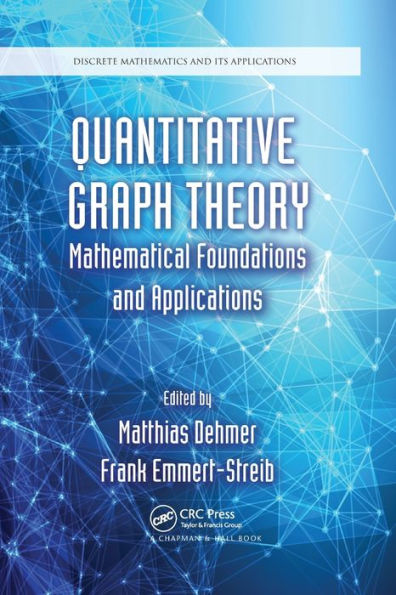
Quantitative Graph Theory: Mathematical Foundations and Applications in Chattanooga, TN
Current price: $84.99
Barnes and Noble
Quantitative Graph Theory: Mathematical Foundations and Applications in Chattanooga, TN
Current price: $84.99
Loading Inventory...
Size: OS
The first book devoted exclusively to quantitative graph theory,
Quantitative Graph Theory: Mathematical Foundations and Applications
presents and demonstrates existing and novel methods for analyzing graphs quantitatively. Incorporating interdisciplinary knowledge from graph theory, information theory, measurement theory, and statistical techniques, this book covers a wide range of quantitative-graph theoretical concepts and methods, including those pertaining to real and random graphs such as:
Comparative approaches (graph similarity or distance)
Graph measures to characterize graphs quantitatively
Applications of graph measures in social network analysis and other disciplines
Metrical properties of graphs and measures
Mathematical properties of quantitative methods or measures in graph theory
Network complexity measures and other topological indices
Quantitative approaches to graphs using machine learning (e.g., clustering)
Graph measures and statistics
Information-theoretic methods to analyze graphs quantitatively (e.g., entropy)
Through its broad coverage,
fills a gap in the contemporary literature of discrete and applied mathematics, computer science, systems biology, and related disciplines. It is intended for researchers as well as graduate and advanced undergraduate students in the fields of mathematics, computer science, mathematical chemistry, cheminformatics, physics, bioinformatics, and systems biology.
Quantitative Graph Theory: Mathematical Foundations and Applications
presents and demonstrates existing and novel methods for analyzing graphs quantitatively. Incorporating interdisciplinary knowledge from graph theory, information theory, measurement theory, and statistical techniques, this book covers a wide range of quantitative-graph theoretical concepts and methods, including those pertaining to real and random graphs such as:
Comparative approaches (graph similarity or distance)
Graph measures to characterize graphs quantitatively
Applications of graph measures in social network analysis and other disciplines
Metrical properties of graphs and measures
Mathematical properties of quantitative methods or measures in graph theory
Network complexity measures and other topological indices
Quantitative approaches to graphs using machine learning (e.g., clustering)
Graph measures and statistics
Information-theoretic methods to analyze graphs quantitatively (e.g., entropy)
Through its broad coverage,
fills a gap in the contemporary literature of discrete and applied mathematics, computer science, systems biology, and related disciplines. It is intended for researchers as well as graduate and advanced undergraduate students in the fields of mathematics, computer science, mathematical chemistry, cheminformatics, physics, bioinformatics, and systems biology.
The first book devoted exclusively to quantitative graph theory,
Quantitative Graph Theory: Mathematical Foundations and Applications
presents and demonstrates existing and novel methods for analyzing graphs quantitatively. Incorporating interdisciplinary knowledge from graph theory, information theory, measurement theory, and statistical techniques, this book covers a wide range of quantitative-graph theoretical concepts and methods, including those pertaining to real and random graphs such as:
Comparative approaches (graph similarity or distance)
Graph measures to characterize graphs quantitatively
Applications of graph measures in social network analysis and other disciplines
Metrical properties of graphs and measures
Mathematical properties of quantitative methods or measures in graph theory
Network complexity measures and other topological indices
Quantitative approaches to graphs using machine learning (e.g., clustering)
Graph measures and statistics
Information-theoretic methods to analyze graphs quantitatively (e.g., entropy)
Through its broad coverage,
fills a gap in the contemporary literature of discrete and applied mathematics, computer science, systems biology, and related disciplines. It is intended for researchers as well as graduate and advanced undergraduate students in the fields of mathematics, computer science, mathematical chemistry, cheminformatics, physics, bioinformatics, and systems biology.
Quantitative Graph Theory: Mathematical Foundations and Applications
presents and demonstrates existing and novel methods for analyzing graphs quantitatively. Incorporating interdisciplinary knowledge from graph theory, information theory, measurement theory, and statistical techniques, this book covers a wide range of quantitative-graph theoretical concepts and methods, including those pertaining to real and random graphs such as:
Comparative approaches (graph similarity or distance)
Graph measures to characterize graphs quantitatively
Applications of graph measures in social network analysis and other disciplines
Metrical properties of graphs and measures
Mathematical properties of quantitative methods or measures in graph theory
Network complexity measures and other topological indices
Quantitative approaches to graphs using machine learning (e.g., clustering)
Graph measures and statistics
Information-theoretic methods to analyze graphs quantitatively (e.g., entropy)
Through its broad coverage,
fills a gap in the contemporary literature of discrete and applied mathematics, computer science, systems biology, and related disciplines. It is intended for researchers as well as graduate and advanced undergraduate students in the fields of mathematics, computer science, mathematical chemistry, cheminformatics, physics, bioinformatics, and systems biology.
You May Also Like










More About Barnes and Noble at Hamilton Place
Barnes & Noble is the world’s largest retail bookseller and a leading retailer of content, digital media and educational products. Our Nook Digital business offers a lineup of NOOK® tablets and e-Readers and an expansive collection of digital reading content through the NOOK Store®. Barnes & Noble’s mission is to operate the best omni-channel specialty retail business in America, helping both our customers and booksellers reach their aspirations, while being a credit to the communities we serve.
2100 Hamilton Pl Blvd, Chattanooga, TN 37421, United States
Find Barnes and Noble at Hamilton Place in Chattanooga, TN
Visit Barnes and Noble at Hamilton Place in Chattanooga, TN
