
Home
Philosophical Languages the Seventeenth Century: Dalgarno, Wilkins, Leibniz
Barnes and Noble
Loading Inventory...

Philosophical Languages the Seventeenth Century: Dalgarno, Wilkins, Leibniz in Chattanooga, TN
Current price: $169.99
Barnes and Noble
Philosophical Languages the Seventeenth Century: Dalgarno, Wilkins, Leibniz in Chattanooga, TN
Current price: $169.99
Loading Inventory...
Size: Hardcover
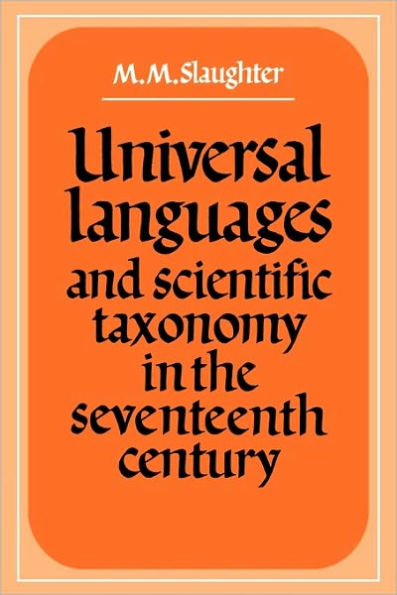
This book discusses three linguistic projects carried out in the seventeenth century: the artificial languages created by Dalgamo and Wilkins, and Leibniz's uncompleted scheme. It treats each of the projects as self contained undertakings, which deserve to be studied and judged in their own right. For this reason, the two artificial languages, as well as Leib niz's work in this area, are described in considerable detail. At the same time, the characteristics of these schemes are linked with their intellectual context, and their multiple interrelations are examined at some length. In this way, the book seeks to combine a systematical with a historical approach to the subject, in the hope that both approaches profit from the combination. When I first started the research on which this book is based, I intended to look only briefly into the seventeenth-century schemes, which I assumed represented a typical universalist approach to the study of language, as opposed to a relativistic one. The authors of these schemes thought, or so the assumption was, that almost the only thing required for a truly universal language was the systematic labelling of the items of an apparently readily available, universal catalogue of everything that exists.
This book discusses three linguistic projects carried out in the seventeenth century: the artificial languages created by Dalgamo and Wilkins, and Leibniz's uncompleted scheme. It treats each of the projects as self contained undertakings, which deserve to be studied and judged in their own right. For this reason, the two artificial languages, as well as Leib niz's work in this area, are described in considerable detail. At the same time, the characteristics of these schemes are linked with their intellectual context, and their multiple interrelations are examined at some length. In this way, the book seeks to combine a systematical with a historical approach to the subject, in the hope that both approaches profit from the combination. When I first started the research on which this book is based, I intended to look only briefly into the seventeenth-century schemes, which I assumed represented a typical universalist approach to the study of language, as opposed to a relativistic one. The authors of these schemes thought, or so the assumption was, that almost the only thing required for a truly universal language was the systematic labelling of the items of an apparently readily available, universal catalogue of everything that exists.
You May Also Like
















More About Barnes and Noble at Hamilton Place
Barnes & Noble is the world’s largest retail bookseller and a leading retailer of content, digital media and educational products. Our Nook Digital business offers a lineup of NOOK® tablets and e-Readers and an expansive collection of digital reading content through the NOOK Store®. Barnes & Noble’s mission is to operate the best omni-channel specialty retail business in America, helping both our customers and booksellers reach their aspirations, while being a credit to the communities we serve.
2100 Hamilton Pl Blvd, Chattanooga, TN 37421, United States
Find Barnes and Noble at Hamilton Place in Chattanooga, TN
Visit Barnes and Noble at Hamilton Place in Chattanooga, TN
