
Home
Paganism in Christian Holidays: Did Christiannity Borrow from Other Belief Systems?
Barnes and Noble
Loading Inventory...
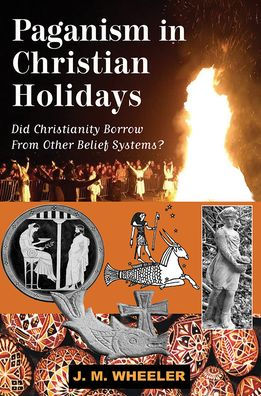
Paganism in Christian Holidays: Did Christiannity Borrow from Other Belief Systems? in Chattanooga, TN
Current price: $24.95
Barnes and Noble
Paganism in Christian Holidays: Did Christiannity Borrow from Other Belief Systems? in Chattanooga, TN
Current price: $24.95
Loading Inventory...
Size: OS
The word Pagan came from the Latin word paganus, which means “country-dweller.” These rural people often incorporated nature in their belief systems and were polytheistic (believing in more than one God). They differed from most religions in its non-hierarchal (with no paid clergy) and were more equally led by women. Pagans celebrate seasonal festivals and ceremonies. Christians used the term Pagan interchangeably with heathen, as a put down because many country people were not rich or highly educated. In Paganism In Christian Holidays, Wheeler presents evidence that modern Christian beliefs, practices and symbolism borrowed heavily not only from Pagan beliefs, but also from Roman, Greek, Egyptian, Aztec, Hinduism, Buddhism and other ideologies. Do these concepts sound familiar? Blood sacrifice, a triune god, a man-god who had to be sacrificed for society’s salvation. Persians believed in Mithra, a great mediator between God and man. He was born on December 25th by a virgin, he died for humanity and was resurrected after being buried. Mithra’s holidays were the Winter Solstice and the Vernal Equinox (Christmas and Easter). Years of adversity and oppression pushed the practice of Paganism and other nature-loving belief systems underground. This is a pattern among many indigenous people who were “conquered” by Christians and were stripped of their right to continue their own religion on penalty of death. Many refused to convert and were killed. And yet customs and symbology from “nature-oriented” religions can be found throughout Christian beliefs. Many Pagans worshiped in secret to avoid persecution, many including Aleister Crowley worked hard to develop Paganism as a “religion” and more than a magical movement.
The word Pagan came from the Latin word paganus, which means “country-dweller.” These rural people often incorporated nature in their belief systems and were polytheistic (believing in more than one God). They differed from most religions in its non-hierarchal (with no paid clergy) and were more equally led by women. Pagans celebrate seasonal festivals and ceremonies. Christians used the term Pagan interchangeably with heathen, as a put down because many country people were not rich or highly educated. In Paganism In Christian Holidays, Wheeler presents evidence that modern Christian beliefs, practices and symbolism borrowed heavily not only from Pagan beliefs, but also from Roman, Greek, Egyptian, Aztec, Hinduism, Buddhism and other ideologies. Do these concepts sound familiar? Blood sacrifice, a triune god, a man-god who had to be sacrificed for society’s salvation. Persians believed in Mithra, a great mediator between God and man. He was born on December 25th by a virgin, he died for humanity and was resurrected after being buried. Mithra’s holidays were the Winter Solstice and the Vernal Equinox (Christmas and Easter). Years of adversity and oppression pushed the practice of Paganism and other nature-loving belief systems underground. This is a pattern among many indigenous people who were “conquered” by Christians and were stripped of their right to continue their own religion on penalty of death. Many refused to convert and were killed. And yet customs and symbology from “nature-oriented” religions can be found throughout Christian beliefs. Many Pagans worshiped in secret to avoid persecution, many including Aleister Crowley worked hard to develop Paganism as a “religion” and more than a magical movement.
You May Also Like











More About Barnes and Noble at Hamilton Place
Barnes & Noble is the world’s largest retail bookseller and a leading retailer of content, digital media and educational products. Our Nook Digital business offers a lineup of NOOK® tablets and e-Readers and an expansive collection of digital reading content through the NOOK Store®. Barnes & Noble’s mission is to operate the best omni-channel specialty retail business in America, helping both our customers and booksellers reach their aspirations, while being a credit to the communities we serve.
2100 Hamilton Pl Blvd, Chattanooga, TN 37421, United States
Find Barnes and Noble at Hamilton Place in Chattanooga, TN
Visit Barnes and Noble at Hamilton Place in Chattanooga, TN