
Home
One Classroom at a Time: How Better Teaching Can Make College More Equitable
Barnes and Noble
Loading Inventory...
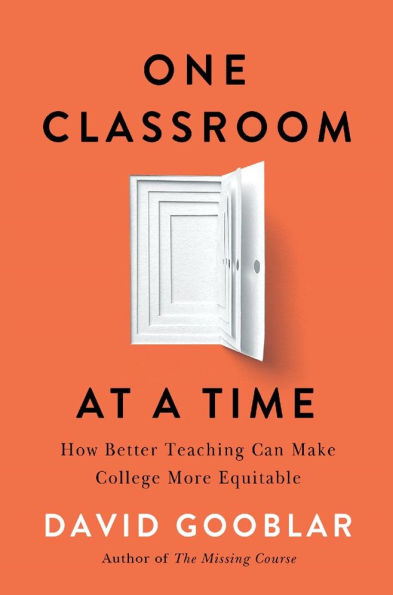
One Classroom at a Time: How Better Teaching Can Make College More Equitable in Chattanooga, TN
Current price: $19.99
Barnes and Noble
One Classroom at a Time: How Better Teaching Can Make College More Equitable in Chattanooga, TN
Current price: $19.99
Loading Inventory...
Size: Audiobook
From the author of
The Missing Course,
an essential guide to pedagogy that serves all members of an ever more diverse undergraduate population.
A century ago, a typical US college campus was a sanctuary of privilege, with white men of means constituting nearly the entire student population. Today, half of US undergraduates live at or near the poverty line, and universities are more diverse than ever. But teaching and curricula have not caught up, resulting in stark inequities. Black and Hispanic students graduate at lower rates than their white and Asian counterparts, economically insecure and disabled students face persistent disadvantages, and in STEM disciplines gender imbalances remain the norm.
One Classroom at a Time
provides practical, research-based recommendations for teachers and administrators who want to narrow such academic gaps. David Gooblar explains the psychological hardships facing many marginalized students—including stereotype threat and belonging uncertainty—and provides detailed remedies. This wide-ranging guide also offers advice for mitigating burdens of financial insecurity and designing classes that work for all students regardless of disabilities. The emphasis throughout is on helping instructors and administrators understand not just the principles of equitable pedagogy but also the reasoning; not just what works, but why it works.
In the twenty-first century, college courses shouldn’t be built for imaginary students of yesteryear.
shows how we can tailor pedagogy to the students of today, so that all of them can secure the education and the success they deserve.
The Missing Course,
an essential guide to pedagogy that serves all members of an ever more diverse undergraduate population.
A century ago, a typical US college campus was a sanctuary of privilege, with white men of means constituting nearly the entire student population. Today, half of US undergraduates live at or near the poverty line, and universities are more diverse than ever. But teaching and curricula have not caught up, resulting in stark inequities. Black and Hispanic students graduate at lower rates than their white and Asian counterparts, economically insecure and disabled students face persistent disadvantages, and in STEM disciplines gender imbalances remain the norm.
One Classroom at a Time
provides practical, research-based recommendations for teachers and administrators who want to narrow such academic gaps. David Gooblar explains the psychological hardships facing many marginalized students—including stereotype threat and belonging uncertainty—and provides detailed remedies. This wide-ranging guide also offers advice for mitigating burdens of financial insecurity and designing classes that work for all students regardless of disabilities. The emphasis throughout is on helping instructors and administrators understand not just the principles of equitable pedagogy but also the reasoning; not just what works, but why it works.
In the twenty-first century, college courses shouldn’t be built for imaginary students of yesteryear.
shows how we can tailor pedagogy to the students of today, so that all of them can secure the education and the success they deserve.
From the author of
The Missing Course,
an essential guide to pedagogy that serves all members of an ever more diverse undergraduate population.
A century ago, a typical US college campus was a sanctuary of privilege, with white men of means constituting nearly the entire student population. Today, half of US undergraduates live at or near the poverty line, and universities are more diverse than ever. But teaching and curricula have not caught up, resulting in stark inequities. Black and Hispanic students graduate at lower rates than their white and Asian counterparts, economically insecure and disabled students face persistent disadvantages, and in STEM disciplines gender imbalances remain the norm.
One Classroom at a Time
provides practical, research-based recommendations for teachers and administrators who want to narrow such academic gaps. David Gooblar explains the psychological hardships facing many marginalized students—including stereotype threat and belonging uncertainty—and provides detailed remedies. This wide-ranging guide also offers advice for mitigating burdens of financial insecurity and designing classes that work for all students regardless of disabilities. The emphasis throughout is on helping instructors and administrators understand not just the principles of equitable pedagogy but also the reasoning; not just what works, but why it works.
In the twenty-first century, college courses shouldn’t be built for imaginary students of yesteryear.
shows how we can tailor pedagogy to the students of today, so that all of them can secure the education and the success they deserve.
The Missing Course,
an essential guide to pedagogy that serves all members of an ever more diverse undergraduate population.
A century ago, a typical US college campus was a sanctuary of privilege, with white men of means constituting nearly the entire student population. Today, half of US undergraduates live at or near the poverty line, and universities are more diverse than ever. But teaching and curricula have not caught up, resulting in stark inequities. Black and Hispanic students graduate at lower rates than their white and Asian counterparts, economically insecure and disabled students face persistent disadvantages, and in STEM disciplines gender imbalances remain the norm.
One Classroom at a Time
provides practical, research-based recommendations for teachers and administrators who want to narrow such academic gaps. David Gooblar explains the psychological hardships facing many marginalized students—including stereotype threat and belonging uncertainty—and provides detailed remedies. This wide-ranging guide also offers advice for mitigating burdens of financial insecurity and designing classes that work for all students regardless of disabilities. The emphasis throughout is on helping instructors and administrators understand not just the principles of equitable pedagogy but also the reasoning; not just what works, but why it works.
In the twenty-first century, college courses shouldn’t be built for imaginary students of yesteryear.
shows how we can tailor pedagogy to the students of today, so that all of them can secure the education and the success they deserve.
You May Also Like














More About Barnes and Noble at Hamilton Place
Barnes & Noble is the world’s largest retail bookseller and a leading retailer of content, digital media and educational products. Our Nook Digital business offers a lineup of NOOK® tablets and e-Readers and an expansive collection of digital reading content through the NOOK Store®. Barnes & Noble’s mission is to operate the best omni-channel specialty retail business in America, helping both our customers and booksellers reach their aspirations, while being a credit to the communities we serve.
2100 Hamilton Pl Blvd, Chattanooga, TN 37421, United States
Find Barnes and Noble at Hamilton Place in Chattanooga, TN
Visit Barnes and Noble at Hamilton Place in Chattanooga, TN
