
Home
On Architecture, Volume I: Books 1-5
Barnes and Noble
Loading Inventory...
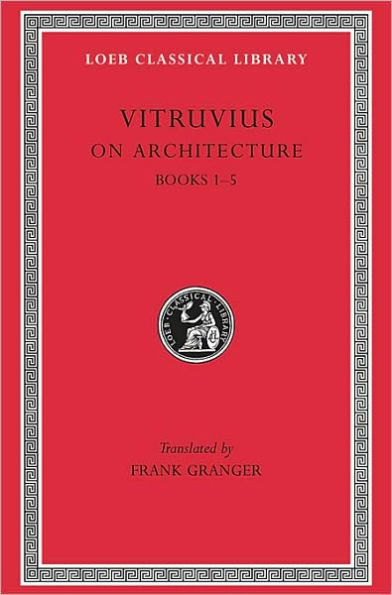
On Architecture, Volume I: Books 1-5 in Chattanooga, TN
Current price: $32.76
Barnes and Noble
On Architecture, Volume I: Books 1-5 in Chattanooga, TN
Current price: $32.76
Loading Inventory...
Size: OS
The Renaissance man
avant la lettre
.
Vitruvius (Marcus V. Pollio), Roman architect and engineer, studied Greek philosophy and science and gained experience in the course of professional work. He was one of those appointed to be overseers of imperial artillery or military engines, and was architect of at least one unit of buildings for Augustus in the reconstruction of Rome. Late in life and in ill health he completed, sometime before 27 BC,
De Architectura
which, after its rediscovery in the fifteenth century, was influential enough to be studied by architects from the early Renaissance to recent times.
In
On Architecture
Vitruvius adds to the tradition of Greek theory and practice the results of his own experience. The contents of this treatise in ten books are as follows. Book 1: Requirements for an architect; town planning; design, cities, aspects; temples. 2: Materials and their treatment. Greek systems. 3: Styles. Forms of Greek temples. Ionic. 4: Styles. Corinthian, Ionic, Doric; Tuscan; altars. 5: Other public buildings (fora, basilicae, theaters, colonnades, baths, harbors). 6: Sites and planning, especially of houses. 7: Construction of pavements, roads, mosaic floors, vaults. Decoration (stucco, wall painting, colors). 8: Hydraulic engineering; water supply; aqueducts. 9: Astronomy. Greek and Roman discoveries; signs of the zodiac, planets, moon phases, constellations, astrology, gnomon, sundials. 10: Machines for war and other purposes.
avant la lettre
.
Vitruvius (Marcus V. Pollio), Roman architect and engineer, studied Greek philosophy and science and gained experience in the course of professional work. He was one of those appointed to be overseers of imperial artillery or military engines, and was architect of at least one unit of buildings for Augustus in the reconstruction of Rome. Late in life and in ill health he completed, sometime before 27 BC,
De Architectura
which, after its rediscovery in the fifteenth century, was influential enough to be studied by architects from the early Renaissance to recent times.
In
On Architecture
Vitruvius adds to the tradition of Greek theory and practice the results of his own experience. The contents of this treatise in ten books are as follows. Book 1: Requirements for an architect; town planning; design, cities, aspects; temples. 2: Materials and their treatment. Greek systems. 3: Styles. Forms of Greek temples. Ionic. 4: Styles. Corinthian, Ionic, Doric; Tuscan; altars. 5: Other public buildings (fora, basilicae, theaters, colonnades, baths, harbors). 6: Sites and planning, especially of houses. 7: Construction of pavements, roads, mosaic floors, vaults. Decoration (stucco, wall painting, colors). 8: Hydraulic engineering; water supply; aqueducts. 9: Astronomy. Greek and Roman discoveries; signs of the zodiac, planets, moon phases, constellations, astrology, gnomon, sundials. 10: Machines for war and other purposes.
The Renaissance man
avant la lettre
.
Vitruvius (Marcus V. Pollio), Roman architect and engineer, studied Greek philosophy and science and gained experience in the course of professional work. He was one of those appointed to be overseers of imperial artillery or military engines, and was architect of at least one unit of buildings for Augustus in the reconstruction of Rome. Late in life and in ill health he completed, sometime before 27 BC,
De Architectura
which, after its rediscovery in the fifteenth century, was influential enough to be studied by architects from the early Renaissance to recent times.
In
On Architecture
Vitruvius adds to the tradition of Greek theory and practice the results of his own experience. The contents of this treatise in ten books are as follows. Book 1: Requirements for an architect; town planning; design, cities, aspects; temples. 2: Materials and their treatment. Greek systems. 3: Styles. Forms of Greek temples. Ionic. 4: Styles. Corinthian, Ionic, Doric; Tuscan; altars. 5: Other public buildings (fora, basilicae, theaters, colonnades, baths, harbors). 6: Sites and planning, especially of houses. 7: Construction of pavements, roads, mosaic floors, vaults. Decoration (stucco, wall painting, colors). 8: Hydraulic engineering; water supply; aqueducts. 9: Astronomy. Greek and Roman discoveries; signs of the zodiac, planets, moon phases, constellations, astrology, gnomon, sundials. 10: Machines for war and other purposes.
avant la lettre
.
Vitruvius (Marcus V. Pollio), Roman architect and engineer, studied Greek philosophy and science and gained experience in the course of professional work. He was one of those appointed to be overseers of imperial artillery or military engines, and was architect of at least one unit of buildings for Augustus in the reconstruction of Rome. Late in life and in ill health he completed, sometime before 27 BC,
De Architectura
which, after its rediscovery in the fifteenth century, was influential enough to be studied by architects from the early Renaissance to recent times.
In
On Architecture
Vitruvius adds to the tradition of Greek theory and practice the results of his own experience. The contents of this treatise in ten books are as follows. Book 1: Requirements for an architect; town planning; design, cities, aspects; temples. 2: Materials and their treatment. Greek systems. 3: Styles. Forms of Greek temples. Ionic. 4: Styles. Corinthian, Ionic, Doric; Tuscan; altars. 5: Other public buildings (fora, basilicae, theaters, colonnades, baths, harbors). 6: Sites and planning, especially of houses. 7: Construction of pavements, roads, mosaic floors, vaults. Decoration (stucco, wall painting, colors). 8: Hydraulic engineering; water supply; aqueducts. 9: Astronomy. Greek and Roman discoveries; signs of the zodiac, planets, moon phases, constellations, astrology, gnomon, sundials. 10: Machines for war and other purposes.
You May Also Like













More About Barnes and Noble at Hamilton Place
Barnes & Noble is the world’s largest retail bookseller and a leading retailer of content, digital media and educational products. Our Nook Digital business offers a lineup of NOOK® tablets and e-Readers and an expansive collection of digital reading content through the NOOK Store®. Barnes & Noble’s mission is to operate the best omni-channel specialty retail business in America, helping both our customers and booksellers reach their aspirations, while being a credit to the communities we serve.
2100 Hamilton Pl Blvd, Chattanooga, TN 37421, United States
Find Barnes and Noble at Hamilton Place in Chattanooga, TN
Visit Barnes and Noble at Hamilton Place in Chattanooga, TN
