
Home
Old Man's Playing Ground: Gaming and Trade on the Plains/Plateau Frontier
Barnes and Noble
Loading Inventory...
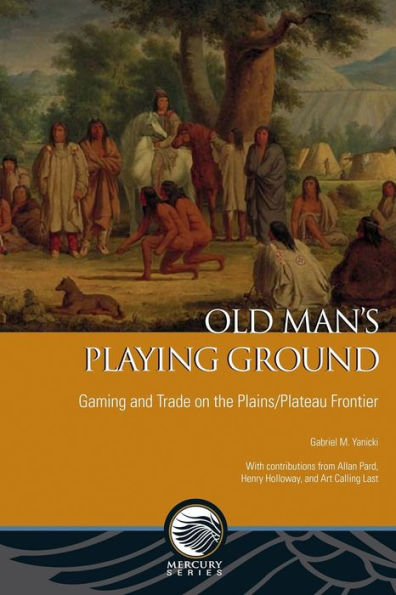
Old Man's Playing Ground: Gaming and Trade on the Plains/Plateau Frontier in Chattanooga, TN
Current price: $64.95
Barnes and Noble
Old Man's Playing Ground: Gaming and Trade on the Plains/Plateau Frontier in Chattanooga, TN
Current price: $64.95
Loading Inventory...
Size: OS
Oral traditions of the Piikáni, together with textual records spanning centuries, reveal the enduring cultural significance of prehistoric intergroup trading and gaming grounds. When Hudson’s Bay Company surveyor Peter Fidler made contact with the Ktunaxa at the Gap of the Oldman River in the winter of 1792, his Piikáni guides brought him to the river’s namesake. These were the playing grounds where Napi, or Old Man, taught the various nations how to play a game as a way of making peace. In the centuries since, travelers, adventurers, and scholars have recorded several accounts of Old Man’s Playing Ground and of the hoop-and-arrow game that was played there. Although it has been destroyed, much can be learned from an interdisciplinary study of Old Man’s Playing Ground. Oral traditions of the Piikáni and other First Nations of the Northwest Plains and Interior Plateau, together with textual records spanning centuries, show it to be a place of enduring cultural significance irrespective of its physical remains. Knowledge of the site and the hoop-and-arrow game played there is widespread, in keeping with historic and ethnographic accounts of multiple groups meeting and gambling at the site. In this work, oral tradition, history, and ethnography are brought together with a geomorphic assessment of the playing ground’s most probable location—a floodplain scoured and rebuilt by floodwaters of the Oldman—and the archaeology of adjacent prehistoric campsite DlPo-8. Taken together, the locale can be understood as a nexus for cultural interaction and trade, through the medium of gambling and games, on the natural frontier between peoples of the Interior Plateau and Northwest Plains. When Hudson’s Bay Company surveyor Peter Fidler made contact with the Ktunaxa at the Gap of the Oldman River in the winter of 1792, his Piikáni guides brought him to the river’s namesake. These were the playing grounds where Napi, or Old Man, taught the various nations how to play a game as a way of making peace. In the centuries since, travelers, adventurers, and scholars have recorded several accounts of Old Man’s Playing Ground and of the hoop-and-arrow game that was played there. Although it has been destroyed, much can be learned from an interdisciplinary study of Old Man’s Playing Ground. Oral traditions of the Piikáni and other First Nations of the Northwest Plains and Interior Plateau, together with textual records spanning centuries, show it to be a place of enduring cultural significance irrespective of its physical remains. Knowledge of the site and the hoop-and-arrow game played there is widespread, in keeping with historic and ethnographic accounts of multiple groups meeting and gambling at the site. In this work, oral tradition, history, and ethnography are brought together with a geomorphic assessment of the playing ground’s most probable location—a floodplain scoured and rebuilt by floodwaters of the Oldman—and the archaeology of adjacent prehistoric campsite DlPo-8.
Taken together, the locale can be understood as a nexus for cultural interaction and trade, through the medium of gambling and games, on the natural frontier between peoples of the Interior Plateau and Northwest Plains.
Publlished in English.
Taken together, the locale can be understood as a nexus for cultural interaction and trade, through the medium of gambling and games, on the natural frontier between peoples of the Interior Plateau and Northwest Plains.
Publlished in English.
Oral traditions of the Piikáni, together with textual records spanning centuries, reveal the enduring cultural significance of prehistoric intergroup trading and gaming grounds. When Hudson’s Bay Company surveyor Peter Fidler made contact with the Ktunaxa at the Gap of the Oldman River in the winter of 1792, his Piikáni guides brought him to the river’s namesake. These were the playing grounds where Napi, or Old Man, taught the various nations how to play a game as a way of making peace. In the centuries since, travelers, adventurers, and scholars have recorded several accounts of Old Man’s Playing Ground and of the hoop-and-arrow game that was played there. Although it has been destroyed, much can be learned from an interdisciplinary study of Old Man’s Playing Ground. Oral traditions of the Piikáni and other First Nations of the Northwest Plains and Interior Plateau, together with textual records spanning centuries, show it to be a place of enduring cultural significance irrespective of its physical remains. Knowledge of the site and the hoop-and-arrow game played there is widespread, in keeping with historic and ethnographic accounts of multiple groups meeting and gambling at the site. In this work, oral tradition, history, and ethnography are brought together with a geomorphic assessment of the playing ground’s most probable location—a floodplain scoured and rebuilt by floodwaters of the Oldman—and the archaeology of adjacent prehistoric campsite DlPo-8. Taken together, the locale can be understood as a nexus for cultural interaction and trade, through the medium of gambling and games, on the natural frontier between peoples of the Interior Plateau and Northwest Plains. When Hudson’s Bay Company surveyor Peter Fidler made contact with the Ktunaxa at the Gap of the Oldman River in the winter of 1792, his Piikáni guides brought him to the river’s namesake. These were the playing grounds where Napi, or Old Man, taught the various nations how to play a game as a way of making peace. In the centuries since, travelers, adventurers, and scholars have recorded several accounts of Old Man’s Playing Ground and of the hoop-and-arrow game that was played there. Although it has been destroyed, much can be learned from an interdisciplinary study of Old Man’s Playing Ground. Oral traditions of the Piikáni and other First Nations of the Northwest Plains and Interior Plateau, together with textual records spanning centuries, show it to be a place of enduring cultural significance irrespective of its physical remains. Knowledge of the site and the hoop-and-arrow game played there is widespread, in keeping with historic and ethnographic accounts of multiple groups meeting and gambling at the site. In this work, oral tradition, history, and ethnography are brought together with a geomorphic assessment of the playing ground’s most probable location—a floodplain scoured and rebuilt by floodwaters of the Oldman—and the archaeology of adjacent prehistoric campsite DlPo-8.
Taken together, the locale can be understood as a nexus for cultural interaction and trade, through the medium of gambling and games, on the natural frontier between peoples of the Interior Plateau and Northwest Plains.
Publlished in English.
Taken together, the locale can be understood as a nexus for cultural interaction and trade, through the medium of gambling and games, on the natural frontier between peoples of the Interior Plateau and Northwest Plains.
Publlished in English.
You May Also Like









More About Barnes and Noble at Hamilton Place
Barnes & Noble is the world’s largest retail bookseller and a leading retailer of content, digital media and educational products. Our Nook Digital business offers a lineup of NOOK® tablets and e-Readers and an expansive collection of digital reading content through the NOOK Store®. Barnes & Noble’s mission is to operate the best omni-channel specialty retail business in America, helping both our customers and booksellers reach their aspirations, while being a credit to the communities we serve.
2100 Hamilton Pl Blvd, Chattanooga, TN 37421, United States
Find Barnes and Noble at Hamilton Place in Chattanooga, TN
Visit Barnes and Noble at Hamilton Place in Chattanooga, TN
