
Home
Novel Acid-Amine Derivatives for Their In-Silico and In-Vitro Analysis
Barnes and Noble
Loading Inventory...
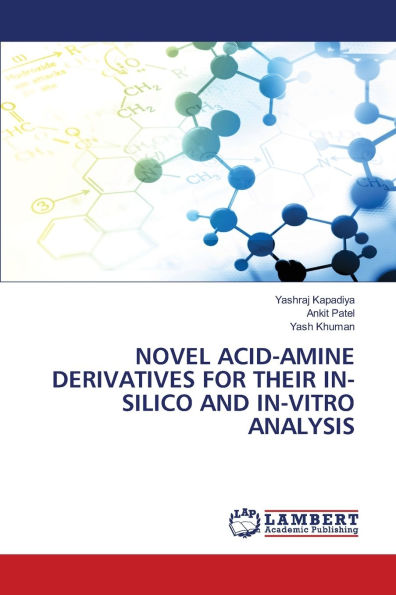
Novel Acid-Amine Derivatives for Their In-Silico and In-Vitro Analysis in Chattanooga, TN
Current price: $81.00
Barnes and Noble
Novel Acid-Amine Derivatives for Their In-Silico and In-Vitro Analysis in Chattanooga, TN
Current price: $81.00
Loading Inventory...
Size: OS
This book explores the design, synthesis, spectroscopic characterisation, computational insights, and antimicrobial evaluation of novel acid-amine derivatives. It highlights the importance of amide-containing drugs, their synthesis through acid-amine coupling reactions, and the vital role of computational tools in modern drug discovery. The study utilised high-purity chemicals and advanced software to ensure reliable outcomes. Novel derivatives were successfully synthesised by coupling -COOH and -NH₂ groups with reagents such as HATU, HBTU, SOCl₂, and POCl₃, and characterised using ¹H NMR, ¹3C NMR, UV, and mass spectrometry. Computational analysis provided insights into optimised geometries, Mulliken charge distribution, molecular electrostatic potential maps, and HOMO-LUMO energy gaps via DFT. Protein-ligand interaction studies using Schrödinger software revealed significant hydrogen bonding and hydrophobic contacts. Biological evaluation further demonstrated the antimicrobial potential of these derivatives, with certain compounds showing strong activity against both Gram-positive and Gram-negative bacterial strains, identifying them as promising leads for drug development.
This book explores the design, synthesis, spectroscopic characterisation, computational insights, and antimicrobial evaluation of novel acid-amine derivatives. It highlights the importance of amide-containing drugs, their synthesis through acid-amine coupling reactions, and the vital role of computational tools in modern drug discovery. The study utilised high-purity chemicals and advanced software to ensure reliable outcomes. Novel derivatives were successfully synthesised by coupling -COOH and -NH₂ groups with reagents such as HATU, HBTU, SOCl₂, and POCl₃, and characterised using ¹H NMR, ¹3C NMR, UV, and mass spectrometry. Computational analysis provided insights into optimised geometries, Mulliken charge distribution, molecular electrostatic potential maps, and HOMO-LUMO energy gaps via DFT. Protein-ligand interaction studies using Schrödinger software revealed significant hydrogen bonding and hydrophobic contacts. Biological evaluation further demonstrated the antimicrobial potential of these derivatives, with certain compounds showing strong activity against both Gram-positive and Gram-negative bacterial strains, identifying them as promising leads for drug development.
You May Also Like















More About Barnes and Noble at Hamilton Place
Barnes & Noble is the world’s largest retail bookseller and a leading retailer of content, digital media and educational products. Our Nook Digital business offers a lineup of NOOK® tablets and e-Readers and an expansive collection of digital reading content through the NOOK Store®. Barnes & Noble’s mission is to operate the best omni-channel specialty retail business in America, helping both our customers and booksellers reach their aspirations, while being a credit to the communities we serve.
2100 Hamilton Pl Blvd, Chattanooga, TN 37421, United States
Find Barnes and Noble at Hamilton Place in Chattanooga, TN
Visit Barnes and Noble at Hamilton Place in Chattanooga, TN