
Home
Not So Weird After All: The Changing Relationship Between Status and Fertility
Barnes and Noble
Loading Inventory...
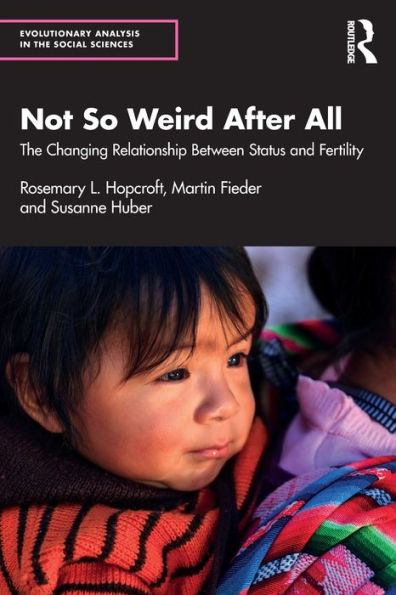
Not So Weird After All: The Changing Relationship Between Status and Fertility in Chattanooga, TN
Current price: $190.00
Barnes and Noble
Not So Weird After All: The Changing Relationship Between Status and Fertility in Chattanooga, TN
Current price: $190.00
Loading Inventory...
Size: Hardcover
This is the first book to fully examine, from an evolutionary point of view, the association of social status and fertility in human societies before, during, and after the demographic transition. In most nonhuman social species, social status or relative rank in a social group is positively associated with the number of offspring, with high-status individuals typically having more offspring than low-status individuals. However, humans appear to be different. As societies have gotten richer, fertility has dipped to unprecedented lows, with some developed societies now at or below replacement fertility. Within rich societies, women in higher-income families often have fewer children than women in lower-income families. Evolutionary theory suggests that the relationship between social status and fertility is likely to be somewhat different for men and women, so it is important to examine this relationship for men and women separately. When this is done, the positive association between individual social status and fertility is often clear in less-developed, pre-transitional societies, particularly for men. Once the demographic transition begins, it is elite families, particularly the women of elite families, who lead the way in fertility decline. Post-transition, the evidence from a variety of developed societies in Europe, North America and East Asia is that high-status men (particularly men with high personal income) do have more children on average than lower-status men. The reverse is often true of women, although there is evidence that this is changing in Nordic countries. The implications of these observations for evolutionary theory are also discussed. This book will be of interest to students and researchers in the social sciences with an interest in evolutionary sociology, evolutionary anthropology, evolutionary psychology, demography, and fertility.
This is the first book to fully examine, from an evolutionary point of view, the association of social status and fertility in human societies before, during, and after the demographic transition. In most nonhuman social species, social status or relative rank in a social group is positively associated with the number of offspring, with high-status individuals typically having more offspring than low-status individuals. However, humans appear to be different. As societies have gotten richer, fertility has dipped to unprecedented lows, with some developed societies now at or below replacement fertility. Within rich societies, women in higher-income families often have fewer children than women in lower-income families. Evolutionary theory suggests that the relationship between social status and fertility is likely to be somewhat different for men and women, so it is important to examine this relationship for men and women separately. When this is done, the positive association between individual social status and fertility is often clear in less-developed, pre-transitional societies, particularly for men. Once the demographic transition begins, it is elite families, particularly the women of elite families, who lead the way in fertility decline. Post-transition, the evidence from a variety of developed societies in Europe, North America and East Asia is that high-status men (particularly men with high personal income) do have more children on average than lower-status men. The reverse is often true of women, although there is evidence that this is changing in Nordic countries. The implications of these observations for evolutionary theory are also discussed. This book will be of interest to students and researchers in the social sciences with an interest in evolutionary sociology, evolutionary anthropology, evolutionary psychology, demography, and fertility.
You May Also Like















More About Barnes and Noble at Hamilton Place
Barnes & Noble is the world’s largest retail bookseller and a leading retailer of content, digital media and educational products. Our Nook Digital business offers a lineup of NOOK® tablets and e-Readers and an expansive collection of digital reading content through the NOOK Store®. Barnes & Noble’s mission is to operate the best omni-channel specialty retail business in America, helping both our customers and booksellers reach their aspirations, while being a credit to the communities we serve.
2100 Hamilton Pl Blvd, Chattanooga, TN 37421, United States
Find Barnes and Noble at Hamilton Place in Chattanooga, TN
Visit Barnes and Noble at Hamilton Place in Chattanooga, TN
