
Home
Nitrogen Removal Characteristics of Aerobic Denitrifying Bacteria and Their Applications Oxides Emission Mitigation
Barnes and Noble
Loading Inventory...
Nitrogen Removal Characteristics of Aerobic Denitrifying Bacteria and Their Applications Oxides Emission Mitigation in Chattanooga, TN
Current price: $109.99
Barnes and Noble
Nitrogen Removal Characteristics of Aerobic Denitrifying Bacteria and Their Applications Oxides Emission Mitigation in Chattanooga, TN
Current price: $109.99
Loading Inventory...
Size: Hardcover
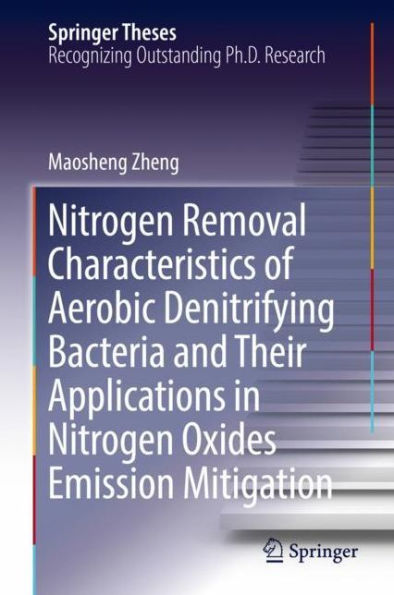
This book systematically investigates the nitrogen removal characteristics of two screened aerobic denitrifying bacteria and their applications in nitrogen oxides emissions reduction. It reveals that
Pseudomonas stutzeri
PCN-1 possesses excellent capacity for aerobic nitrogen removal, regardless of whether nitrate, nitrite or N2O were taken as denitrification substrates. It also demonstrates that the rapid N2O reduction is due to the coordinate expression of denitrification genes. Further, the book discusses the bioaugmentation experiments conducted in denitrifying SBR and a pilot-scale Carrousel oxidation ditch, which confirmed that the strain could significantly enhance denitrification performance, reduce N2O emission and improve system stability. The second strain,
P.aeruginosa
PCN-2 accumulated negligible NO during aerobic nitrate and nitrite removal and efficiently removed NO from flue gas. This study is of great significance for potentialapplications of aerobic denitrification in mitigating nitrogen oxides emissions from biological nitrogen removal systems.
Pseudomonas stutzeri
PCN-1 possesses excellent capacity for aerobic nitrogen removal, regardless of whether nitrate, nitrite or N2O were taken as denitrification substrates. It also demonstrates that the rapid N2O reduction is due to the coordinate expression of denitrification genes. Further, the book discusses the bioaugmentation experiments conducted in denitrifying SBR and a pilot-scale Carrousel oxidation ditch, which confirmed that the strain could significantly enhance denitrification performance, reduce N2O emission and improve system stability. The second strain,
P.aeruginosa
PCN-2 accumulated negligible NO during aerobic nitrate and nitrite removal and efficiently removed NO from flue gas. This study is of great significance for potentialapplications of aerobic denitrification in mitigating nitrogen oxides emissions from biological nitrogen removal systems.
This book systematically investigates the nitrogen removal characteristics of two screened aerobic denitrifying bacteria and their applications in nitrogen oxides emissions reduction. It reveals that
Pseudomonas stutzeri
PCN-1 possesses excellent capacity for aerobic nitrogen removal, regardless of whether nitrate, nitrite or N2O were taken as denitrification substrates. It also demonstrates that the rapid N2O reduction is due to the coordinate expression of denitrification genes. Further, the book discusses the bioaugmentation experiments conducted in denitrifying SBR and a pilot-scale Carrousel oxidation ditch, which confirmed that the strain could significantly enhance denitrification performance, reduce N2O emission and improve system stability. The second strain,
P.aeruginosa
PCN-2 accumulated negligible NO during aerobic nitrate and nitrite removal and efficiently removed NO from flue gas. This study is of great significance for potentialapplications of aerobic denitrification in mitigating nitrogen oxides emissions from biological nitrogen removal systems.
Pseudomonas stutzeri
PCN-1 possesses excellent capacity for aerobic nitrogen removal, regardless of whether nitrate, nitrite or N2O were taken as denitrification substrates. It also demonstrates that the rapid N2O reduction is due to the coordinate expression of denitrification genes. Further, the book discusses the bioaugmentation experiments conducted in denitrifying SBR and a pilot-scale Carrousel oxidation ditch, which confirmed that the strain could significantly enhance denitrification performance, reduce N2O emission and improve system stability. The second strain,
P.aeruginosa
PCN-2 accumulated negligible NO during aerobic nitrate and nitrite removal and efficiently removed NO from flue gas. This study is of great significance for potentialapplications of aerobic denitrification in mitigating nitrogen oxides emissions from biological nitrogen removal systems.
You May Also Like










More About Barnes and Noble at Hamilton Place
Barnes & Noble is the world’s largest retail bookseller and a leading retailer of content, digital media and educational products. Our Nook Digital business offers a lineup of NOOK® tablets and e-Readers and an expansive collection of digital reading content through the NOOK Store®. Barnes & Noble’s mission is to operate the best omni-channel specialty retail business in America, helping both our customers and booksellers reach their aspirations, while being a credit to the communities we serve.
2100 Hamilton Pl Blvd, Chattanooga, TN 37421, United States
Find Barnes and Noble at Hamilton Place in Chattanooga, TN
Visit Barnes and Noble at Hamilton Place in Chattanooga, TN