
Home
Navy-After-Next Contingency Producible Corvette
Barnes and Noble
Loading Inventory...
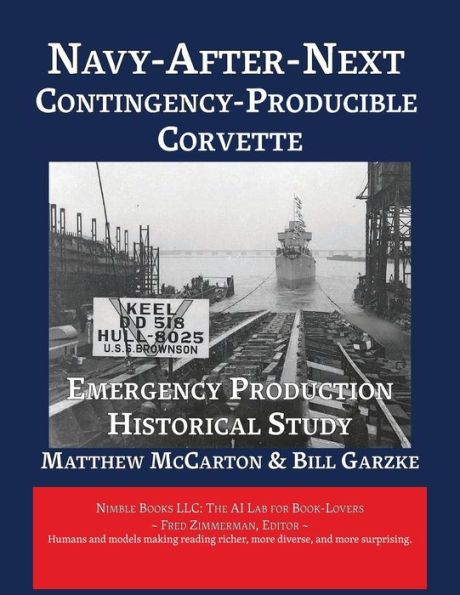
Navy-After-Next Contingency Producible Corvette in Chattanooga, TN
Current price: $33.99
Barnes and Noble
Navy-After-Next Contingency Producible Corvette in Chattanooga, TN
Current price: $33.99
Loading Inventory...
Size: OS
The next naval war in the Pacific will likely involve significant ship losses for the US Navy, which will immediately raise the question asked by the authors in the Executive Summary to this document: "what is the best approach to acquiring a large number of warships in an emergency?" The document compares two approaches: 1) building more of a proven design 2) building a simplified emergency design. The authors examine a total of 1,345 ships (327 for World War I and 1,018 for World War II) that were built in response to war emergencies. Crucially, it finds that that "the simplified design of emergency escorts does not markedly decrease the time needed for those ships to first enter service compared to destroyers." This assessment bears careful consideration because as the US defense establishment contemplates a future in which its ship building capacity is outpaced by China, there is a great temptation to look for shortcuts: "we can offset losses by building lots of drones" or "replicators." This document provides information about the construction of destroyers, destroyer escorts, and patrol frigates during World War I and World War II. It discusses the strategic background, design decisions, construction challenges, and the importance of quickly producing large numbers of ships to meet the demands of wartime. The document includes details on the shipyards involved, the number of ships built, and the average time it took to build and commission each type of ship. It also highlights the shortages of materials and the impact they had on the construction process. Overall, the document emphasizes the significance of experienced shipyards in achieving rapid production rates and supporting the war effort. This annotated edition illustrates the capabilities of the AI Lab for Book-Lovers to add context and ease-of-use to manuscripts. It includes five types of abstracts, building from simplest to more complex: TLDR (one word), ELI5, TLDR (vanilla), Scientific Style, and Action Items; three essays to increase viewpoint diversity: Grounds for Dissent, Red Team Critique, and MAGA Perspective; and Notable Passages and Nutshell Summaries for each page.
The next naval war in the Pacific will likely involve significant ship losses for the US Navy, which will immediately raise the question asked by the authors in the Executive Summary to this document: "what is the best approach to acquiring a large number of warships in an emergency?" The document compares two approaches: 1) building more of a proven design 2) building a simplified emergency design. The authors examine a total of 1,345 ships (327 for World War I and 1,018 for World War II) that were built in response to war emergencies. Crucially, it finds that that "the simplified design of emergency escorts does not markedly decrease the time needed for those ships to first enter service compared to destroyers." This assessment bears careful consideration because as the US defense establishment contemplates a future in which its ship building capacity is outpaced by China, there is a great temptation to look for shortcuts: "we can offset losses by building lots of drones" or "replicators." This document provides information about the construction of destroyers, destroyer escorts, and patrol frigates during World War I and World War II. It discusses the strategic background, design decisions, construction challenges, and the importance of quickly producing large numbers of ships to meet the demands of wartime. The document includes details on the shipyards involved, the number of ships built, and the average time it took to build and commission each type of ship. It also highlights the shortages of materials and the impact they had on the construction process. Overall, the document emphasizes the significance of experienced shipyards in achieving rapid production rates and supporting the war effort. This annotated edition illustrates the capabilities of the AI Lab for Book-Lovers to add context and ease-of-use to manuscripts. It includes five types of abstracts, building from simplest to more complex: TLDR (one word), ELI5, TLDR (vanilla), Scientific Style, and Action Items; three essays to increase viewpoint diversity: Grounds for Dissent, Red Team Critique, and MAGA Perspective; and Notable Passages and Nutshell Summaries for each page.
You May Also Like





![After Dark: The Alternative + Gothic Rock Collection [Barnes & Noble Exclusive]](https://prodimage.images-bn.com/pimages/0081227987183_p0_v1_s600x595.jpg)







More About Barnes and Noble at Hamilton Place
Barnes & Noble is the world’s largest retail bookseller and a leading retailer of content, digital media and educational products. Our Nook Digital business offers a lineup of NOOK® tablets and e-Readers and an expansive collection of digital reading content through the NOOK Store®. Barnes & Noble’s mission is to operate the best omni-channel specialty retail business in America, helping both our customers and booksellers reach their aspirations, while being a credit to the communities we serve.
2100 Hamilton Pl Blvd, Chattanooga, TN 37421, United States
Find Barnes and Noble at Hamilton Place in Chattanooga, TN
Visit Barnes and Noble at Hamilton Place in Chattanooga, TN