
Home
Music's Monisms: Disarticulating Modernism
Barnes and Noble
Loading Inventory...
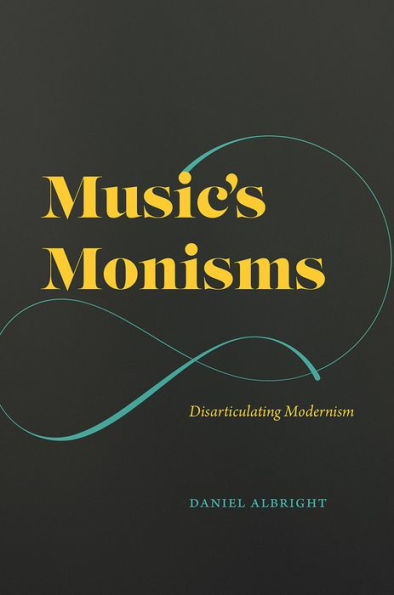
Music's Monisms: Disarticulating Modernism in Chattanooga, TN
Current price: $49.00
Barnes and Noble
Music's Monisms: Disarticulating Modernism in Chattanooga, TN
Current price: $49.00
Loading Inventory...
Size: Hardcover
Daniel Albright investigates musical phenomena through the lens of monism, the philosophical belief that things that appear to be two are actually one.
Daniel Albright was one of the preeminent scholars of musical and literary modernism, leaving behind a rich body of work before his untimely passing. In
Music’s Monisms
, he shows how musical and literary phenomena alike can be fruitfully investigated through the lens of monism, a philosophical conviction that does away with the binary structures we use to make sense of reality. Albright shows that despite music’s many binariesdiatonic vs. chromatic, major vs. minor, tonal vs. atonalthere is always a larger system at work that aims to reconcile tension and resolve conflict.
Albright identifies a “radical monism” in the work of modernist poets such as T. S. Eliot and musical works by Wagner, Debussy, Britten, Schoenberg, and Stravinsky. Radical monism insists on the interchangeability, even the sameness, of the basic dichotomies that govern our thinking and modes of organizing the universe. Through a series of close readings of musical and literary works, Albright advances powerful philosophical arguments that not only shed light on these specific figures but also on aesthetic experience in general.
is a revelatory work by one of modernist studies’ most distinguished figures.
Daniel Albright was one of the preeminent scholars of musical and literary modernism, leaving behind a rich body of work before his untimely passing. In
Music’s Monisms
, he shows how musical and literary phenomena alike can be fruitfully investigated through the lens of monism, a philosophical conviction that does away with the binary structures we use to make sense of reality. Albright shows that despite music’s many binariesdiatonic vs. chromatic, major vs. minor, tonal vs. atonalthere is always a larger system at work that aims to reconcile tension and resolve conflict.
Albright identifies a “radical monism” in the work of modernist poets such as T. S. Eliot and musical works by Wagner, Debussy, Britten, Schoenberg, and Stravinsky. Radical monism insists on the interchangeability, even the sameness, of the basic dichotomies that govern our thinking and modes of organizing the universe. Through a series of close readings of musical and literary works, Albright advances powerful philosophical arguments that not only shed light on these specific figures but also on aesthetic experience in general.
is a revelatory work by one of modernist studies’ most distinguished figures.
Daniel Albright investigates musical phenomena through the lens of monism, the philosophical belief that things that appear to be two are actually one.
Daniel Albright was one of the preeminent scholars of musical and literary modernism, leaving behind a rich body of work before his untimely passing. In
Music’s Monisms
, he shows how musical and literary phenomena alike can be fruitfully investigated through the lens of monism, a philosophical conviction that does away with the binary structures we use to make sense of reality. Albright shows that despite music’s many binariesdiatonic vs. chromatic, major vs. minor, tonal vs. atonalthere is always a larger system at work that aims to reconcile tension and resolve conflict.
Albright identifies a “radical monism” in the work of modernist poets such as T. S. Eliot and musical works by Wagner, Debussy, Britten, Schoenberg, and Stravinsky. Radical monism insists on the interchangeability, even the sameness, of the basic dichotomies that govern our thinking and modes of organizing the universe. Through a series of close readings of musical and literary works, Albright advances powerful philosophical arguments that not only shed light on these specific figures but also on aesthetic experience in general.
is a revelatory work by one of modernist studies’ most distinguished figures.
Daniel Albright was one of the preeminent scholars of musical and literary modernism, leaving behind a rich body of work before his untimely passing. In
Music’s Monisms
, he shows how musical and literary phenomena alike can be fruitfully investigated through the lens of monism, a philosophical conviction that does away with the binary structures we use to make sense of reality. Albright shows that despite music’s many binariesdiatonic vs. chromatic, major vs. minor, tonal vs. atonalthere is always a larger system at work that aims to reconcile tension and resolve conflict.
Albright identifies a “radical monism” in the work of modernist poets such as T. S. Eliot and musical works by Wagner, Debussy, Britten, Schoenberg, and Stravinsky. Radical monism insists on the interchangeability, even the sameness, of the basic dichotomies that govern our thinking and modes of organizing the universe. Through a series of close readings of musical and literary works, Albright advances powerful philosophical arguments that not only shed light on these specific figures but also on aesthetic experience in general.
is a revelatory work by one of modernist studies’ most distinguished figures.
You May Also Like

![Moon Music [Translucent Yellow Vinyl] [Barnes & Noble Exclusive]](https://prodimage.images-bn.com/pimages/5021732278944_p0_v4_s600x595.jpg)










More About Barnes and Noble at Hamilton Place
Barnes & Noble is the world’s largest retail bookseller and a leading retailer of content, digital media and educational products. Our Nook Digital business offers a lineup of NOOK® tablets and e-Readers and an expansive collection of digital reading content through the NOOK Store®. Barnes & Noble’s mission is to operate the best omni-channel specialty retail business in America, helping both our customers and booksellers reach their aspirations, while being a credit to the communities we serve.
2100 Hamilton Pl Blvd, Chattanooga, TN 37421, United States
Find Barnes and Noble at Hamilton Place in Chattanooga, TN
Visit Barnes and Noble at Hamilton Place in Chattanooga, TN
