
Home
Models and Modeling Perspectives: A Special Double Issue of mathematical Thinking Learning
Barnes and Noble
Loading Inventory...
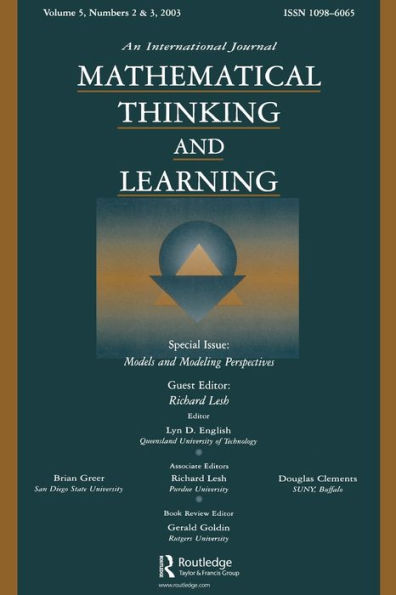
Models and Modeling Perspectives: A Special Double Issue of mathematical Thinking Learning in Chattanooga, TN
Current price: $250.00
Barnes and Noble
Models and Modeling Perspectives: A Special Double Issue of mathematical Thinking Learning in Chattanooga, TN
Current price: $250.00
Loading Inventory...
Size: Hardcover
This special issue of
Mathematical Thinking and Learning
describes models and modeling perspectives toward mathematics problem solving, learning, and teaching. The concern is not only the mature forms of models and modeling in communities of scientists and mathematicians, but also the need to initiate students in these forms of thought. The contributions of this issue suggest a variety of ways that students (children through adults) can be introduced to highly productive forms of modeling practices. Collectively, they illustrate how modeling activities often lead to remarkable mathematical achievements by students formerly judged to be too young or too lacking in ability for such sophisticated and powerful forms of mathematical thinking. The papers also illustrate how modeling activities often create productive interdisciplinary niches for mathematical thinking, learning, and problem solving that involve simulations of similar situations that occur when mathematics is useful beyond school.
Mathematical Thinking and Learning
describes models and modeling perspectives toward mathematics problem solving, learning, and teaching. The concern is not only the mature forms of models and modeling in communities of scientists and mathematicians, but also the need to initiate students in these forms of thought. The contributions of this issue suggest a variety of ways that students (children through adults) can be introduced to highly productive forms of modeling practices. Collectively, they illustrate how modeling activities often lead to remarkable mathematical achievements by students formerly judged to be too young or too lacking in ability for such sophisticated and powerful forms of mathematical thinking. The papers also illustrate how modeling activities often create productive interdisciplinary niches for mathematical thinking, learning, and problem solving that involve simulations of similar situations that occur when mathematics is useful beyond school.
This special issue of
Mathematical Thinking and Learning
describes models and modeling perspectives toward mathematics problem solving, learning, and teaching. The concern is not only the mature forms of models and modeling in communities of scientists and mathematicians, but also the need to initiate students in these forms of thought. The contributions of this issue suggest a variety of ways that students (children through adults) can be introduced to highly productive forms of modeling practices. Collectively, they illustrate how modeling activities often lead to remarkable mathematical achievements by students formerly judged to be too young or too lacking in ability for such sophisticated and powerful forms of mathematical thinking. The papers also illustrate how modeling activities often create productive interdisciplinary niches for mathematical thinking, learning, and problem solving that involve simulations of similar situations that occur when mathematics is useful beyond school.
Mathematical Thinking and Learning
describes models and modeling perspectives toward mathematics problem solving, learning, and teaching. The concern is not only the mature forms of models and modeling in communities of scientists and mathematicians, but also the need to initiate students in these forms of thought. The contributions of this issue suggest a variety of ways that students (children through adults) can be introduced to highly productive forms of modeling practices. Collectively, they illustrate how modeling activities often lead to remarkable mathematical achievements by students formerly judged to be too young or too lacking in ability for such sophisticated and powerful forms of mathematical thinking. The papers also illustrate how modeling activities often create productive interdisciplinary niches for mathematical thinking, learning, and problem solving that involve simulations of similar situations that occur when mathematics is useful beyond school.
You May Also Like













More About Barnes and Noble at Hamilton Place
Barnes & Noble is the world’s largest retail bookseller and a leading retailer of content, digital media and educational products. Our Nook Digital business offers a lineup of NOOK® tablets and e-Readers and an expansive collection of digital reading content through the NOOK Store®. Barnes & Noble’s mission is to operate the best omni-channel specialty retail business in America, helping both our customers and booksellers reach their aspirations, while being a credit to the communities we serve.
2100 Hamilton Pl Blvd, Chattanooga, TN 37421, United States
Find Barnes and Noble at Hamilton Place in Chattanooga, TN
Visit Barnes and Noble at Hamilton Place in Chattanooga, TN
