
Home
Modeling Vertical Flow Treatment Wetland Hydraulics to Optimize Efficiency
Barnes and Noble
Loading Inventory...
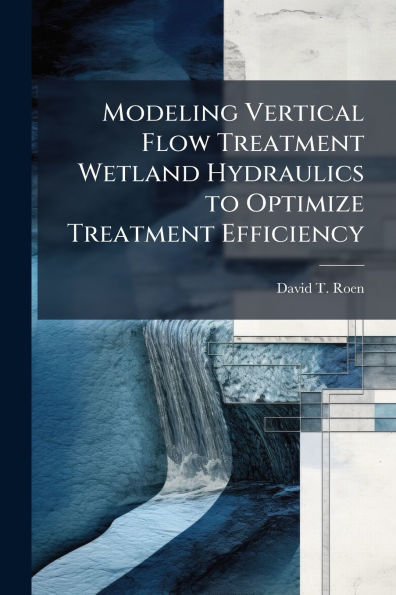
Modeling Vertical Flow Treatment Wetland Hydraulics to Optimize Efficiency in Chattanooga, TN
Current price: $30.95
Barnes and Noble
Modeling Vertical Flow Treatment Wetland Hydraulics to Optimize Efficiency in Chattanooga, TN
Current price: $30.95
Loading Inventory...
Size: Hardcover
An upward Vertical Flow Treatment Wetland (uVFTW) at Wright Patterson AFB designed to bioremediate contaminated groundwater exhibits hydraulic short-circuiting. Prior studies estimated that groundwater flowed through less than 50% of the wetland's volume, and that the mean residence time was significantly less than the nominal residence time, which was calculated assuming flow through the entire wetland volume. The objective of this research was to investigate how uVFTW hydraulics affects treatment efficiency, and to propose design strategies to maximize treatment efficiency. A groundwater flow and contaminant transport model of a uVFTW that couples hydraulics and degradation kinetics was built and applied to estimate the effectiveness of engineering solutions aimed at improving treatment efficiency. Model simulations indicate that the engineering solutions improve hydraulic residence times, volumetric utilization, and treatment efficiency over the existing wetland, but also that increasing hydraulic residence time only has a significant impact on treatment efficiency when the time scale for the biodegradation process is similar to the wetland residence time. Degradation kinetics must be quantitatively understood to determine an optimum range for hydraulic residence time, and to ensure that resources are not wasted in an attempt to improve hydraulic performance where no improvement in degradation performance is possible.
This work has been selected by scholars as being culturally important, and is part of the knowledge base of civilization as we know it. This work was reproduced from the original artifact, and remains as true to the original work as possible. Therefore, you will see the original copyright references, library stamps (as most of these works have been housed in our most important libraries around the world), and other notations in the work.
This work is in the public domain in the United States of America, and possibly other nations. Within the United States, you may freely copy and distribute this work, as no entity (individual or corporate) has a copyright on the body of the work.
As a reproduction of a historical artifact, this work may contain missing or blurred pages, poor pictures, errant marks, etc. Scholars believe, and we concur, that this work is important enough to be preserved, reproduced, and made generally available to the public. We appreciate your support of the preservation process, and thank you for being an important part of keeping this knowledge alive and relevant.
This work has been selected by scholars as being culturally important, and is part of the knowledge base of civilization as we know it. This work was reproduced from the original artifact, and remains as true to the original work as possible. Therefore, you will see the original copyright references, library stamps (as most of these works have been housed in our most important libraries around the world), and other notations in the work.
This work is in the public domain in the United States of America, and possibly other nations. Within the United States, you may freely copy and distribute this work, as no entity (individual or corporate) has a copyright on the body of the work.
As a reproduction of a historical artifact, this work may contain missing or blurred pages, poor pictures, errant marks, etc. Scholars believe, and we concur, that this work is important enough to be preserved, reproduced, and made generally available to the public. We appreciate your support of the preservation process, and thank you for being an important part of keeping this knowledge alive and relevant.
An upward Vertical Flow Treatment Wetland (uVFTW) at Wright Patterson AFB designed to bioremediate contaminated groundwater exhibits hydraulic short-circuiting. Prior studies estimated that groundwater flowed through less than 50% of the wetland's volume, and that the mean residence time was significantly less than the nominal residence time, which was calculated assuming flow through the entire wetland volume. The objective of this research was to investigate how uVFTW hydraulics affects treatment efficiency, and to propose design strategies to maximize treatment efficiency. A groundwater flow and contaminant transport model of a uVFTW that couples hydraulics and degradation kinetics was built and applied to estimate the effectiveness of engineering solutions aimed at improving treatment efficiency. Model simulations indicate that the engineering solutions improve hydraulic residence times, volumetric utilization, and treatment efficiency over the existing wetland, but also that increasing hydraulic residence time only has a significant impact on treatment efficiency when the time scale for the biodegradation process is similar to the wetland residence time. Degradation kinetics must be quantitatively understood to determine an optimum range for hydraulic residence time, and to ensure that resources are not wasted in an attempt to improve hydraulic performance where no improvement in degradation performance is possible.
This work has been selected by scholars as being culturally important, and is part of the knowledge base of civilization as we know it. This work was reproduced from the original artifact, and remains as true to the original work as possible. Therefore, you will see the original copyright references, library stamps (as most of these works have been housed in our most important libraries around the world), and other notations in the work.
This work is in the public domain in the United States of America, and possibly other nations. Within the United States, you may freely copy and distribute this work, as no entity (individual or corporate) has a copyright on the body of the work.
As a reproduction of a historical artifact, this work may contain missing or blurred pages, poor pictures, errant marks, etc. Scholars believe, and we concur, that this work is important enough to be preserved, reproduced, and made generally available to the public. We appreciate your support of the preservation process, and thank you for being an important part of keeping this knowledge alive and relevant.
This work has been selected by scholars as being culturally important, and is part of the knowledge base of civilization as we know it. This work was reproduced from the original artifact, and remains as true to the original work as possible. Therefore, you will see the original copyright references, library stamps (as most of these works have been housed in our most important libraries around the world), and other notations in the work.
This work is in the public domain in the United States of America, and possibly other nations. Within the United States, you may freely copy and distribute this work, as no entity (individual or corporate) has a copyright on the body of the work.
As a reproduction of a historical artifact, this work may contain missing or blurred pages, poor pictures, errant marks, etc. Scholars believe, and we concur, that this work is important enough to be preserved, reproduced, and made generally available to the public. We appreciate your support of the preservation process, and thank you for being an important part of keeping this knowledge alive and relevant.
You May Also Like













More About Barnes and Noble at Hamilton Place
Barnes & Noble is the world’s largest retail bookseller and a leading retailer of content, digital media and educational products. Our Nook Digital business offers a lineup of NOOK® tablets and e-Readers and an expansive collection of digital reading content through the NOOK Store®. Barnes & Noble’s mission is to operate the best omni-channel specialty retail business in America, helping both our customers and booksellers reach their aspirations, while being a credit to the communities we serve.
2100 Hamilton Pl Blvd, Chattanooga, TN 37421, United States
Find Barnes and Noble at Hamilton Place in Chattanooga, TN
Visit Barnes and Noble at Hamilton Place in Chattanooga, TN