
Home
Material Knowledges, Thermodynamic Spaces and the Moloko Sequence of the Late Iron Age (AD 1300-1840) in Southern Africa
Barnes and Noble
Loading Inventory...
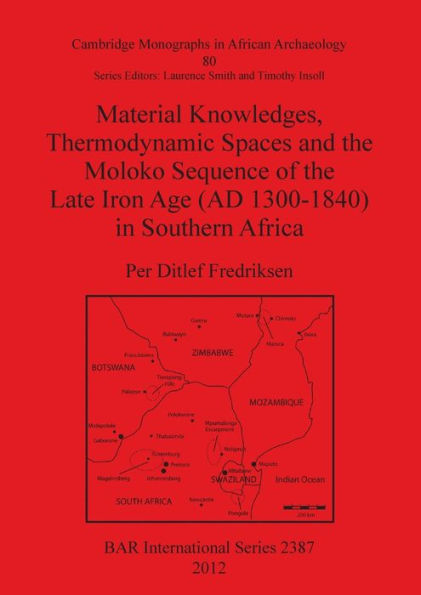
Material Knowledges, Thermodynamic Spaces and the Moloko Sequence of the Late Iron Age (AD 1300-1840) in Southern Africa in Chattanooga, TN
Current price: $72.00
Barnes and Noble
Material Knowledges, Thermodynamic Spaces and the Moloko Sequence of the Late Iron Age (AD 1300-1840) in Southern Africa in Chattanooga, TN
Current price: $72.00
Loading Inventory...
Size: OS
Cambridge Monographs in African Archaeology 80
The two key themes in this work are 1) the meeting between knowledges about the material world, and 2) the intimate relationships between people and their material surroundings we find in the social dynamics of households. The approach consists of three comparative field studies of present-day contexts conducted among eastern Bantu-speakers in Mozambique, Botswana and South Africa, in addition to an archaeological synthesis of the sequence known as 'Moloko', belonging to the Late Iron Age (AD 1300-1840) in southern Africa. While located within the discipline of archaeology, the approach draws on insights from anthropology, history, sociology and philosophy. Focusing on the relationship between clay, ceramic containers and social interaction in household spaces which follow rationales that may be associated with a sub-Saharan 'thermodynamic philosophy', the main objective is to arrive at an understanding of the relevant social dynamics involved in the developments of the Moloko ceramic sequence and the spatial and material changes to associated settlements. The work is presented in three main parts. The first presents the archaeological research status of the Moloko sequence and provides an overview of the main theoretical strands in the discourse. The second part seeks to accommodate the theoretical framework into an approach for studying clay practice, a methodology which is implemented by three field studies. The third part consists of an archaeological synthesis which draws on the insights from the previous two parts. Three specific research questions are sought answered. These relate to 1) diachronic variation in social meanings of fire and hearths, 2) changes to the social dynamics of living members of households and their ancestral links, and 3) the relationship between the microscale changes and regional social transformations towards the terminal Iron Age in southern Africa, with a particular emphasis on the implications for women's personhood.
The two key themes in this work are 1) the meeting between knowledges about the material world, and 2) the intimate relationships between people and their material surroundings we find in the social dynamics of households. The approach consists of three comparative field studies of present-day contexts conducted among eastern Bantu-speakers in Mozambique, Botswana and South Africa, in addition to an archaeological synthesis of the sequence known as 'Moloko', belonging to the Late Iron Age (AD 1300-1840) in southern Africa. While located within the discipline of archaeology, the approach draws on insights from anthropology, history, sociology and philosophy. Focusing on the relationship between clay, ceramic containers and social interaction in household spaces which follow rationales that may be associated with a sub-Saharan 'thermodynamic philosophy', the main objective is to arrive at an understanding of the relevant social dynamics involved in the developments of the Moloko ceramic sequence and the spatial and material changes to associated settlements. The work is presented in three main parts. The first presents the archaeological research status of the Moloko sequence and provides an overview of the main theoretical strands in the discourse. The second part seeks to accommodate the theoretical framework into an approach for studying clay practice, a methodology which is implemented by three field studies. The third part consists of an archaeological synthesis which draws on the insights from the previous two parts. Three specific research questions are sought answered. These relate to 1) diachronic variation in social meanings of fire and hearths, 2) changes to the social dynamics of living members of households and their ancestral links, and 3) the relationship between the microscale changes and regional social transformations towards the terminal Iron Age in southern Africa, with a particular emphasis on the implications for women's personhood.
Cambridge Monographs in African Archaeology 80
The two key themes in this work are 1) the meeting between knowledges about the material world, and 2) the intimate relationships between people and their material surroundings we find in the social dynamics of households. The approach consists of three comparative field studies of present-day contexts conducted among eastern Bantu-speakers in Mozambique, Botswana and South Africa, in addition to an archaeological synthesis of the sequence known as 'Moloko', belonging to the Late Iron Age (AD 1300-1840) in southern Africa. While located within the discipline of archaeology, the approach draws on insights from anthropology, history, sociology and philosophy. Focusing on the relationship between clay, ceramic containers and social interaction in household spaces which follow rationales that may be associated with a sub-Saharan 'thermodynamic philosophy', the main objective is to arrive at an understanding of the relevant social dynamics involved in the developments of the Moloko ceramic sequence and the spatial and material changes to associated settlements. The work is presented in three main parts. The first presents the archaeological research status of the Moloko sequence and provides an overview of the main theoretical strands in the discourse. The second part seeks to accommodate the theoretical framework into an approach for studying clay practice, a methodology which is implemented by three field studies. The third part consists of an archaeological synthesis which draws on the insights from the previous two parts. Three specific research questions are sought answered. These relate to 1) diachronic variation in social meanings of fire and hearths, 2) changes to the social dynamics of living members of households and their ancestral links, and 3) the relationship between the microscale changes and regional social transformations towards the terminal Iron Age in southern Africa, with a particular emphasis on the implications for women's personhood.
The two key themes in this work are 1) the meeting between knowledges about the material world, and 2) the intimate relationships between people and their material surroundings we find in the social dynamics of households. The approach consists of three comparative field studies of present-day contexts conducted among eastern Bantu-speakers in Mozambique, Botswana and South Africa, in addition to an archaeological synthesis of the sequence known as 'Moloko', belonging to the Late Iron Age (AD 1300-1840) in southern Africa. While located within the discipline of archaeology, the approach draws on insights from anthropology, history, sociology and philosophy. Focusing on the relationship between clay, ceramic containers and social interaction in household spaces which follow rationales that may be associated with a sub-Saharan 'thermodynamic philosophy', the main objective is to arrive at an understanding of the relevant social dynamics involved in the developments of the Moloko ceramic sequence and the spatial and material changes to associated settlements. The work is presented in three main parts. The first presents the archaeological research status of the Moloko sequence and provides an overview of the main theoretical strands in the discourse. The second part seeks to accommodate the theoretical framework into an approach for studying clay practice, a methodology which is implemented by three field studies. The third part consists of an archaeological synthesis which draws on the insights from the previous two parts. Three specific research questions are sought answered. These relate to 1) diachronic variation in social meanings of fire and hearths, 2) changes to the social dynamics of living members of households and their ancestral links, and 3) the relationship between the microscale changes and regional social transformations towards the terminal Iron Age in southern Africa, with a particular emphasis on the implications for women's personhood.
You May Also Like


















More About Barnes and Noble at Hamilton Place
Barnes & Noble is the world’s largest retail bookseller and a leading retailer of content, digital media and educational products. Our Nook Digital business offers a lineup of NOOK® tablets and e-Readers and an expansive collection of digital reading content through the NOOK Store®. Barnes & Noble’s mission is to operate the best omni-channel specialty retail business in America, helping both our customers and booksellers reach their aspirations, while being a credit to the communities we serve.
2100 Hamilton Pl Blvd, Chattanooga, TN 37421, United States
Find Barnes and Noble at Hamilton Place in Chattanooga, TN
Visit Barnes and Noble at Hamilton Place in Chattanooga, TN
