
Home
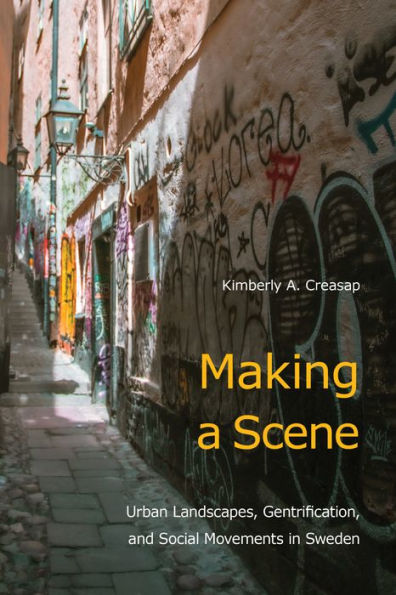
Making a Scene: Urban Landscapes, Gentrification, and Social Movements in Sweden
Barnes and Noble
Loading Inventory...
Making a Scene: Urban Landscapes, Gentrification, and Social Movements in Sweden in Chattanooga, TN
Current price: $27.95
Barnes and Noble
Making a Scene: Urban Landscapes, Gentrification, and Social Movements in Sweden in Chattanooga, TN
Current price: $27.95
Loading Inventory...
Size: OS
In the three largest cities in Sweden, social movement “scenes”networks of social movement actors and the places they inhabitchallenge threats such as gentrification. The geography of the built environment influences their ability to lay claim to urban space and to local political processes. In
Making a Scene
, Kimberly Creasap emphasizes that it is the centrality, concentration, and visibility of these scenes that make them most effective. Whereas some scenes become embedded as part of everyday lifeas in Malmöin contrast, scenes in Göteborg and Stockholm often fail to become part of the fabric of urban neighborhoods.
Creasap investigates key spaces for scenes, from abandoned industrial areas and punk clubs to street festivals, bookstores, and social centers, to show how activists create sites and develop structures of resistance that are anti-capitalist, anti-fascist, anti-gentrification, queer, and feminist. She also charts the relationship between scenes and city spaces to show these autonomous social movements create their own cultural landscapes.
encourages critical thinking about spatiality and place in the sociology of social movements and the role of social movements as important actors in urban development.
Making a Scene
, Kimberly Creasap emphasizes that it is the centrality, concentration, and visibility of these scenes that make them most effective. Whereas some scenes become embedded as part of everyday lifeas in Malmöin contrast, scenes in Göteborg and Stockholm often fail to become part of the fabric of urban neighborhoods.
Creasap investigates key spaces for scenes, from abandoned industrial areas and punk clubs to street festivals, bookstores, and social centers, to show how activists create sites and develop structures of resistance that are anti-capitalist, anti-fascist, anti-gentrification, queer, and feminist. She also charts the relationship between scenes and city spaces to show these autonomous social movements create their own cultural landscapes.
encourages critical thinking about spatiality and place in the sociology of social movements and the role of social movements as important actors in urban development.
In the three largest cities in Sweden, social movement “scenes”networks of social movement actors and the places they inhabitchallenge threats such as gentrification. The geography of the built environment influences their ability to lay claim to urban space and to local political processes. In
Making a Scene
, Kimberly Creasap emphasizes that it is the centrality, concentration, and visibility of these scenes that make them most effective. Whereas some scenes become embedded as part of everyday lifeas in Malmöin contrast, scenes in Göteborg and Stockholm often fail to become part of the fabric of urban neighborhoods.
Creasap investigates key spaces for scenes, from abandoned industrial areas and punk clubs to street festivals, bookstores, and social centers, to show how activists create sites and develop structures of resistance that are anti-capitalist, anti-fascist, anti-gentrification, queer, and feminist. She also charts the relationship between scenes and city spaces to show these autonomous social movements create their own cultural landscapes.
encourages critical thinking about spatiality and place in the sociology of social movements and the role of social movements as important actors in urban development.
Making a Scene
, Kimberly Creasap emphasizes that it is the centrality, concentration, and visibility of these scenes that make them most effective. Whereas some scenes become embedded as part of everyday lifeas in Malmöin contrast, scenes in Göteborg and Stockholm often fail to become part of the fabric of urban neighborhoods.
Creasap investigates key spaces for scenes, from abandoned industrial areas and punk clubs to street festivals, bookstores, and social centers, to show how activists create sites and develop structures of resistance that are anti-capitalist, anti-fascist, anti-gentrification, queer, and feminist. She also charts the relationship between scenes and city spaces to show these autonomous social movements create their own cultural landscapes.
encourages critical thinking about spatiality and place in the sociology of social movements and the role of social movements as important actors in urban development.
You May Also Like









More About Barnes and Noble at Hamilton Place
Barnes & Noble is the world’s largest retail bookseller and a leading retailer of content, digital media and educational products. Our Nook Digital business offers a lineup of NOOK® tablets and e-Readers and an expansive collection of digital reading content through the NOOK Store®. Barnes & Noble’s mission is to operate the best omni-channel specialty retail business in America, helping both our customers and booksellers reach their aspirations, while being a credit to the communities we serve.
2100 Hamilton Pl Blvd, Chattanooga, TN 37421, United States
Find Barnes and Noble at Hamilton Place in Chattanooga, TN
Visit Barnes and Noble at Hamilton Place in Chattanooga, TN
