
Home
Living Data: a Citizen's Guide to Better Information Future
Barnes and Noble
Loading Inventory...
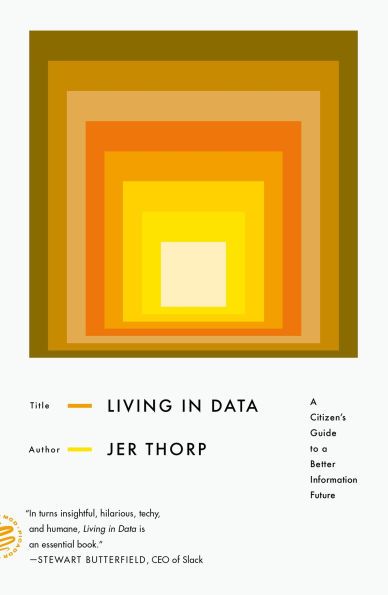
Living Data: a Citizen's Guide to Better Information Future in Chattanooga, TN
Current price: $19.00
Barnes and Noble
Living Data: a Citizen's Guide to Better Information Future in Chattanooga, TN
Current price: $19.00
Loading Inventory...
Size: Paperback
Jer Thorp’s analysis of the word “data” in 10,325
New York Times
stories written between 1984 and 2018 shows a distinct trend: among the words most closely associated with “data,” we find not only its classic companions “information” and “digital,” but also a variety of new neighbors—from “scandal” and “misinformation” to “ethics,” “friends,” and “play.”
To live in data in the twenty-first century is to be incessantly extracted from, classified and categorized, statistic-ified, sold, and surveilled. Data—our data—is mined and processed for profit, power, and political gain. In
Living in Data
, Thorp asks a crucial question for our time: How do we stop passively inhabiting data, and instead become active citizens of it?
Threading a data story through hippo attacks, glaciers, and school gymnasiums, around colossal rice piles, and over active minefields, Jer Thorp reminds us that the future of data is still wide open, that there are ways to transcend facts and figures to engage more viscerally with data, and that there are always new stories to be told about how data can be used.
Punctuated with Thorp’s original and informative illustrations,
not only redefines what data is, but also reimagines who gets to speak its language and how to use its power to create a more just and democratic future. Timely and inspiring,
gives us a much-needed path forward.
New York Times
stories written between 1984 and 2018 shows a distinct trend: among the words most closely associated with “data,” we find not only its classic companions “information” and “digital,” but also a variety of new neighbors—from “scandal” and “misinformation” to “ethics,” “friends,” and “play.”
To live in data in the twenty-first century is to be incessantly extracted from, classified and categorized, statistic-ified, sold, and surveilled. Data—our data—is mined and processed for profit, power, and political gain. In
Living in Data
, Thorp asks a crucial question for our time: How do we stop passively inhabiting data, and instead become active citizens of it?
Threading a data story through hippo attacks, glaciers, and school gymnasiums, around colossal rice piles, and over active minefields, Jer Thorp reminds us that the future of data is still wide open, that there are ways to transcend facts and figures to engage more viscerally with data, and that there are always new stories to be told about how data can be used.
Punctuated with Thorp’s original and informative illustrations,
not only redefines what data is, but also reimagines who gets to speak its language and how to use its power to create a more just and democratic future. Timely and inspiring,
gives us a much-needed path forward.
Jer Thorp’s analysis of the word “data” in 10,325
New York Times
stories written between 1984 and 2018 shows a distinct trend: among the words most closely associated with “data,” we find not only its classic companions “information” and “digital,” but also a variety of new neighbors—from “scandal” and “misinformation” to “ethics,” “friends,” and “play.”
To live in data in the twenty-first century is to be incessantly extracted from, classified and categorized, statistic-ified, sold, and surveilled. Data—our data—is mined and processed for profit, power, and political gain. In
Living in Data
, Thorp asks a crucial question for our time: How do we stop passively inhabiting data, and instead become active citizens of it?
Threading a data story through hippo attacks, glaciers, and school gymnasiums, around colossal rice piles, and over active minefields, Jer Thorp reminds us that the future of data is still wide open, that there are ways to transcend facts and figures to engage more viscerally with data, and that there are always new stories to be told about how data can be used.
Punctuated with Thorp’s original and informative illustrations,
not only redefines what data is, but also reimagines who gets to speak its language and how to use its power to create a more just and democratic future. Timely and inspiring,
gives us a much-needed path forward.
New York Times
stories written between 1984 and 2018 shows a distinct trend: among the words most closely associated with “data,” we find not only its classic companions “information” and “digital,” but also a variety of new neighbors—from “scandal” and “misinformation” to “ethics,” “friends,” and “play.”
To live in data in the twenty-first century is to be incessantly extracted from, classified and categorized, statistic-ified, sold, and surveilled. Data—our data—is mined and processed for profit, power, and political gain. In
Living in Data
, Thorp asks a crucial question for our time: How do we stop passively inhabiting data, and instead become active citizens of it?
Threading a data story through hippo attacks, glaciers, and school gymnasiums, around colossal rice piles, and over active minefields, Jer Thorp reminds us that the future of data is still wide open, that there are ways to transcend facts and figures to engage more viscerally with data, and that there are always new stories to be told about how data can be used.
Punctuated with Thorp’s original and informative illustrations,
not only redefines what data is, but also reimagines who gets to speak its language and how to use its power to create a more just and democratic future. Timely and inspiring,
gives us a much-needed path forward.
You May Also Like












More About Barnes and Noble at Hamilton Place
Barnes & Noble is the world’s largest retail bookseller and a leading retailer of content, digital media and educational products. Our Nook Digital business offers a lineup of NOOK® tablets and e-Readers and an expansive collection of digital reading content through the NOOK Store®. Barnes & Noble’s mission is to operate the best omni-channel specialty retail business in America, helping both our customers and booksellers reach their aspirations, while being a credit to the communities we serve.
2100 Hamilton Pl Blvd, Chattanooga, TN 37421, United States
Find Barnes and Noble at Hamilton Place in Chattanooga, TN
Visit Barnes and Noble at Hamilton Place in Chattanooga, TN
