
Home
Linguistic Resources for Natural Language Processing: On the Necessity of Using Methods to Develop NLP Software
Barnes and Noble
Loading Inventory...
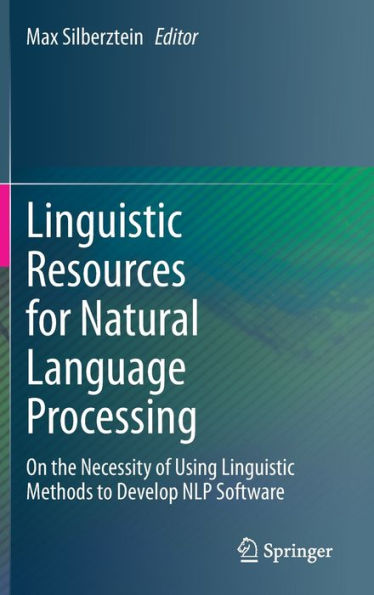
Linguistic Resources for Natural Language Processing: On the Necessity of Using Methods to Develop NLP Software in Chattanooga, TN
Current price: $169.99
Barnes and Noble
Linguistic Resources for Natural Language Processing: On the Necessity of Using Methods to Develop NLP Software in Chattanooga, TN
Current price: $169.99
Loading Inventory...
Size: Hardcover
Empirical — data-driven, neural network-based, probabilistic, and statistical — methods seem to be the modern trend. Recently, OpenAI’s ChatGPT, Google’s Bard and Microsoft’s Sydney chatbots have been garnering a lot of attention for their detailed answers across many knowledge domains. In consequence, most AI researchers are no longer interested in trying to understand what common intelligence is or how intelligent agents construct scenarios to solve various problems. Instead, they now develop systems that extract solutions from massive databases used as cheat sheets. In the same manner, Natural Language Processing (NLP) software that uses training corpora associated with empirical methods are trendy, as most researchers in NLP today use large training corpora, always to the detriment of the development of formalized dictionaries and grammars.
Not questioning the intrinsic value of many software applications based on empirical methods, this volume aims at rehabilitating the linguistic approach to NLP. In an introduction, the editor uncovers several limitations and flaws of using training corpora to develop NLP applications, even the simplest ones, such as automatic taggers.
The first part of the volume is dedicated to showing how carefully handcrafted linguistic resources could be successfully used to enhance current NLP software applications. The second part presents two representative cases where data-driven approaches cannot be implemented simply because there is not enough data available for low-resource languages. The third part addresses the problem of how to treat multiword units in NLP software, which is arguably the weakest point of NLP applications today but has a simple and elegant linguistic solution.
It is the editor's belief that readers interested in Natural Language Processing will appreciate the importance of this volume, both for its questioning of the training corpus-based approaches and for the intrinsic value of the linguistic formalization and the underlying methodology presented.
Not questioning the intrinsic value of many software applications based on empirical methods, this volume aims at rehabilitating the linguistic approach to NLP. In an introduction, the editor uncovers several limitations and flaws of using training corpora to develop NLP applications, even the simplest ones, such as automatic taggers.
The first part of the volume is dedicated to showing how carefully handcrafted linguistic resources could be successfully used to enhance current NLP software applications. The second part presents two representative cases where data-driven approaches cannot be implemented simply because there is not enough data available for low-resource languages. The third part addresses the problem of how to treat multiword units in NLP software, which is arguably the weakest point of NLP applications today but has a simple and elegant linguistic solution.
It is the editor's belief that readers interested in Natural Language Processing will appreciate the importance of this volume, both for its questioning of the training corpus-based approaches and for the intrinsic value of the linguistic formalization and the underlying methodology presented.
Empirical — data-driven, neural network-based, probabilistic, and statistical — methods seem to be the modern trend. Recently, OpenAI’s ChatGPT, Google’s Bard and Microsoft’s Sydney chatbots have been garnering a lot of attention for their detailed answers across many knowledge domains. In consequence, most AI researchers are no longer interested in trying to understand what common intelligence is or how intelligent agents construct scenarios to solve various problems. Instead, they now develop systems that extract solutions from massive databases used as cheat sheets. In the same manner, Natural Language Processing (NLP) software that uses training corpora associated with empirical methods are trendy, as most researchers in NLP today use large training corpora, always to the detriment of the development of formalized dictionaries and grammars.
Not questioning the intrinsic value of many software applications based on empirical methods, this volume aims at rehabilitating the linguistic approach to NLP. In an introduction, the editor uncovers several limitations and flaws of using training corpora to develop NLP applications, even the simplest ones, such as automatic taggers.
The first part of the volume is dedicated to showing how carefully handcrafted linguistic resources could be successfully used to enhance current NLP software applications. The second part presents two representative cases where data-driven approaches cannot be implemented simply because there is not enough data available for low-resource languages. The third part addresses the problem of how to treat multiword units in NLP software, which is arguably the weakest point of NLP applications today but has a simple and elegant linguistic solution.
It is the editor's belief that readers interested in Natural Language Processing will appreciate the importance of this volume, both for its questioning of the training corpus-based approaches and for the intrinsic value of the linguistic formalization and the underlying methodology presented.
Not questioning the intrinsic value of many software applications based on empirical methods, this volume aims at rehabilitating the linguistic approach to NLP. In an introduction, the editor uncovers several limitations and flaws of using training corpora to develop NLP applications, even the simplest ones, such as automatic taggers.
The first part of the volume is dedicated to showing how carefully handcrafted linguistic resources could be successfully used to enhance current NLP software applications. The second part presents two representative cases where data-driven approaches cannot be implemented simply because there is not enough data available for low-resource languages. The third part addresses the problem of how to treat multiword units in NLP software, which is arguably the weakest point of NLP applications today but has a simple and elegant linguistic solution.
It is the editor's belief that readers interested in Natural Language Processing will appreciate the importance of this volume, both for its questioning of the training corpus-based approaches and for the intrinsic value of the linguistic formalization and the underlying methodology presented.
You May Also Like













More About Barnes and Noble at Hamilton Place
Barnes & Noble is the world’s largest retail bookseller and a leading retailer of content, digital media and educational products. Our Nook Digital business offers a lineup of NOOK® tablets and e-Readers and an expansive collection of digital reading content through the NOOK Store®. Barnes & Noble’s mission is to operate the best omni-channel specialty retail business in America, helping both our customers and booksellers reach their aspirations, while being a credit to the communities we serve.
2100 Hamilton Pl Blvd, Chattanooga, TN 37421, United States
Find Barnes and Noble at Hamilton Place in Chattanooga, TN
Visit Barnes and Noble at Hamilton Place in Chattanooga, TN
