
Home
Liheap: Program and Funding
Barnes and Noble
Loading Inventory...
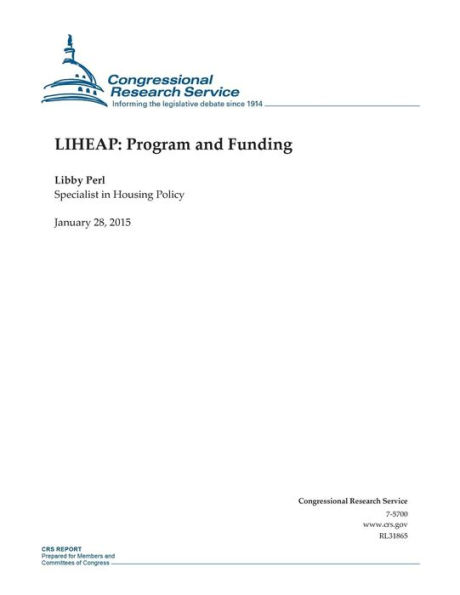
Liheap: Program and Funding in Chattanooga, TN
Current price: $19.95
Barnes and Noble
Liheap: Program and Funding in Chattanooga, TN
Current price: $19.95
Loading Inventory...
Size: OS
The Low Income Home Energy Assistance Program (LIHEAP), established in 1981 as part of the Omnibus Budget Reconciliation Act (P.L. 97-35), is a program through which the federal government makes annual grants to states, tribes, and territories to operate home energy assistance programs for low-income households. The LIHEAP statute authorizes two types of funds: regular funds (sometimes referred to as formula or block grant funds), which are allocated to all states using a statutory formula, and emergency contingency funds, which are allocated to one or more states at the discretion of the Administration in cases of emergency as defined by the LIHEAP statute. States may use LIHEAP funds to help low-income households pay for heating and cooling costs, for crisis assistance, weatherization assistance, and services (such as counseling) to reduce the need for energy assistance. The LIHEAP statute establishes federal eligibility for households with incomes at or below 150% of poverty or 60% of state median income, whichever is higher, although states may set lower limits. Available federal information regarding use of LIHEAP funds and households assisted is dated. The Department of Health and Human Services (HHS) releases annual LIHEAP Reports to Congress, but the most recent report available is from FY2009. In its FY2015 budget justifications, HHS reported limited preliminary LIHEAP data for FY2011. Of funds expended for heating, cooling, crisis assistance, and weatherization, 60% of funds went to pay for heating assistance, 6% was used for cooling aid, 24% went to crisis assistance, and 10% was used for weatherization. (Note that these percentages do not account for administrative expenses or services to reduce the need for energy assistance.) Also in FY2011, an estimated 6.8 million households received an average of $370 in heating assistance for the year. For FY2015, Congress appropriated $3.39 billion for LIHEAP as part of the FY2015 Consolidated and Further Continuing Appropriations Act (P.L. 113-235). This is the same as the amount distributed to LIHEAP grantees in the previous year pursuant to the FY2014 Consolidated Appropriations Act (P.L. 113-76), though not the same amount appropriated in FY2014. In that year, Congress provided approximately $3.425 billion for LIHEAP, but $34 million was transferred elsewhere within HHS and not distributed to grantees. The $3.39 billion is the same amount proposed for FY2015 by the Senate Appropriations Subcommittee for the Departments of Labor, Health and Human Services, and Education, and exceeds the amount proposed by the President by $1 billion. P.L. 113-235 provides that the total for LIHEAP in FY2015 be distributed as regular funds. Of that amount, $491 million is distributed according to the "new" LIHEAP formula and the remainder ($2.9 billion) according to the proportions of the "old" LIHEAP formula. (See Table B-1 for amounts available to states, tribes, and territories pursuant to the FY2015 appropriations act.)
The Low Income Home Energy Assistance Program (LIHEAP), established in 1981 as part of the Omnibus Budget Reconciliation Act (P.L. 97-35), is a program through which the federal government makes annual grants to states, tribes, and territories to operate home energy assistance programs for low-income households. The LIHEAP statute authorizes two types of funds: regular funds (sometimes referred to as formula or block grant funds), which are allocated to all states using a statutory formula, and emergency contingency funds, which are allocated to one or more states at the discretion of the Administration in cases of emergency as defined by the LIHEAP statute. States may use LIHEAP funds to help low-income households pay for heating and cooling costs, for crisis assistance, weatherization assistance, and services (such as counseling) to reduce the need for energy assistance. The LIHEAP statute establishes federal eligibility for households with incomes at or below 150% of poverty or 60% of state median income, whichever is higher, although states may set lower limits. Available federal information regarding use of LIHEAP funds and households assisted is dated. The Department of Health and Human Services (HHS) releases annual LIHEAP Reports to Congress, but the most recent report available is from FY2009. In its FY2015 budget justifications, HHS reported limited preliminary LIHEAP data for FY2011. Of funds expended for heating, cooling, crisis assistance, and weatherization, 60% of funds went to pay for heating assistance, 6% was used for cooling aid, 24% went to crisis assistance, and 10% was used for weatherization. (Note that these percentages do not account for administrative expenses or services to reduce the need for energy assistance.) Also in FY2011, an estimated 6.8 million households received an average of $370 in heating assistance for the year. For FY2015, Congress appropriated $3.39 billion for LIHEAP as part of the FY2015 Consolidated and Further Continuing Appropriations Act (P.L. 113-235). This is the same as the amount distributed to LIHEAP grantees in the previous year pursuant to the FY2014 Consolidated Appropriations Act (P.L. 113-76), though not the same amount appropriated in FY2014. In that year, Congress provided approximately $3.425 billion for LIHEAP, but $34 million was transferred elsewhere within HHS and not distributed to grantees. The $3.39 billion is the same amount proposed for FY2015 by the Senate Appropriations Subcommittee for the Departments of Labor, Health and Human Services, and Education, and exceeds the amount proposed by the President by $1 billion. P.L. 113-235 provides that the total for LIHEAP in FY2015 be distributed as regular funds. Of that amount, $491 million is distributed according to the "new" LIHEAP formula and the remainder ($2.9 billion) according to the proportions of the "old" LIHEAP formula. (See Table B-1 for amounts available to states, tribes, and territories pursuant to the FY2015 appropriations act.)
You May Also Like











More About Barnes and Noble at Hamilton Place
Barnes & Noble is the world’s largest retail bookseller and a leading retailer of content, digital media and educational products. Our Nook Digital business offers a lineup of NOOK® tablets and e-Readers and an expansive collection of digital reading content through the NOOK Store®. Barnes & Noble’s mission is to operate the best omni-channel specialty retail business in America, helping both our customers and booksellers reach their aspirations, while being a credit to the communities we serve.
2100 Hamilton Pl Blvd, Chattanooga, TN 37421, United States
Find Barnes and Noble at Hamilton Place in Chattanooga, TN
Visit Barnes and Noble at Hamilton Place in Chattanooga, TN